Showing posts with label Tomb. Show all posts

Monday, 4 February 2019

Places to visit in Narnaul: Shah Ibrahim’s Tomb


Shah Ibrahim’s Tomb, Narnaul

Most of the times while crossing Narnaul I do not make a detour and pass through this town without looking at the local attractions. However, this time I factored in couple of hours extra to visit few monuments which are the heritage of the area and architecturally important.

I decided to visit the Shah Ibrahim’s Tomb located in the Piran Mohalla of the town. To reach there either put on Google maps or ask for directions from a local as it is situated in the middle of a inhabited colony and there are no markers to guide you there.

When I reached there I was surprised that how well it has been maintained over the years as it has been built by Sher Shah Suri during 1540-45 in memory of his grandfather Ibrahim Khan Sur who died in Narnaul in the year 1518. The square structure made of red and grey sandstone is built on a platform and is entered from the east gate. The monument is surrounded on all sides by houses.

The tomb of Shah Ibrahim, Narnaul 

The structure is two storey high. On the ground level besides the main tomb of Ibrahim Khan Sur there are also few other smaller tombs as well. The light filters in through the trellised grills. 


One of the cupola at the Shah Inrahim Tomb, Narnaul

One can go up by means of narrow (and dark) stairs. On the second storey besides the main dome there are four cupolas giving the structure a symmetry and elegant look. One can get a 360 degree view of the city from here. 


The Pir Turkman Dargah as seen from the Shah Ibrahim Tomb, Narnaul

Close to the Shah Ibrahim’s Tomb is the Dargah of Pir Turkman. I was told that the building of the Pir Turkman predates the Shah Ibrahim’s Tomb by nearly 200 years! The buildings of the Pir Turkman though are in a dilapidated state.


The backside view of the Shah Ibrahim Tomb, Narnaul

An advice to the Archaeological Survey of India and to the Tourism department of the Government of Haryana is to provide road markers so that this important heritage site is easy to locate and reach.

Narnaul, a small town in Haryana, is about 170 km from Delhi on the Delhi-Rewari-Khetri route and can be reached by road in about three and half hours. It is also the district headquarters of Mahendergarh District

Also read:
Places to visit in Narnaul: Chor Gumbad
Dhosi Hills
Rural Tourism

Tuesday, 27 December 2016

Places to visit in Delhi: Safdarjung Tomb

Safdarjung Tomb viewed from the arch of  the entrance gate

The Safdarjung Tomb could be considered as the ‘last flicker of the lamp of Mughal architecture’ in Delhi. Though on a smaller scale, compared to the grandeur of the Humayun’s Tomb, it is still no less beautiful.

The entrance gate of the Safdarjung Tomb

There is an ornamental gate at the entrance. Also there is a three domed mosque on the right side of the entrance though it is not being maintained properly.

The three domed mosque at the Safdarjung Tomb Complex

Safdarjung Tomb was built in 1753-54 by Nawab Shujau’d-Daulah in memory of his father Mirza Muqim Abdul Mansur Khan or Safdarjung who was the Governor of Awadh under Muhammad Shah. 

Tomb of Safdarjung

Red and buff color sandstone has been used for construction of the tomb. Marble has been used for the flooring, inlay work and the dome.

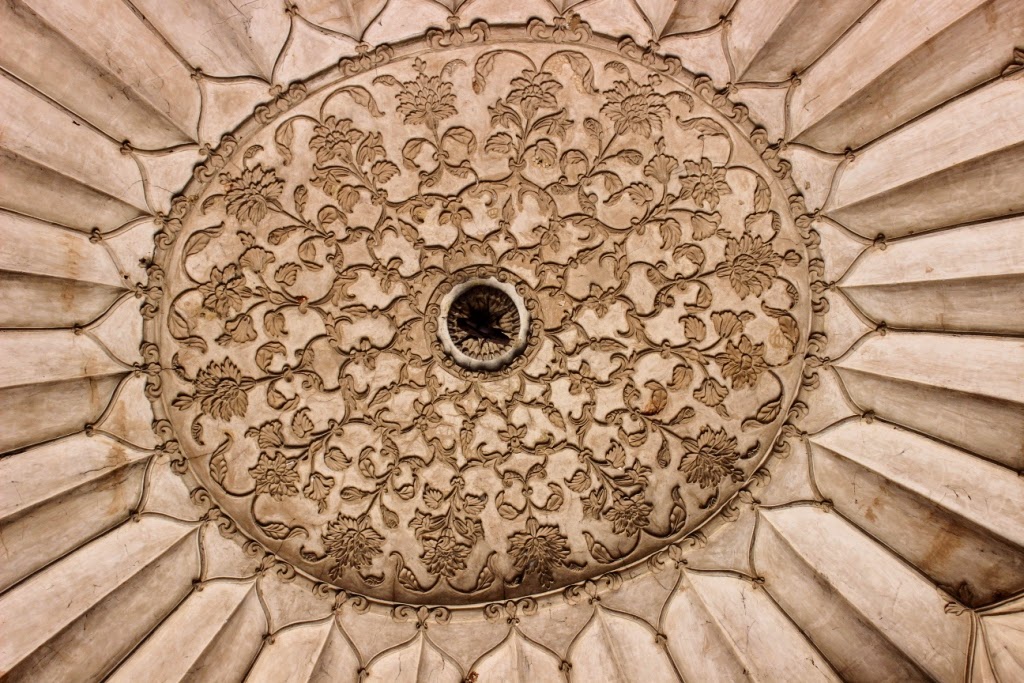
Floral pattern on the domes of the Safdarjung Tomb

The domes have interesting floral patterns. The tomb is encircled with beautiful and well maintained garden which is in the shape of Charbagh or quadrilateral garden.

The gardens, water channels and the pavallions at the Safdarjung Tomb Complex

The gardens are then surrounded by pavallions which were used as resting places. The Southern pavallion is called Badshah Pasand or the King's Choice, Northern one is Moti Mahal or the Pearl Palace and the Western side as Jangli Mahal or the Palace in the Woods.

The Safdarjung Tomb, Delhi

The Safdarjung Tomb is not very crowded compared to the Humayun Tomb so one can really enjoy the place at leisure. Since the ticket is not very exorbitant, I noticed lot of young couples sitting in the gardens who had no romance for the the monument but for each other only! Safdarjung Tomb is a protected monument of the Archaeological Survey of India (ASI).

Side view of the Safdarjung Tomb

I wonder why the ASI or other relevant authorities do not have some decent tea, coffee and snacks kiosks as people come from far off and would like to rest and spend some time at the monument. Also I did not see any ramps for the disabled to use wheel chairs.

Situated right next to the Safdarjung Airport (not a functional commercial airport) and very close to the Lodhi Gardens, Safdarjung Tomb is a must see place if one is interested in history and architecture. If you plan to go by the metro then the Jorbagh Metro station is the closest to the monument.

Also read:
Places to Visit in Delhi: Humayun Tomb
Places to Visit in Delhi: Qutub Minar, Alai Minar and the Iron Pillar
Places to visit in Delhi: Mirza Ghalib ki Haveli
Places to visit in Delhi: The Isa Khan’s Garden Tomb
Places to visit in Delhi: Ugrasen ki Baoli

Thursday, 3 September 2015

Travelling through Alma Mater, JNU


After several years I got a chance to visit, rather revisit JNU, my alma mater. It is hard for an outsider to think of JNU, a 1000 acre campus, as part of the congested capital city. There are plenty of open spaces, even wild, practically untouched spaces.

The various JNU school buildings in the foreground with Vasant Kunj in the background

The Aravali hill on which JNU is located, is lush green, especially in monsoons. Despite many new university buildings coming up in the past few years, the forest-like impression persists and there is still a lot of undergrowth.

The JNU Library

The green cover and the buildings are integrated together in such a way that they blend into each other.

Purvanchal & Mahanadi hostels in the foreground with Qutub Minar in the background

The aerial shots from the top floor (10th floor) of the university central library show a dense green cover. The Mehrauli area in general and Qutub Minar in particular is clearly visible.

Qutub Minar & Alai Minar seen from JNU

The Alai Minar, the unfinished Qutub Minar like structure which Alauddin Khilji planned to build two times higher than Qutub Minar is also visible.

Adham Khan's tomb in Mehrauli seen from JNU

The Adham Khan’s tomb in the Mehrauli area is also clearly visible from the JNU.

NII, Munirka in the foreground and Lotus Temple in the background as seen from JNU

On a clear day, one can even see the Lotus Temple and Nehru Place which are several km away. If you observe the photo carefully you can see the lotus temple in the far centre. Only when I saw the photo at leisure on the laptop, I realised that the photo captures the temple.

The new manicured look of JNU campus

Fortunately, the nature is allowed to be, although there seem to be attempts here-and-there to give it a manicured lawn look with potted plants and hedges that, in my view, looks out of place with the overall grandeur of undergrowth and huge trees.

The campus is ideal for walking, jogging and cycling. JNU is a paradise for bird-watchers. Peacocks are common. Some JNU residents swear that they have seen owls and snakes. Wolfs and Nilgais (Asian Antelope or Blue Bull) are not exactly uncommon. Caves exploration and rock-climbing is another activity which I indulged in during my student days here.

Parthsarthi Rocks, JNU

And how can I complete this post without mentioning Parthasarathi Rocks (named after the first VC of JNU). It is the highest natural vantage point in JNU and functions as an open auditorium and venue for various late-night parties. One can sit and view the beautiful sunsets from here.

Thursday, 25 June 2015

Places to visit in Delhi: The Isa Khan’s Garden Tomb

Most people have heard of the famous Humayun Tomb in Delhi but few know that within the Nizamuddin area there lies the Isa Khan’s Garden Tomb.

The Isa Khan Garden Tomb, Delhi

Though much smaller in size as compared to the Humayun Tomb it is a beautiful structure which actually predates Humayun Tomb by 20 years. It was built in 1547 AD during the lifetime of Isa Khan himself. Isa Khan was a noble in the court of Sher Shah Suri. It is probably the only surviving octagonal tomb complex. The canopied structure has beautiful glazed tiles and lattice screens (also known as Jaali) . Within this complex there is a red sandstone mosque that adds to its beauty. Like the Humayun Tomb this structure is also being maintained by the Aga Khan Trust and the Archaeological Survey of India (ASI).

Isa Khan Tomb in the foreground and the Mosque in the background

The Isa Khan Tomb complex is surrounded by beautiful gardens and high walls. In fact one can walk on these high walls which provide a much better view of the tomb and the mosque. Inside the structure I saw that like Humayun tomb this also contained not only the grave of Isa Khan but also several other graves as well. The lattice screens provide light as well as allow cool breeze inside.

The graves inside the Isa Khan complex - also observe the lattice screens

The inside of the dome has been painted by beautiful art work and also writings in Persian. Likewise the arches of the gates are also beautifully decorated.

The fresco on the inside of the dome of Isa Khan Tomb

The Isa Khan Tomb complex is a quieter and more beautiful place than its world renowned neighbour and is a worth seeing place if you are interested in gardens and Mughal and Lodhi architecture. It is part of the World Heritage Site Complex of Humayun Tomb.

Also read:
Places to Visit in Delhi: Humayun Tomb
Places to visit in Delhi: Ugrasen ki Baoli
The Changing Moods of Hauz Khas Lake

Friday, 22 May 2015

Shaking Minarets in Nuh

Just an hour away from Delhi is a mosque that has shaking minarets!

Gateway of the Tomb of Sheikh Musa, Nuh

This place has a tomb of Sheikh Musa, a mosque as well as a Madrasa. To reach there one has to take the Gurgaon-Nuh road via Sohna and at Nuh take the Toaru road. It is not very far from Nuh town and is part of the Mewat rural belt.

Mughal Style arches

The structure has a mix of Mughal and Rajput architecture and was built sometime in the 14th century. The walls of the gateway to the tomb are very thick and the stairs steep. It is said that if you shake one minar the vibrations are felt in the other minar

Rajputana style of architecture

I was not able to test this as the Waqf Board had closed the Minars for repairs stating that it is dangerous and can fall any time. I think such an old building should be repaired not by basic methods and should be dealt with by the Archaeological Survey of India (ASI) as it is an important heritage site of this region. The whole repair work being carried out is not being done by professionals.

The Tomb of Sheikh Musa

The tomb is made of white marble and the outer walls are also white. The locals believe that the water receptacle at the tomb have healing powers. 

The mosque

Within the same compound I also saw that there is a madrasa where religious teachings are imparted to the students. 

A student of Madrasa showed me the place

I did interact with a couple of students from the Madrasa who in fact showed me around the place. But right in front of this complex there is also a modern building of Mewat Engineering College which is also run by the Waqf Board.

Ruins of a Haveli visible from Sheikh Musa Tomb

From this complex one can also see high on the hill ruins of a haveli (said to be of a local merchant).

Also read:
Chui Mal Ka Talaab in Nuh
The Cenotaph of Chui Mal in Nuh