Showing posts with label Rural tourism. Show all posts

Sunday, 9 July 2017

Places to visit in Narnaul: Chor Gumbad

Chor Gumbad, Narnaul

I have been crossing Narnaul over the years and used to notice an old structure from the road but somehow did not see it up close. Now it is no longer visible from the road as residential houses hide the view from the road. This time, despite the fact that I was passing the place very early in the morning, I decided to stop over and see the place.

Chor Gumbad, Narnaul basking at Sunrise

The structure is located on top of a hillock in the sleepy town of Narnaul. It was built by Jamal Khan, an Afghan during the reign of Feroz Shah Tughlaq (1351 to 1388 AD) as his tomb. What I heard from the locals though is that right now there is no tomb inside. It is a square shaped building with minarets at each corner. Though the administration has done some repairs to the structure but it has also closed all access to go inside the building by putting a closed perimeter fence with grills. So one can only look at the Chor Gumbad from a distance.

A dawn, Statue of Subhas Chandra Bose and a man doing Yoga

Over the centuries the place got into a state of disrepair and it became a hiding place for the thieves and vagabonds and that is why it probably acquired the name of Chor Gumbad (the dome where the thieves reside).

Chor Gumbad from a distance with the statue of Bose in the foreground

During the current days the local administration has developed a park with walking paths encircling the structure. It seems to be popular among the locals for morning and evening walks as well as a place for doing Yoga etc as I believe there are not too many parks in the city (and at that one which is well maintained and has a beautiful backdrop!). There is also a statue of Subhas Chandra Bose.

A well maintained park is popular among morning walkers at the Chor Gumbad 

Despite being arguably the most important historical building of the town there is just a small signboard. Haryana Tourism department must make proper signage’s to encourage tourists to visit the site.

Another view of the Park at Chor Gumbad, Narnaul

Narnaul, a small town in Haryana, is about 170 km from Delhi on the Delhi-Rewari-Khetri route and can be reached by road in about three and half hours. It is also the district headquarters of Mahendragarh District

Also read:
Dhosi Hills
Rural Tourism

Wednesday, 1 July 2015

A Natural Reservoir in Nalhar, Nuh

When I was visiting the Cenotaph of Chui Mal I was suggested by Mr Chander Bhan who manages the cenotaph and the pond to also visit Nalhar (also pronounced as Nallad) a nearby village where there is a natural reservoir.

Ceremonial Gate to Shiva Temple, Nalhar

Nalhar is located in the foothills of the Aravallis and also has at its base a Shiva temple which forms the starting point of the trek to the reservoir. There is a big ceremonial gate at the temple. 

The Climb to the Nalhar reservoir

There are more than 250 steep stair-steps to be climbed to the place and the last bit is a bit slippery and one has to hold on to the tree roots and branches to climb. It is a good climb if you are looking for some good exercise and once you reach the top it provides a view of the whole area. 

The view of the Mewat area from Nalhar reservoir

I was expecting a big reservoir but when I reached there I found that the water was trickling directly into a hollow created (natural) in the tree from the rock. This reservoir is about 2 feet long and maybe a foot wide only. 

Last part of the climb

The water keeps flowing round the year into this hollow and this is the reservoir that people locally talk with veneration as it is believed by locals that it is some ‘chamatkar’ (miracle) of the gods that water is flowing out of the rocks in this arid region. Of course we as geographers know better! 

The Nalhar reservoir in a hollow of a tree

It is also believed that the Panadavas stayed there and drank this water during their 14-year exile. Lot of locals travel till the Shiva temple but only the more determined and fit people climb up to the reservoir. 

One has to hold the tree branches above these stairs to climb

How to reach: From Rajiv Chowk in Gurgaon take the Sohna-Nuh-Alwar highway till Nuh for about 47 km. From Nuh it is about 3 km to the Nalhar Shiva temple and the road ends there.

Also read:
The Cenotaph of Chui Mal in Nuh
Chui Mal Ka Talaab in Nuh
Shaking Minarets in Nuh

Tuesday, 2 June 2015

Hathnikund Barrage in Haryana

Hathnikund Barrage is at the foothills of the Himalayas in the Yamunanagar district of Haryana. It is about 40 km from the Yamunanagar town on the road to Paonta Saheb, a famous Sikh shrine 23 km ahead and Dehradun.

Scenic Hathnikund Barrage with the Hiamalaya foothills in the background 

The road is very good except the last part where you have to leave the National Highway and take the Major District Road (MDR). In fact it is hardly a road and it is not even a levelled kutcha (non-metalled) road.

Poor road conditions leading to & fro from Hathnikund

The Barrage works as a boundary between Haryana and Uttar Pradesh (UP). The MDR on the Haryana side is just 500 meters or so but if someone wants to come from the Uttar Pradesh after leaving the Yamunotri Highway then one has to cover about 12 kms of rough roads.

The Hathnikund Barrage

Neither Haryana nor Uttar Pradesh have made any efforts to develop the site as a tourist attraction despite its tremendous potential. There are no shops catering to the tourists. I could see only couple of sugarcane juice vendors. While talking to a local I was told that the hills have provided everything to the powers that be as well as the general population sitting in Delhi like water, electricity, wood (a major wood industry thrives in Yamunanagar) etc but the area providing everything remains poor and neglected.

Yamuna is just a trickle after the Hanthikund Barrage as water is channeled into the two canals

The Hathnikund Barrage has been built on the river Yamuna and from here the water is diverted into the Eastern and Western Yamuna canals. After the barrage the free flowing water of the Yamuna is just a trickle. The barrage forms a wetland which attracts migratory birds in the winters and some rafting activities from Paonta Saheb till here.

One of the canals after the Hathnikund Narrage

On the Uttar Pradesh side the road that I covered I saw several mango orchards but the economic condition of the villagers is still not good.

At a mango orchard producing the famous Dassahri

The Hathnikund Barrage was completed in 1999 and got operational in 2002 replacing the Tajewala Barrage three km downstream which was built in 1873.

This is a clarion call to the state governments’ of Haryana and Uttar Pradesh to encourage tourism here by providing basic infrastructure.

Friday, 22 May 2015

Shaking Minarets in Nuh

Just an hour away from Delhi is a mosque that has shaking minarets!

Gateway of the Tomb of Sheikh Musa, Nuh

This place has a tomb of Sheikh Musa, a mosque as well as a Madrasa. To reach there one has to take the Gurgaon-Nuh road via Sohna and at Nuh take the Toaru road. It is not very far from Nuh town and is part of the Mewat rural belt.

Mughal Style arches

The structure has a mix of Mughal and Rajput architecture and was built sometime in the 14th century. The walls of the gateway to the tomb are very thick and the stairs steep. It is said that if you shake one minar the vibrations are felt in the other minar. 

Rajputana style of architecture

I was not able to test this as the Waqf Board had closed the Minars for repairs stating that it is dangerous and can fall any time. I think such an old building should be repaired not by basic methods and should be dealt with by the Archaeological Survey of India (ASI) as it is an important heritage site of this region. The whole repair work being carried out is not being done by professionals.

The Tomb of Sheikh Musa

The tomb is made of white marble and the outer walls are also white. The locals believe that the water receptacle at the tomb have healing powers. 

The mosque

Within the same compound I also saw that there is a madrasa where religious teachings are imparted to the students. 

A student of Madrasa showed me the place

I did interact with a couple of students from the Madrasa who in fact showed me around the place. But right in front of this complex there is also a modern building of Mewat Engineering College which is also run by the Waqf Board.

Ruins of a Haveli visible from Sheikh Musa Tomb

From this complex one can also see high on the hill ruins of a haveli (said to be of a local merchant).

Also read:
Chui Mal Ka Talaab in Nuh
The Cenotaph of Chui Mal in Nuh

Friday, 27 March 2015

Chui Mal Ka Talaab in Nuh

Chui Mal ka Taalab is a masonry pond with cenotaphs located in the town of Nuh in the Mewat district of Haryana.

Chui Mal ka Talaab (pond), Nuh

Adjoining it is a grand two-storied structure, the Cenotaph of Seth Chui Mal. Both the pond and the Samadhi (memorial) have been built around the same time by Chui Mal. Of course the tomb in the structure was placed after his death by his son.

The pond in the foreground & the Cenotaph of Chui Mal in the background

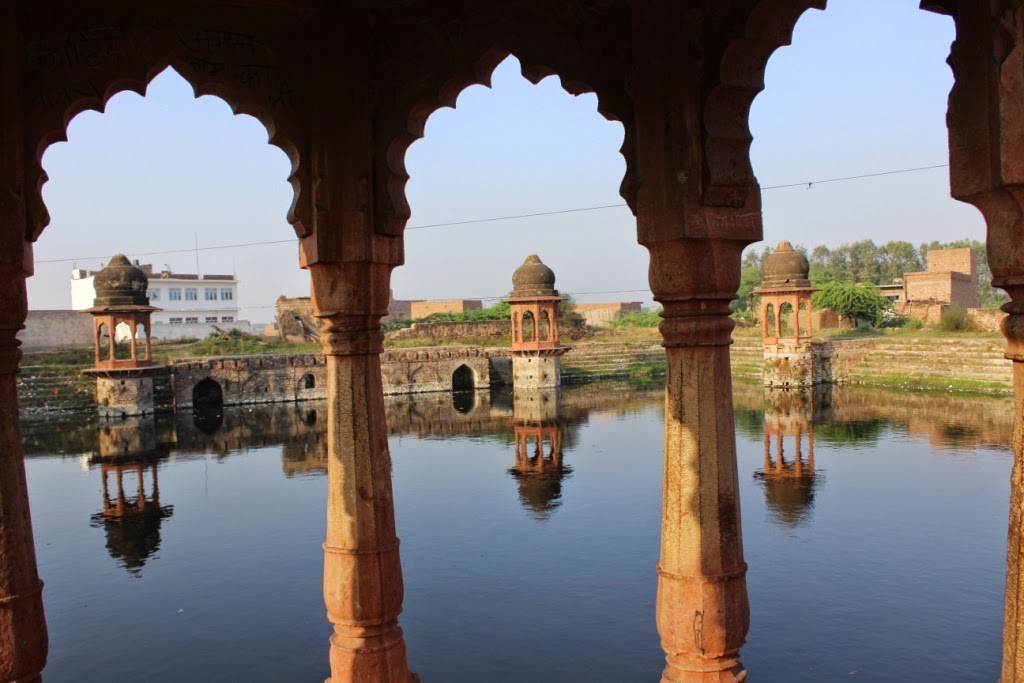
The pond has eight cenotaphs around it and looks picturesque. During my talks with the owners of the property (no, it is not under State Government or the Archaeological Survey of India (ASI) but privately owned by the descendants of Chui Mal) I was told that all the burj (the structure beneath the Chattri or the cenotaph) have wells underneath and therefore there is always water in the pond.

Another view of the Pond of Chui Mal in Nuh

Also during Monsoons the pond gets filled with water flowing from nearby areas. But this is changing as now people have cut plots around this place.

The beautiful pond littered with polybags

Unfortunately the open area is subjected to decay and misuse. There are plastic bags in the pond and as usual locals have scribbled their names on the cenotaphs.

A well at Chui Mal ka Talaab filled with plastic bags

I think it is imperative that the heritage properties, the Cenotaph of Chui Mal as well as the Chui Mal ka Talaab, are taken over by the State Government or ASI for despite the best intentions, the Chui Mal family cannot be expected to maintain sites in the long run as that is a skilled and expensive task.

The view of the Chui Mal ka Talaab in the background with Chattri of the memorial of Chui Mal in the foreground

Both the cenotaphs and the masonry pond are worth seeing places. Offbeat places have a charm of their own. These are sightseeing places for Delhlites and Gurgaonites looking for an outing over the weekend.

This post is part of Skywatch Friday.

Tuesday, 24 March 2015

The Cenotaph of Chui Mal in Nuh

Adjoining the Chui Mal Talaab (pond) is a large two-storied structure, the Samadhi (tomb) of Seth Chui Mal. According to Chander Bhan, now a retired teacher, these magnificent structures were built by his forefathers seven generations ago.

Cenotaph of Chui Mal in Nuh

This structure has surprisingly got very little publicity despite its proximity to Delhi and Gurgaon. Located in the Nuh town of the Mewat district of Haryana, 75 min drive from Gurgaon, the 300-year old structure reminds you of cenotaphs of Rajasthan.

The Samadhi (tomb) of Seth Chui Mal

It has beautiful engravings on the first floor with a variety of motifs – soldiers, dancing girls, men playing musical instruments, processions of men and women, elephants, lions and deer. The ground floor also had engravings etc but with time they were completely destroyed by vandals. Now the ground floor has been repaired with cement arches only.


Engraved Antelopes & others in flight 

Particularly fascinating for me was a carved piece of a deer/antelope that captures the animal in motion with its legs in the air and head turned back − the the hunted looking at the hunter.

Engraved soldier with Rifle

Some other engraved figures that surprised me were of soldiers in uniform carrying rifles on their shoulders. From the uniform it was obvious that they were from the British-Indian army. Most unusual I must say!

The interior of the upper floor of the Chui Mal cenotaph

The structure was subjected to neglect and vandalism till Mr Chander Bhan and his brother took matters in their hands and built a brick wall around it. It is their family legacy after all! The wall sadly blocks somewhat the frontal view but then these are two individuals trying to protect and preserve these beautiful structures. The Government of Haryana or the Archaeological Survey of India (ASI) is conspicuous by its absence.

The inside of the majestic dome of the cenotaph of Chui Mal

The architecture is definitely Rajasthani and infact there are similarities in the cenotaph (or Chattri) of Chui Mal with those of the Cenotaph of Bakhtawar Singh of Alwar.

The carved pillars on the upper floor of Cenotaph of Chui Mal

Infact like at Alwar here also there is a water pond next to this cenotaph but then I am going to write a separate post on that soon.

The Rajasthani style architecture of the Chui Mal Cenotaph

For those interested in visiting these structures, keys are with Mr Chander Bhan who lives in the house nearby. You may even be served tea by the extremely nice family members that include Chander Bhan’s grandchildren who are now studying in Delhi. They gave us a guided tour.

Mr Chander Bhan, the 7th generation descendant of Chui Mal

Seth Chui Mal was a salt merchant and had built most of this cenotaph as well as the water pond during his life time itself though finally it was completed by his son Hukam Chand

Must see for those who look beyond the mainstream tourism!

Also See:
Cenotaph of Bakhtawar Singh of Alwar

Wednesday, 5 June 2013

Water Tank Themes in Punjab

If you go to Punjab, be it the urban or the rural areas, you are bound to notice the interesting themes and shapes used in either making the overhead water tanks or just for decoration purposes.

A Water Jug

Though I have noticed these water tanks in urban Punjab for the past several years but I was surprised when recently I was visiting some villages I found them in the rural households as well. The water jug shows the importance of water in the rural lifestyles of Punjab.

Two oxes

So also are the oxen ubiquitous in the agriculture dominant Punjab even if most people nowadays use tractors and thrashers for cultivation purposes.

A Whiskey Bottle

And how can one not find a whiskey bottle as a theme in Punjab! After all it is widely known that Punjabis have a huge capacity to drink large amounts of hard drinks. The Patiala Peg is a term coined for an unusually large peg of whiskey. There is also a joke (it is a joke only - no means to verify the statement!) that in India maximum number of English speakers before 8 PM are in the state of Kerala but after 8 PM maximum number of English speakers are in Punjab!

Football Water Tank

Punjab is also known for its sports culture and there are several factories which produce sports goods in Ludhiana and Jalandhar. The National Institute of Sports (NIS) is also there in Patiala. So football as a theme for an overhead water tank also is very commonly seen.

Interesting themes for water tanks & housetops

I saw these interesting themes being made in one of the villages. All these are made from cement. The themes included, among others, birds, woman carrying a pitcher of water, lions, umbrella, snakes, oxen and even Statue of Liberty!

Friday, 8 March 2013

Rural Tourism

Whenever I go to the rural parts of India I am amazed at its beauty and then wonder why India does not promote rural tourism as a destination in a big way. As it is India has a minuscule share in world tourism.

Beautiful reflection of sunset on water body

I had gone for a few days to stay at Goad-Balawa which is at the border of Haryana and Rajasthan and is about 175 kms from Delhi. The closest town to this place is Narnaul. During evening walks I saw this pond with beautiful reflection of the setting sun and the clouds.

Mustard Fields

My mornings were greeted with fog and the mustard fields unlike the smog of the cities. The air had the freshness to it and you don't have to worry about getting cough and cold which one catches in the winters of polluted cities.

Tree Art

Even the kikar trees looked lovely surrounded by the mustard crop. The rural areas still have lots of old houses where one can see the work of the artisans which is sadly lacking in the modern houses of the cities as well as the villages.

Carved Door Frames

 In fact now a days one can see such wooden carved door frames being displayed in the living rooms of the houses of some rich people and I have heard there is a whole industry at work in Rajasthan that produces such work and then season it in such a way that the stuff looks old!

Old Cenotaph

I saw some old cenotaphs or chattris also  - some in ruins and others still part of the tube-well structure in fields. They look beautiful under the setting sun.

Beautiful Sunset

And at end of the day the sunset that you get is unbelievable. What more could one ask for if one is looking at having a relaxed tension-free holiday.

There is a huge potential that can be tapped by encouraging rural tourism that will bring in much needed foreign exchange to India and also provide much needed employment and money to people in their villages. This will also stop, to some extent, the mad mush of people to migrate to cities due to paucity of jobs in the hinterland.