Showing posts with label Archaeological Survey of India. Show all posts

Monday, 4 February 2019

Places to visit in Narnaul: Shah Ibrahim’s Tomb


Shah Ibrahim’s Tomb, Narnaul

Most of the times while crossing Narnaul I do not make a detour and pass through this town without looking at the local attractions. However, this time I factored in couple of hours extra to visit few monuments which are the heritage of the area and architecturally important.

I decided to visit the Shah Ibrahim’s Tomb located in the Piran Mohalla of the town. To reach there either put on Google maps or ask for directions from a local as it is situated in the middle of a inhabited colony and there are no markers to guide you there.

When I reached there I was surprised that how well it has been maintained over the years as it has been built by Sher Shah Suri during 1540-45 in memory of his grandfather Ibrahim Khan Sur who died in Narnaul in the year 1518. The square structure made of red and grey sandstone is built on a platform and is entered from the east gate. The monument is surrounded on all sides by houses.

The tomb of Shah Ibrahim, Narnaul 

The structure is two storey high. On the ground level besides the main tomb of Ibrahim Khan Sur there are also few other smaller tombs as well. The light filters in through the trellised grills. 


One of the cupola at the Shah Inrahim Tomb, Narnaul

One can go up by means of narrow (and dark) stairs. On the second storey besides the main dome there are four cupolas giving the structure a symmetry and elegant look. One can get a 360 degree view of the city from here. 


The Pir Turkman Dargah as seen from the Shah Ibrahim Tomb, Narnaul

Close to the Shah Ibrahim’s Tomb is the Dargah of Pir Turkman. I was told that the building of the Pir Turkman predates the Shah Ibrahim’s Tomb by nearly 200 years! The buildings of the Pir Turkman though are in a dilapidated state.


The backside view of the Shah Ibrahim Tomb, Narnaul

An advice to the Archaeological Survey of India and to the Tourism department of the Government of Haryana is to provide road markers so that this important heritage site is easy to locate and reach.

Narnaul, a small town in Haryana, is about 170 km from Delhi on the Delhi-Rewari-Khetri route and can be reached by road in about three and half hours. It is also the district headquarters of Mahendergarh District

Also read:
Places to visit in Narnaul: Chor Gumbad
Dhosi Hills
Rural Tourism

Tuesday, 27 December 2016

Places to visit in Delhi: Safdarjung Tomb

Safdarjung Tomb viewed from the arch of  the entrance gate

The Safdarjung Tomb could be considered as the ‘last flicker of the lamp of Mughal architecture’ in Delhi. Though on a smaller scale, compared to the grandeur of the Humayun’s Tomb, it is still no less beautiful.

The entrance gate of the Safdarjung Tomb

There is an ornamental gate at the entrance. Also there is a three domed mosque on the right side of the entrance though it is not being maintained properly.

The three domed mosque at the Safdarjung Tomb Complex

Safdarjung Tomb was built in 1753-54 by Nawab Shujau’d-Daulah in memory of his father Mirza Muqim Abdul Mansur Khan or Safdarjung who was the Governor of Awadh under Muhammad Shah. 

Tomb of Safdarjung

Red and buff color sandstone has been used for construction of the tomb. Marble has been used for the flooring, inlay work and the dome.

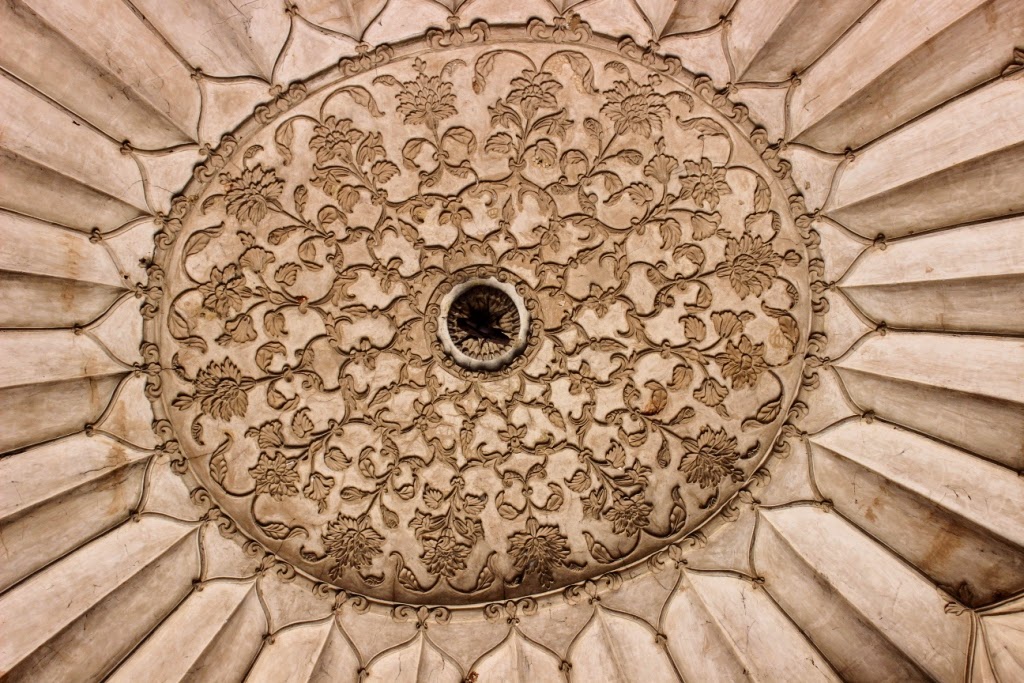
Floral pattern on the domes of the Safdarjung Tomb

The domes have interesting floral patterns. The tomb is encircled with beautiful and well maintained garden which is in the shape of Charbagh or quadrilateral garden.

The gardens, water channels and the pavallions at the Safdarjung Tomb Complex

The gardens are then surrounded by pavallions which were used as resting places. The Southern pavallion is called Badshah Pasand or the King's Choice, Northern one is Moti Mahal or the Pearl Palace and the Western side as Jangli Mahal or the Palace in the Woods.

The Safdarjung Tomb, Delhi

The Safdarjung Tomb is not very crowded compared to the Humayun Tomb so one can really enjoy the place at leisure. Since the ticket is not very exorbitant, I noticed lot of young couples sitting in the gardens who had no romance for the the monument but for each other only! Safdarjung Tomb is a protected monument of the Archaeological Survey of India (ASI).

Side view of the Safdarjung Tomb

I wonder why the ASI or other relevant authorities do not have some decent tea, coffee and snacks kiosks as people come from far off and would like to rest and spend some time at the monument. Also I did not see any ramps for the disabled to use wheel chairs.

Situated right next to the Safdarjung Airport (not a functional commercial airport) and very close to the Lodhi Gardens, Safdarjung Tomb is a must see place if one is interested in history and architecture. If you plan to go by the metro then the Jorbagh Metro station is the closest to the monument.

Also read:
Places to Visit in Delhi: Humayun Tomb
Places to Visit in Delhi: Qutub Minar, Alai Minar and the Iron Pillar
Places to visit in Delhi: Mirza Ghalib ki Haveli
Places to visit in Delhi: The Isa Khan’s Garden Tomb
Places to visit in Delhi: Ugrasen ki Baoli

Friday, 18 December 2015

Buddhist Vestiges of Sanghol, Punjab

One would not associate Buddhism with Punjab in the current era. But you would be surprised (at least I was) that Buddhism was thriving in Punjab 2100 years ago.

Buddhist Stupa site at Sanghol, Punjab

This is corroborated by the fact that recently (in comparative terms) Stupa and monasteries were unearthed in Sanghol on the Chandigarh-Ludhiana highway. (Stupa contains relics of a Buddhist teacher.) Sanghol is also called Ucha Pind (high village) as it is situated on a mound. Seven sites in the village were excavated by the Archaeological Survey of India (ASI) from1968 to 1990. Two of these are significantly important which I visited and are called SGL5 and SGL11.

View from the entrance of SGL5 Buddhist Stupa site at Sanghol

The larger site contains the bigger Stupa having three concentric circles with spoke-like radial walls raised on a square platform. It has a diameter of 16 meters on a 17 meter square platform.

Concentric circles placed on a square platform, Sanghol Buddhist Stupa site

The smaller site also has a Stupa but much smaller in size. Both the sites also have Vihara (residences for the monks). What has been excavated is only the base which was mainly below the ground as the super structure was completely destroyed (by man or nature over time). Maybe the ASI should reconstruct at one of the sites to give a feel of the place as it was at that time.

The smaller Stupa at SGL11 Buddhist Stupa site, Sanghol

A rich treasure of 69 pillars and 35 cross bars have been unearthed from Sanghol containing figures of Yakshis and Salabhanjikas (art motifs of the Kushan period). Also found on the site were seals and pottery of the Late Harappan period. These are no longer on the site and have been placed in the Archaeological Museum at Sanghol. As both the sites are out in the open a security fencing around both the places have been put up to prevent encroachment.

The squarish ones were the living quarters of the monks, Buddhist Stupa site SGL11, Sanghol

Teja Singh, an employee of the ASI was kind enough to show me the first site and explain about the place. Not only that - he has a hidden talent of Punjabi folk music – and he enthralled me with the rendition of few folk songs with the accompaniment of Tumba.

Teja Singh with his Tumba
The Tourism Department of Punjab should give more publicity to such a great heritage site.

Tuesday, 27 October 2015

Places to visit in Mumbai: Elephanta Caves - a World Heritage Site

Elephanta Caves, located on the Elephanta Island can be reached by a ferry from the Gateway of India, Bombay. It is a UNESCO World Heritage Site. 

Trimurti, Elephanta Caves

Distance from Bombay: 10 km
Duration of Ferry: one hour, first ferry at 9 a.m.
Price: Rs 160 to-and-fro (as of October 2015)
Monday closed
Ticket: Rs 10 for the village and Rs 10 for the caves. Foreigners have to pay Rs 250.

Elephanta hills and the Arabian Sea

Then there is a toy train for a km or less and then a steep ascent of about 120 steps. October is not the best month for this excursion. You need stamina and lots of water intake. Those with knee problems should stay away. There are lots of shops selling all kinds of stuff but the most sought ones are food stalls selling raw mangoes, starfruit (amrack) and lemon water. Many of them are run by women.

The entrance to the Elephanta cave 1

These rock-cut temple caves dated between 5 and 7 Century CE comprise of five Hindu caves dedicated to Lord Shiva and two Buddhist caves at a distance of about 2 km. 

Grand pillars at Elephanta cave 1

The latter are closed to public and amongst the five Hindu caves only the first cave is worth the trouble. The other caves are almost empty except for the presence of a shivling. In that sense there is a slight sense of disappointment. 

Gangadhara Shiva & Parvati

However Cave 1 is a magnificent structure. It is a grand cave with huge pillars and huge sculptures, many of them fragments. The fragments speak for the glorious art in ancient India. Most of the panels depict Lord Shiva and Parvati. Then there is a huge Trimurti (first photo in this post) sculpture depicting the three faces of Shiva: the creator, the preserver and the destroyer. It is said that the Portuguese colonisers destroyed many of these grand narratives, including the elephant structure that gave the island its name.

Shiva as Yogisvara

Visitors who came 10-15 years ago say the caves were dirty and stinking. The last time I visited the caves was in 1985 of which I have only some hazy memories. But now that they are managed by Archaeological Survey of India (ASI), they are clean and there are guards to prevent vandalising. There are toilet facilities. Monkeys are however a nuisance.

Also read:
Karla Buddhist Caves near Pune
Places to visit in Mumbai: The Haji Ali Dargah

Thursday, 25 June 2015

Places to visit in Delhi: The Isa Khan’s Garden Tomb

Most people have heard of the famous Humayun Tomb in Delhi but few know that within the Nizamuddin area there lies the Isa Khan’s Garden Tomb.

The Isa Khan Garden Tomb, Delhi

Though much smaller in size as compared to the Humayun Tomb it is a beautiful structure which actually predates Humayun Tomb by 20 years. It was built in 1547 AD during the lifetime of Isa Khan himself. Isa Khan was a noble in the court of Sher Shah Suri. It is probably the only surviving octagonal tomb complex. The canopied structure has beautiful glazed tiles and lattice screens (also known as Jaali) . Within this complex there is a red sandstone mosque that adds to its beauty. Like the Humayun Tomb this structure is also being maintained by the Aga Khan Trust and the Archaeological Survey of India (ASI).

Isa Khan Tomb in the foreground and the Mosque in the background

The Isa Khan Tomb complex is surrounded by beautiful gardens and high walls. In fact one can walk on these high walls which provide a much better view of the tomb and the mosque. Inside the structure I saw that like Humayun tomb this also contained not only the grave of Isa Khan but also several other graves as well. The lattice screens provide light as well as allow cool breeze inside.

The graves inside the Isa Khan complex - also observe the lattice screens

The inside of the dome has been painted by beautiful art work and also writings in Persian. Likewise the arches of the gates are also beautifully decorated.

The fresco on the inside of the dome of Isa Khan Tomb

The Isa Khan Tomb complex is a quieter and more beautiful place than its world renowned neighbour and is a worth seeing place if you are interested in gardens and Mughal and Lodhi architecture. It is part of the World Heritage Site Complex of Humayun Tomb.

Also read:
Places to Visit in Delhi: Humayun Tomb
Places to visit in Delhi: Ugrasen ki Baoli
The Changing Moods of Hauz Khas Lake

Thursday, 30 April 2015

Places to visit in Delhi: Ugrasen ki Baoli

Baoli (a stepwell) were a very common feature as a means of water harvesting and conservation system in north India in the earlier times as the rains are seasonal and therefore storage of water for leaner periods were essential.

Ugrasen ki Baoli with modern buildings of central Delhi in the background

Even in Delhi there used to be several stepwells and but most of them have either vanished are or in utter state of disrepair. However, the Ugrasen ki Baoli (also pronounced sometimes as Agrasen ki Baoli) has survived and is maintained by the Archaeological Survey of India (ASI) right in the central Delhi very close to the Connaught Place.

The arches of Agrasen ki Baoli

I have been to the Max Mueller Bhavan several times but was not aware that from there this stepwell is less than five minute walk away! It is kind of hidden as it is on a side road on the Hailey Road with tall multi-storied buildings of Central Delhi forming a backdrop. The entrance is very ordinary but the moment you step in the place really amazes you with its beauty.

The reflection of author, Baoli & the modern buildings

This 60 meter long and 15 meter wide stepwell is said to have been built by King Ugrasen who was an Agarwal leader. The architecture is late Tughlak and Lodhi period. It has very thick side walls and has arched corridors. There is an ancient mosque on the same premises but I could not go in as it was undergoing maintenance at the time I had visited it. Even the stepwell was under maintenance due to which I could not go down and had to content myself with seeing it from top.

The mosque at the Agrasen Stepwell complex

Now stepwells are not made as with technology people have other means of storage and supply of water. But I have had the opportunity to visit a modern stepwell in Jodhpur made recently. It is very beautiful and is able to supply all the water required the year round to the beautifully maintained gardens.

The baoli has very thick side walls

Also Read:
Ali Gosh Khan Baoli in Farrukhnagar
Umaid Heritage:Water Conservation with Beauty

Monday, 6 April 2015

Places to Visit in Delhi: Humayun Tomb

It is well-known that Taj Mahal borrowed its design to a large extent from the Humayun Tomb in Delhi. What differentiates the two is the pristine white marble of Taj Mahal.

The Humayun Tomb, Delhi

Another important but little-known difference is that Taj Mahal was made by the Mughal Emperor Shah Jahan in memory of his beloved wife whereas Humayun Tomb was built during 1565 to 1572 AD in memory of Emperor Humayun by his widow Hamida Bano Begum.

The main tomb is that of Humayun

This 47 meter high mausoleum structure was built on a 12000 square meter platform and has over 100 graves including, of course, that of Humayun. The mausoleum is surrounded by Char Bagh (four geometrical gardens in Persian style).

The Humayun Tomb has well maintained gardens on all sides

The structures and the gardens have been painstakingly restored by the Archaeological Survey of India (ASI) and Agha Khan Trust and they seem to have done a good job. Some of the restoration work is still going on. This is an UNESCO World Heritage site.

One of the magnificent arches of Humayun Tomb

During and immediately after partition the complex was used as a camp for refugees. During that time the complex suffered lot of damage which took the ASI quite some time to restore.

Humayun Tomb is a World Heritage Site 

Just behind the grand structure is a historical Gurudwara, Gurudwara Dam Dama Sahib whose onion-style dome is visible from the complex.

Carvings on the interior-side of the dome of Humayun Tomb

Inside the structure there are several sandstone screens which look beautiful, provide light and cool air and during summers it is a relief to be inside this building from the outside soaring temperatures.

A sandstome screen

There is a separate structure called Nai-ka-Gumbad for the royal barber. A person who is allowed to touch and cut the Emperor’s precious hair, has to be, by definition, immensely trustworthy. He probably passed on the palace gossip to the Emperor while massaging his scalp. No wonder he gets an exclusive resting place close to that of his master!

Nai ka Gumbad

Humayun Tomb was built by artisans brought all the way from Persia (today Iran). They knew their trade except that the stairs are as treacherous as ever. I wonder if it was deliberate!

The stairs at the Humayun Tomb are very steep

These artisans lived in the complex in what is today called Arab-ki-Sarai.

Arab-ki-Sarai Gateway

There are Gateways which are 48 foot high. A major portion of the Arab-ki-Sarai is either in ruins or has been taken over by an Industrial Training Institute. Though I could see conservation work on its Southern Gateway but on the main premises not much has been done. In this premises there is a well and a stepwell though both are not in good condition and the water collected there was green due to algae formation.

Arab-ki-Sarai where the artisans from Persia lived

Why is there no cafeteria and no souvenir shop in this important place visited by so many foreign and local tourists? 

Saturday, 6 July 2013

Sheesh Mahal, Farrukhnagar

Farrukhnagar, a Mughal era town in the Gurgaon district of Haryana is a treasure trove for heritage buildings.  Most tourists go to the Sultanpur National Park famous for the migratory wintering birds but somehow ignore this town. Though now the city of Gurgaon is called the 'Millenium City' (a misnomer according to me) it was Farrukhnagar which was a bigger and important town during the Mughal and British rules.

The Sheesh Mahal, Farrukhnagar

The Sheesh Mahal palace was built by Fauzdar Khan around 1711 AD. To reach the palace one has to cross the main market as well as the Delhi Darwaza (gate) and takes one amidst very old houses and havelis.

The entrance gate of the Sheesh Mahal Palace

From the entrance gate one cannot make out that there is a whole palace inside. Though the palace is surrounded by fort walls but at most places there is now no trace of the walls.

The Sheesh Mahal from inside

Though the name (Sheesh Mahal means Mirror Palace) is suggestive of mirror inlay work but with time now there are no more mirror inlay works that I could see. There is a courtyard in front with water channel.  


The backside of the Sheesh Mahal in ruins

Despite being the most important monument in Farrukhnagar what I saw of the state of the monument disappointed me. Only a part of the monument is now under restoration including the basement. The back side is in utter disrepair and the walls are crumbling down.

Red Sandstone was used extensively in the Sheesh Mahal

The Sheesh Mahal is now being restored by the Archaeological Survey of India. When I went there was no restoration work going on and I believe the pace is slow and the work tardy. There is also a memorial for the martyrs of the 1857 rebellion in the courtyard.

An Air duct

The Sheesh Mahal is three storeys including the basement which people often miss to locate. The stairs leading to the basement are steep, dark and dingy. The basement must have been very good place to sit in summers as there are air ducts (you can't see where this air duct opening is going) from which air passes and there is a cool breeze in the basement.

The basement in the Sheesh Mahal

I also saw that the basement was a refuge of liquor bottles and other waste material. How is it possible when  they keep the doors closed as for example I had to wait for quite some time before the caretaker arrived as he had gone somewhere for lunch (and probably a siesta!). He even took my identification card before allowing me to enter and returned it only when I came out of the premises (this is presumably being done to stop the vagabonds from entering and spoiling the place).

In Farrukhnagar one can also see Ali Gosh Khan Baoli, a stepwell and Sethani Ki Chattri which is a memorial cenotaph.