Showing posts with label Humayun Tomb. Show all posts

Tuesday, 27 December 2016

Places to visit in Delhi: Safdarjung Tomb

Safdarjung Tomb viewed from the arch of  the entrance gate

The Safdarjung Tomb could be considered as the ‘last flicker of the lamp of Mughal architecture’ in Delhi. Though on a smaller scale, compared to the grandeur of the Humayun’s Tomb, it is still no less beautiful.

The entrance gate of the Safdarjung Tomb

There is an ornamental gate at the entrance. Also there is a three domed mosque on the right side of the entrance though it is not being maintained properly.

The three domed mosque at the Safdarjung Tomb Complex

Safdarjung Tomb was built in 1753-54 by Nawab Shujau’d-Daulah in memory of his father Mirza Muqim Abdul Mansur Khan or Safdarjung who was the Governor of Awadh under Muhammad Shah. 

Tomb of Safdarjung

Red and buff color sandstone has been used for construction of the tomb. Marble has been used for the flooring, inlay work and the dome.
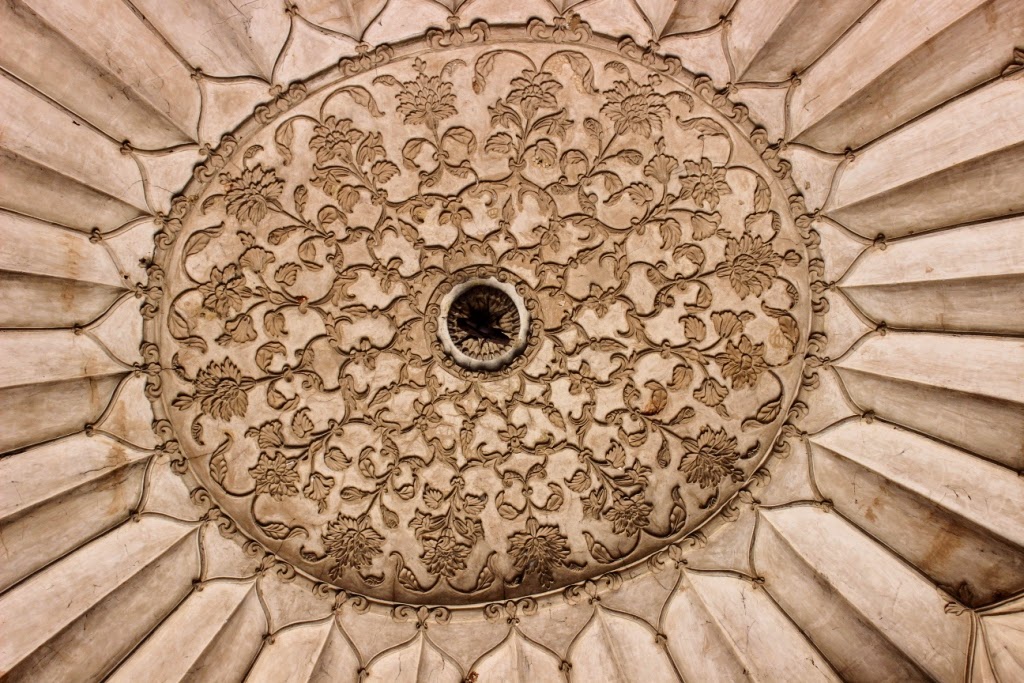
Floral pattern on the domes of the Safdarjung Tomb

The domes have interesting floral patterns. The tomb is encircled with beautiful and well maintained garden which is in the shape of Charbagh or quadrilateral garden.

The gardens, water channels and the pavallions at the Safdarjung Tomb Complex

The gardens are then surrounded by pavallions which were used as resting places. The Southern pavallion is called Badshah Pasand or the King's Choice, Northern one is Moti Mahal or the Pearl Palace and the Western side as Jangli Mahal or the Palace in the Woods.

The Safdarjung Tomb, Delhi

The Safdarjung Tomb is not very crowded compared to the Humayun Tomb so one can really enjoy the place at leisure. Since the ticket is not very exorbitant, I noticed lot of young couples sitting in the gardens who had no romance for the the monument but for each other only! Safdarjung Tomb is a protected monument of the Archaeological Survey of India (ASI).

Side view of the Safdarjung Tomb

I wonder why the ASI or other relevant authorities do not have some decent tea, coffee and snacks kiosks as people come from far off and would like to rest and spend some time at the monument. Also I did not see any ramps for the disabled to use wheel chairs.

Situated right next to the Safdarjung Airport (not a functional commercial airport) and very close to the Lodhi Gardens, Safdarjung Tomb is a must see place if one is interested in history and architecture. If you plan to go by the metro then the Jorbagh Metro station is the closest to the monument.

Also read:
Places to Visit in Delhi: Humayun Tomb
Places to Visit in Delhi: Qutub Minar, Alai Minar and the Iron Pillar
Places to visit in Delhi: Mirza Ghalib ki Haveli
Places to visit in Delhi: The Isa Khan’s Garden Tomb
Places to visit in Delhi: Ugrasen ki Baoli

Monday, 6 April 2015

Places to Visit in Delhi: Humayun Tomb

It is well-known that Taj Mahal borrowed its design to a large extent from the Humayun Tomb in Delhi. What differentiates the two is the pristine white marble of Taj Mahal.

The Humayun Tomb, Delhi

Another important but little-known difference is that Taj Mahal was made by the Mughal Emperor Shah Jahan in memory of his beloved wife whereas Humayun Tomb was built during 1565 to 1572 AD in memory of Emperor Humayun by his widow Hamida Bano Begum.

The main tomb is that of Humayun

This 47 meter high mausoleum structure was built on a 12000 square meter platform and has over 100 graves including, of course, that of Humayun. The mausoleum is surrounded by Char Bagh (four geometrical gardens in Persian style).

The Humayun Tomb has well maintained gardens on all sides

The structures and the gardens have been painstakingly restored by the Archaeological Survey of India (ASI) and Agha Khan Trust and they seem to have done a good job. Some of the restoration work is still going on. This is an UNESCO World Heritage site.

One of the magnificent arches of Humayun Tomb

During and immediately after partition the complex was used as a camp for refugees. During that time the complex suffered lot of damage which took the ASI quite some time to restore.

Humayun Tomb is a World Heritage Site 

Just behind the grand structure is a historical Gurudwara, Gurudwara Dam Dama Sahib whose onion-style dome is visible from the complex.

Carvings on the interior-side of the dome of Humayun Tomb

Inside the structure there are several sandstone screens which look beautiful, provide light and cool air and during summers it is a relief to be inside this building from the outside soaring temperatures.

A sandstome screen

There is a separate structure called Nai-ka-Gumbad for the royal barber. A person who is allowed to touch and cut the Emperor’s precious hair, has to be, by definition, immensely trustworthy. He probably passed on the palace gossip to the Emperor while massaging his scalp. No wonder he gets an exclusive resting place close to that of his master!

Nai ka Gumbad

Humayun Tomb was built by artisans brought all the way from Persia (today Iran). They knew their trade except that the stairs are as treacherous as ever. I wonder if it was deliberate!

The stairs at the Humayun Tomb are very steep

These artisans lived in the complex in what is today called Arab-ki-Sarai.

Arab-ki-Sarai Gateway

There are Gateways which are 48 foot high. A major portion of the Arab-ki-Sarai is either in ruins or has been taken over by an Industrial Training Institute. Though I could see conservation work on its Southern Gateway but on the main premises not much has been done. In this premises there is a well and a stepwell though both are not in good condition and the water collected there was green due to algae formation.

Arab-ki-Sarai where the artisans from Persia lived

Why is there no cafeteria and no souvenir shop in this important place visited by so many foreign and local tourists?