Showing posts with label Ornithology. Show all posts

Sunday, 26 May 2019

Bharatpur National Park - a Birders Delight

A Snake Bird in flight at Bharatpur National Park

Barely 185 km away from Gurgaon, a four-hour drive can take you to the birders paradise of Bharatpur Bird Sanctuary, also known as Keoladeo Ghana National Park.

Flamingos & Ducks at the Keoladeo Bird Sanctuary

The best time to visit the Park is in winters when the place is swarming with migratory birds from as far away as Siberia and even Africa! 

A Deer & an Egret at the Bharatpur National Park

There are plenty of stay options at Bharatpur including the hotel inside the park as well as several hotels and guest houses at a walkable distance from the Park. 

A huge Sparrow Hawk at the Bharatpur National Park

Owls at the Bharatpur National Park

Best time of the day for bird watching is early in the morning as the birds are more active then. The entrance fee is Rs 50 per person. 

All the way from Africa - Egyptian Vulture at the Bharatpur National Park

Once you reach near the entrance of the Park you will notice that there are lots of cycle-rickshaws. It is a huge Park of 29 sq km. So it is advisable to take some form of transport. 

Darter & Cormorants at the Bharatpur National Park 

Mother comes to feed its Kids at the Bharatpur National Park 

Avoid taking a rickshaw from outside. Rather take one from inside the Park as the rikshawalas inside also serve as guides (they have done the guiding course and are experienced and competent). 

Flock of Birds being watched by Cormorants at the Bharatpur National Park

In 2018 the Cycle cum guide rent was Rs 150 for an hour. They also have binoculars for which you pay extra but it is definitely useful as the birds like to keep their distance from the tourists. 

A Glossy Ibis watching another bird at the Bharatpur National Park 

Several of these guides are Sikhs (as was mine) who were given land near Bharatpur when they migrated from West Punjab (now Pakistan) in 1947 at the time of partition. 

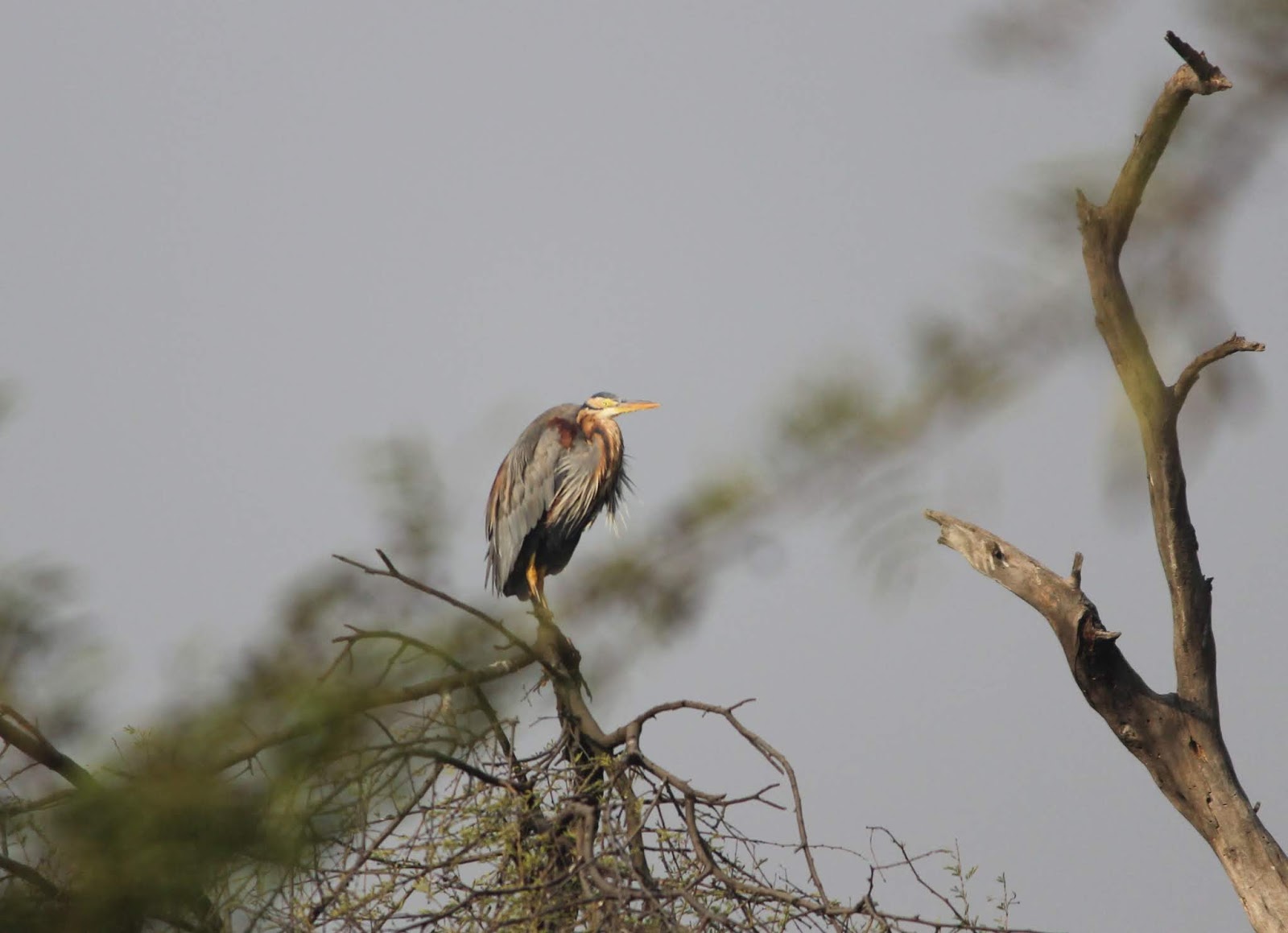
A Purple Pond Heron at the Bharatpur National Park

One can also hire cycles inside the Park but as my partner could not cycle, I therefore took the rickshaw for 5 hours. After that I let the rickshaw go and explored further on foot going on trails not visited by too many people. For bigger groups there are options of battery operated golf-carts and horse drawn carts as well. 

Glossy Ibis at the Bharatpur National Park

The rickshaw pullers cum guides know the routine, the nests and the favourite spots of birds and they can also identify them for you. Our guide knew exactly the nests of owlets, eagles and kites, snakes taking siesta in the sun etc. They also tell you anecdotes, so it is worth the money. 

An eagle about to attack its prey at the Bharatpur National Park

It is advisable not to hurry. See the birds and the wildlife at leisure. 

Kingfisher at the Bharatpur National Park

However, keep in mind that if you are going to spend a long part of the day inside the Park then do carry sufficient water bottles and eatables (please do not litter) as inside the Park the two canteens serve miserable snacks. 

Bharatpur National Park has a huge colony of Storks

Storks displaying themselves at the Bharatpur National Park

Let's take 'Stork" of the Situation

I sat for half an hour at one place and was rewarded by this - absolutely still like a statue -  Pond Heron catching a fish. It was a delight to watch. 

Nice catch - A Pond Heron with its prize - Bharatpur National Park

A Pelican at the Bharatpur National Park

Besides the birds that I could identify like the Egyptian Vulture, Green Himalayan Pigeon or the Ghuggi (in Punjabi), Common Babbler, Dove, Sparrow Hawk, Goose, Oriental Magpie Robin, Pelican, Herons, Cormorants, big colonies of Storks, various types of Kingfishers and wildlife like the Deer, Wild cows (there were some domestic ones also roaming around. Villagers get rid of unproductive cows by dumping them in the Sanctuary over the boundary walls), Wild Boar, Snakes etc. There were several others, which were a delight to watch.

Ajgar Snake sunning itself at the Bharatpur National Park

This UNESCO World Heritage Site incidentally was earlier was a royal Duck game reserve where the local royalty use to come and shoot the ducks as a game.

Perched high on a tree at the Bharatpur National Park

Purple Swamp-hens at the Bharatpur National Park 

Do remember to have good walking shoes, water bottle, snacks, good binoculars (if not then good zoom camera) so as to enjoy your birding experience!

Also Read:

Saturday, 8 December 2018

Things to do in Mcleodganj: The Kora Circuit

I have been visiting Mcleodganj since the year 1987 but somehow had been unaware of one important facet of the Buddhist tradition – the Kora. Kora is a form of pilgrimage wherein you circumambulate a holy site (Parikrama in the Hindu tradition). In Mcleodganj Buddhist, young and old, take the Kora circuit around the hill that has the residence of Dalai Lama and the monastery and therefore considered holy. Surprisingly it is little known.

The Kora in Mcleodganj

This tradition on circumambulation is common in both Buddhism and Bon. However, in Buddhism the walk in a circle is clockwise whereas in Bon it is counter clockwise. Two famous Kora are the Mount Kailash and Lake Mansarovar.

Huge prayer flags on the Kora route, Mcleodganj

The route in Mcleodganj is well paved and away from the town’s honking traffic amidst pine and deodar forest. The route has stringed prayer flags small and large. Buddhists believe that the fluttering of the flags carries the prayers written on them onwards.

The Kora route has benches placed all along for people to take rest

If one gets tired then one can sit down on one of the benches lined up along the route. The older people do sit down to take rest and chant prayers.

Prayer wheels of all sizes on the Kora route in Mcleodganj

The path is lined with prayer wheels in different sizes. Some are made of metal; others are of wood. Some are very small and look antique as if they have been brought from Tibet while there are others that maybe be 8-10 feet in height. The prayer wheels are always on the right side of the devotee.

A Tibetan lady at the prayer wheels on the Kora in Mcleodganj

On the Kora route there are stones carved with the Buddhist prayer Om Mani Padme Hum. The stones are in various sizes and some of them are brightly painted.

Artistically carved stones with Om Mani Padme Hum written on them on the Kora in Mcleodganj

Apart from the serenity and the beauty of the path, the dense forest is a paradise for the birdwatchers. I saw several birds and one could spend several hours just observing them.

Kora route in Mcleodganj is a Birdwatchers paradise 

Langurs come down the mountains in winters and one comes across them in this area. Unlike monkeys they do not trouble people. They are busy with themselves.

Langurs preening each other on the Kora route in Mcleodganj

I liked the Kora circuit so much that I performed the Kora twice in three days. I thank my Tibetan friend who introduced the Kora to me and took me around explaining things on the first visit.

Prayer flags and prayer wheels on the Kora in Mcleodganj 

This route is, fortunately, little known to most tourists and therefore not crowded.  There is something special about it.

Wind carrying the prayers written on the flags

The cleanliness is impressive. Jute bags function as dustbins.

The serene Kora route in Mcleodganj

All in all the best part of McLeodganj, for the devout as well as the curious tourist.

Also read:
Bon Monastery in Himachal
Places to visit in McLeodganj: Bhagsunag Waterfall
McLeodganj, Dharamshala, Himachal
Why I love to go to McLeodganj
Skywatch Friday - Sunset at McLeodganj, Himachal
Places to visit in McLeodganj: The Church of St John-in-the-Wilderness

Saturday, 18 January 2014

Birds at Katnalu Creek, Himachal

The Katnalu Creek is a bird watchers paradise. Though when I had initially gone there I was not aware of this fact. I was able to recognize some but not all (I am not an Ornithologist).

Red Billed Blue Magpie

Among the most beautiful bird in this area that I saw was the Red Billed Blue Magpie. Now these birds do not like to be clicked and do fly away the moment you go closer to them.

Red Billed Blue Magpie in Flight

I was staying at the Hail Himalayas and right next to the camp itself there was a group of Magpies so I was able to get some good shots. They have a pretty long tail and the colour blue looks really beautiful. And they look magnificent when in flight!

Orange Flanked Bush Robin

I also saw a couple of Orange Flanked Bush Robin's very close to the camp but it is again difficult to go too close for a good shot.

Orange Flanked Bush Robin

Compared to the first two the White Capped Redstart now actually likes to be photographed! This one I caught while trekking in the Katnalu Creek area close to the Shiva waterfall and it was not at all camera shy.

White Capped Redstart

 Its head is white and upper body part mainly black and brown red under the wings. It can normally be found near some water source and probably that is why it is also known as the White Capped Water Redstart.

White Capped Redstart

I also noticed a group of Black Headed Jay at one particular point on a trek. It was very difficult to take a good shot as they were high up and camouflaging themselves very well in the trees.

Black Headed Jay

I was told by Mr Hem Thakur of the Hail Himalayas that even he has seen this bird variety in this region for the first time. He has a good knowledge of the bird as well as plant life in the mountains.

A Blue Whistling Thrush near the Hail Himalayas campsite

There were several bird species which I was only able recognize but could not photograph while there were others that that I was able to shoot but did not recognize. Both the photos above and below are the ones I could not recognize.

A bird in the Katnalu Creek area

I also saw the green bee eating birds, several Teetar or the Grey Francolin (also called the Grey Partridge), and also a bird which was turquoise green under the wings.

I think I would go another time only with the mission of bird watching so that I have more time and patience which is required for this activity.

Also read: My Stay at Hail Himalayas

Sunday, 27 January 2013

Guda Bishnoi

Recently I was in Jodhpur on a vacation. Though I knew that around Jodhpur one can see lots of deer and other wildlife I was surprised to see also several water bodies where the migratory birds come in winters from as far as Siberia.

Flamingos

We used the google maps to search for water bodies and saw that a place called Guda Bishnoi has some water bodies. So we headed out to the place.

A flock resting after a long flight

Guda Bishnoi is about 25 kms from Jodhpur and once we crossed the village we saw two lakes visible from the road but since we were carrying the GPS enabled mobile we were also able to detect water bodies which otherwise we would have missed completely. And what a feast these water bodies were to our eyes!

Indian Pond Heron

The second lake (an artificial one in which during summers water is pumped so that the local wildlife as well as cattle of the nearby villages have water to drink) was full of Flamingos, Siberian Cranes - called Khurja in the local language- waterfowls etc. I was also able to spot a solitary Indian Pond Heron and few Shell Ducks as well.

Shell Ducks

The best season to visit Guda Bishnoi is the winter season from October to March as lots of migratory birds from colder climes come to this area.

Indian Gazelle

Around the lake there were several Chinkara or the Indian Gazelle and some of them were in quite a playful mood locking horns and having a mock fight as well!

Chinkaras locking horns

And of course I saw several blackbucks. The area has lots of them as the Bishnoi community protects them with gusto. One may remember a case where one of the Bollywood actors  - Salman Khan - killed blackbucks and was arrested due to pressure from the community.


Blackbucks


A male blackbuck is brown-black with and white underbelly with twisted long horns whereas the female blackbucks are fawn coloured and do not have horns. One of the blackbucks crossed in front of my car just five feet away!


A male & Female Blackbuck


The Bishnoi's also protect Khejri tree (also known as 'Janti' in Hindi) as they worship it and therefore help in preserving the ecosystem of this semi-arid land.


Black Winged Stilt

Though there were several other varieties of birds, I could recognize only a few of them like the Black Winged Stilt in the above photo.

Birds in flight

The third water body which was actually hidden from view and also had lots of weeds in the water was a perfect watering hole for several birds for nesting. A brief glance and you will notice nothing, but wait a few moments and you will see a bird take flight like this Siberian Crane in the photo below.

Siberian Crane

In the fourth water body, I also saw, besides several waterfowls this one huge Purple Pond Heron. It seems that these birds do not stay in flocks like others.

Purple Pond Heron

Overall it was a fantastic tour and in some ways better than my visit to Sambhar Lake as here in Guda Bishnoi I could see the birds and animals from a really close distance. Certainly a very good place for bird watchers. Binoculars are a big help.