Showing posts with label Cormorant. Show all posts

Sunday, 26 May 2019

Bharatpur National Park - a Birders Delight

A Snake Bird in flight at Bharatpur National Park

Barely 185 km away from Gurgaon, a four-hour drive can take you to the birders paradise of Bharatpur Bird Sanctuary, also known as Keoladeo Ghana National Park.

Flamingos & Ducks at the Keoladeo Bird Sanctuary

The best time to visit the Park is in winters when the place is swarming with migratory birds from as far away as Siberia and even Africa! 

A Deer & an Egret at the Bharatpur National Park

There are plenty of stay options at Bharatpur including the hotel inside the park as well as several hotels and guest houses at a walkable distance from the Park. 

A huge Sparrow Hawk at the Bharatpur National Park

Owls at the Bharatpur National Park

Best time of the day for bird watching is early in the morning as the birds are more active then. The entrance fee is Rs 50 per person. 

All the way from Africa - Egyptian Vulture at the Bharatpur National Park

Once you reach near the entrance of the Park you will notice that there are lots of cycle-rickshaws. It is a huge Park of 29 sq km. So it is advisable to take some form of transport. 

Darter & Cormorants at the Bharatpur National Park 

Mother comes to feed its Kids at the Bharatpur National Park 

Avoid taking a rickshaw from outside. Rather take one from inside the Park as the rikshawalas inside also serve as guides (they have done the guiding course and are experienced and competent). 

Flock of Birds being watched by Cormorants at the Bharatpur National Park

In 2018 the Cycle cum guide rent was Rs 150 for an hour. They also have binoculars for which you pay extra but it is definitely useful as the birds like to keep their distance from the tourists. 

A Glossy Ibis watching another bird at the Bharatpur National Park 

Several of these guides are Sikhs (as was mine) who were given land near Bharatpur when they migrated from West Punjab (now Pakistan) in 1947 at the time of partition. 

A Purple Pond Heron at the Bharatpur National Park

One can also hire cycles inside the Park but as my partner could not cycle, I therefore took the rickshaw for 5 hours. After that I let the rickshaw go and explored further on foot going on trails not visited by too many people. For bigger groups there are options of battery operated golf-carts and horse drawn carts as well. 

Glossy Ibis at the Bharatpur National Park

The rickshaw pullers cum guides know the routine, the nests and the favourite spots of birds and they can also identify them for you. Our guide knew exactly the nests of owlets, eagles and kites, snakes taking siesta in the sun etc. They also tell you anecdotes, so it is worth the money. 

An eagle about to attack its prey at the Bharatpur National Park

It is advisable not to hurry. See the birds and the wildlife at leisure. 

Kingfisher at the Bharatpur National Park

However, keep in mind that if you are going to spend a long part of the day inside the Park then do carry sufficient water bottles and eatables (please do not litter) as inside the Park the two canteens serve miserable snacks. 

Bharatpur National Park has a huge colony of Storks

Storks displaying themselves at the Bharatpur National Park

Let's take 'Stork" of the Situation

I sat for half an hour at one place and was rewarded by this - absolutely still like a statue -  Pond Heron catching a fish. It was a delight to watch. 

Nice catch - A Pond Heron with its prize - Bharatpur National Park

A Pelican at the Bharatpur National Park

Besides the birds that I could identify like the Egyptian Vulture, Green Himalayan Pigeon or the Ghuggi (in Punjabi), Common Babbler, Dove, Sparrow Hawk, Goose, Oriental Magpie Robin, Pelican, Herons, Cormorants, big colonies of Storks, various types of Kingfishers and wildlife like the Deer, Wild cows (there were some domestic ones also roaming around. Villagers get rid of unproductive cows by dumping them in the Sanctuary over the boundary walls), Wild Boar, Snakes etc. There were several others, which were a delight to watch.

Ajgar Snake sunning itself at the Bharatpur National Park

This UNESCO World Heritage Site incidentally was earlier was a royal Duck game reserve where the local royalty use to come and shoot the ducks as a game.

Perched high on a tree at the Bharatpur National Park

Purple Swamp-hens at the Bharatpur National Park 

Do remember to have good walking shoes, water bottle, snacks, good binoculars (if not then good zoom camera) so as to enjoy your birding experience!

Also Read:

Thursday, 16 April 2015

This is also Gurgaon: The Sultanpur National Park

Gurgaon, the ‘Millennium City’, is known for its ugly multi-storied glass buildings, multinational companies, lack of basic infrastructure, potholed roads (in some places only potholes and no road!), fancy sounding British and American names of housing societies etc, basically a concrete jungle.

The vibrant colours of a Peacock in flight 

But few know that tucked away in a corner of the Gurgaon district is a paradise for local and migratory birds called the Sultanpur National Park (earlier it was known as Sultanpur Bird Sanctuary). It is just 15 km away from the Gurgaon city on the Gurgaon-Farrukhnagar road.

Spot Billed Ducks

I was a little late in visiting the sanctuary (March end) but this year the weather has been pleasant even in March, so I was still able to see lot of birds. There were few visitors and I was able to enjoy the place in its serenity.

White Breasted Kingfisher

I had reached there at 9 AM as per the timings on the website, but on reaching there I was told that it now opens at 7 AM. The government website requires some updating.

Black Winged Stilt

Visitors should not confuse this Sultanpur with another Sultanpur located in South Delhi. Two American ladies visiting the place were taken by their taxi to Sultanpur in Delhi wasting half of their day.

Cormorant

The birds I could recognise with my limited knowledge of birding were Black Drongo, Cormorant, Egret, Green Bee Eater, Indian Magpie Robin, Indian Pond Heron, Peacock, Purple Heron, Red Wattled Lapwing, Purple Swamphen, Spot Billed Duck, and White Breasted Kingfisher among others.

Egret

In fact I could count more than 30 Kingfishers during my visit. The best was when I got this Peacock in flight captured in its vibrant colours.

Green Bee Eater

There are several watchtowers inside the sanctuary. All but one is closed. I was able to climb up this one and get a bird's eye-view of the whole Bird Sanctuary.

Indian Magpie Robin

Also half the sanctuary is not accessible to the public. When I asked an official he gave me a strange logic that boys and girls come and do ‘mischief’ here.

Look what I got for breakfast: Indian Pond Heron with fish

Now this is not a way to manage things. They should in fact think of ways to improve the facility so that more birds make this their winter destination.

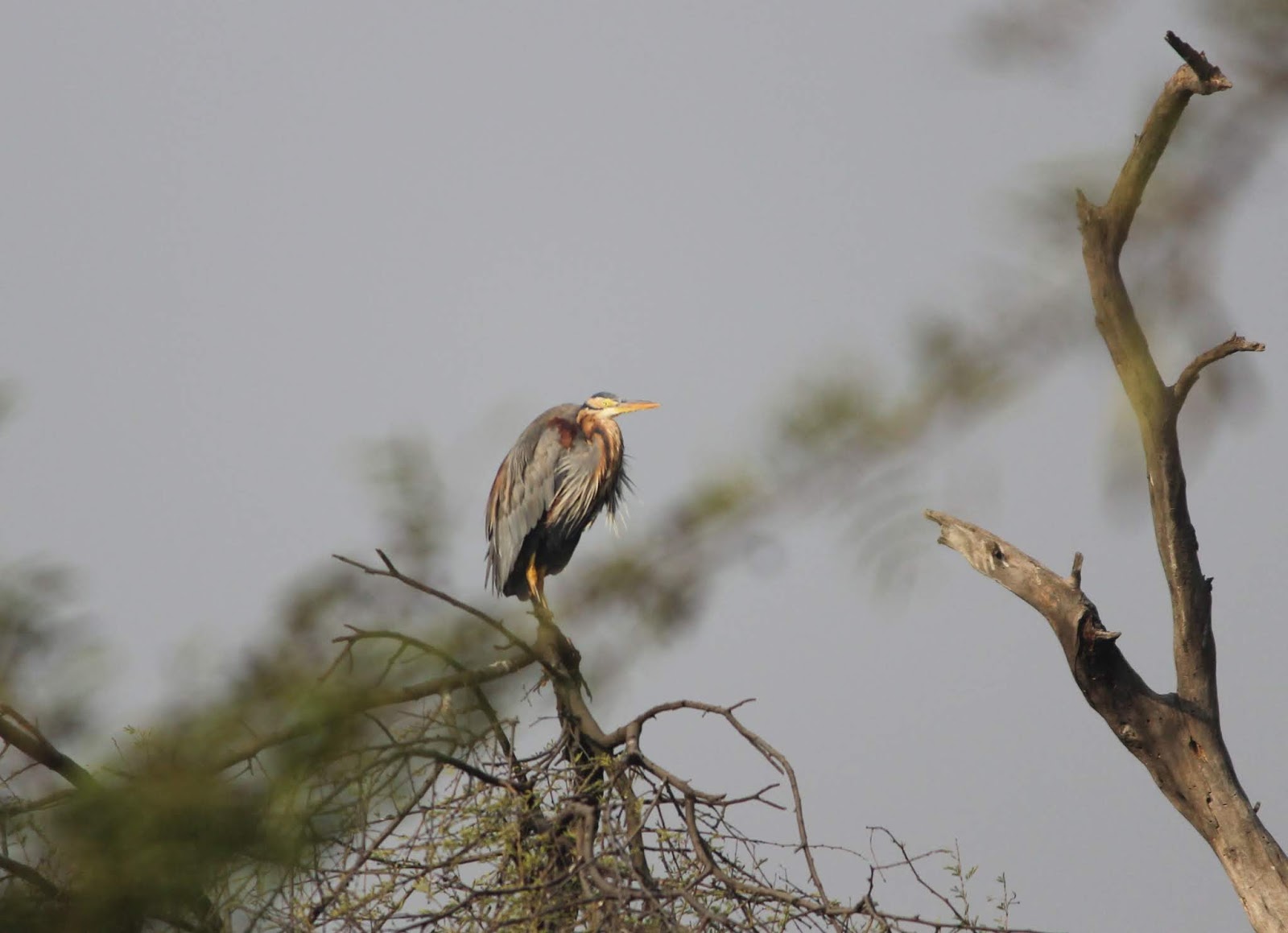
Purple Heron & Red Wattled Lapwing

I was also able to see several turtles (probably nesting) and a group of Nilgai (Asian Antelope) at the site.

Purple Heron

The best time to visit the Sanctuary is in the winters as migratory birds from Siberia and Europe come here.

Purple Swamphen

Do keep up to three hours for the walk in the sanctuary. Of course for the birdies even full day also won’t suffice!

Thursday, 22 March 2012

Birds at Morni

The Morni Hills area is a bird watchers paradise. There were so many birds that I saw for the first time in my life (I am no Ornithologist). Some of the bids I recognized while most of the others I could not. I even sought help for identifying some of the birds in case I was able to capture them in my shots which was not very often.

The birds photos below were taken in the Morni and Tikkar Taal areas. See my earlier posts of Tikkar Taal and Morni Hills & Morni Fort.

Some of the birds I was able to see just by chance for example the Coal Tit bird and the Indian Robin came quite close to where I was sitting in the hope of getting some food.

Coal Tit Bird

Indian Robin Female

The Red Vented Bulbuls were quite content with eating these round fruits of the trees.

Red Vented Bulbul eating a tree fruit

Red Vented Bulbul


I was able to spot two cormorants at the Chota Tikkar Taal. I have watched these birds for the first time and did not know the names initially. I queried at Indiamike to know which bird is this. The Cormorant is a beautiful bird which dives in water for food and can stay underwater for pretty long.

Cormorant at Tikkar Taal

The White Capped Red Waterstart I found was not at all shy and was sitting on a paddle boat on the Tikkar Taal for quite some time.

White Capped Red Waterstart

The beautiful kingfishers I was able to see and click near the Tikkar Taal lake.

White Throated Kingfisher

The Wild Life Wing of the Forest Department of Haryana also has a Pheasant breeding centre at Morni. Some of the Pheasants look like the ordinary cocks but others are very colourful and beautiful.

Kaleej Pheasant

I was also able to locate Barn Owl near dusk at Morni Hills. As the name Morni suggest yes I was able to see few peafowls as well. In the evening near the lake several Egrets,  Indian Pond Herons and Red Wattled Lapwing were also visible.

The area is also home to the Crested Kingfisher, Wallcreeper, Bar-tailed Treecreeper, Oriental Turtle Dove, Quails, Grey Francolin, Black Francolin, Himalayan Bulbul and Red Jungle fowl among several others.
 
In winters several migratory birds visit the area from as far as Siberia.