Showing posts with label lake. Show all posts

Saturday, 2 September 2023

Places to Visit in Sikkim - Khecheopalri Lake

Khecheopalri Lake, Sikkim

Khecheopalri Lake, also known as Khechuperi Lake is located in West Sikkim at a distance of about 32 km from Pelling. In Pelling I was staying at Rufina Palm Bliss Hotel and from there it takes about one and a half hours of drive to reach the lake from Pelling town amidst forests and multiple waterfalls.

View of Khecheopalri Lake at the ground level

The lake, situated at 5938 feet altitude, is surrounded by dense forests and forms like a bowl to accumulate the water of the surrounding Ramam Mountains. 

A walk on the periphery of the Khecheopalri Lake, Sikkim

From the last vehicle point, the walk towards the lake is serene and easy next to the wetland area and one can hear the chirping of a lot of birds. The Buddhist (and Hindus) revere the site and one can see many Buddhist prayer flags next to the lake. Since the local consider the lake as sacred so bathing in the lake is not permitted.

Buddhist Prayer Flags in the wetland of Khecheopalri Lake, Sikkim

At the path at the lake level, you cannot see the full form of the lake. To see the complete lake and the nearby forests one should make an effort and go up a steep climb of about 15 minutes and then at the top all of a sudden the full view of the lake and the surrounding areas is beautiful and mesmerizing. 

A cave used by Buddhist monks for solitary meditation 

While going on this climb just a few meters from the top is a small cave which is used by the Buddhist monks for prayers in isolation (quite common among the Buddhist monks to stay alone in a cave or room away from others meditating where there is no contact with the outside world.  (For sustenance, their food is kept outside by other monks, who then leave without meeting the monk).

Khecheopalri Lake, Sikkim

The area has dense forest around the lake. I had earlier visited West Sikkim nearly 34 years back (that time I had done the Kanchenjunga Base winter snow trek in this region) but after such a long gap also I did not see much deforestation. Maybe this is due to the very environment friendly campaign of the Sikkim government of planting 100 saplings for each birth.  


A complete view of the Khecheopalri Lake and its surrounding Ramam mountains

If you want to reach directly to Pelling then the nearest Airport is Bagdogra in West Bengal at a distance of about 145 kms. Pakyong airport in Sikkim is closer but has lesser flight options.

Sunday, 1 January 2023

Places to visit in Ladakh - Pangong Tso


Pangong Tso, Ladakh

It is said that sometimes the journey is equally important, if not more, than the final destination. The same can be said for most of the journeys & destinations in Ladakh, an erstwhile province of Jammu & Kashmir and now a Union Territory. 


On way to Pangong Tso, Ladakh

My journey from Nubra region to Pangong Tso (or Pangong Lake), though long, was mesmerizing what with the clear green waters of the Shyok river and rivulets on the way as well as the moonscape mountains having different hues at every turn.


Shyok River, Ladakh
 

Changthangi, Ladakh

On the way I saw the Pashmina goats, also known as Changthangi (for the region they come from) grazing at high altitudes.


Yaks grazing, Ladakh

Then there were the Yaks feeling at home and grazing in the frozen pond and grass landscape. Yaks are at home in extremely low temperatures at these high altitudes. Yaks are sturdy beasts of the region providing not only milk and cheese but also as beasts of burden to the locals especially in winters when all motorised transport may cease in remote areas.


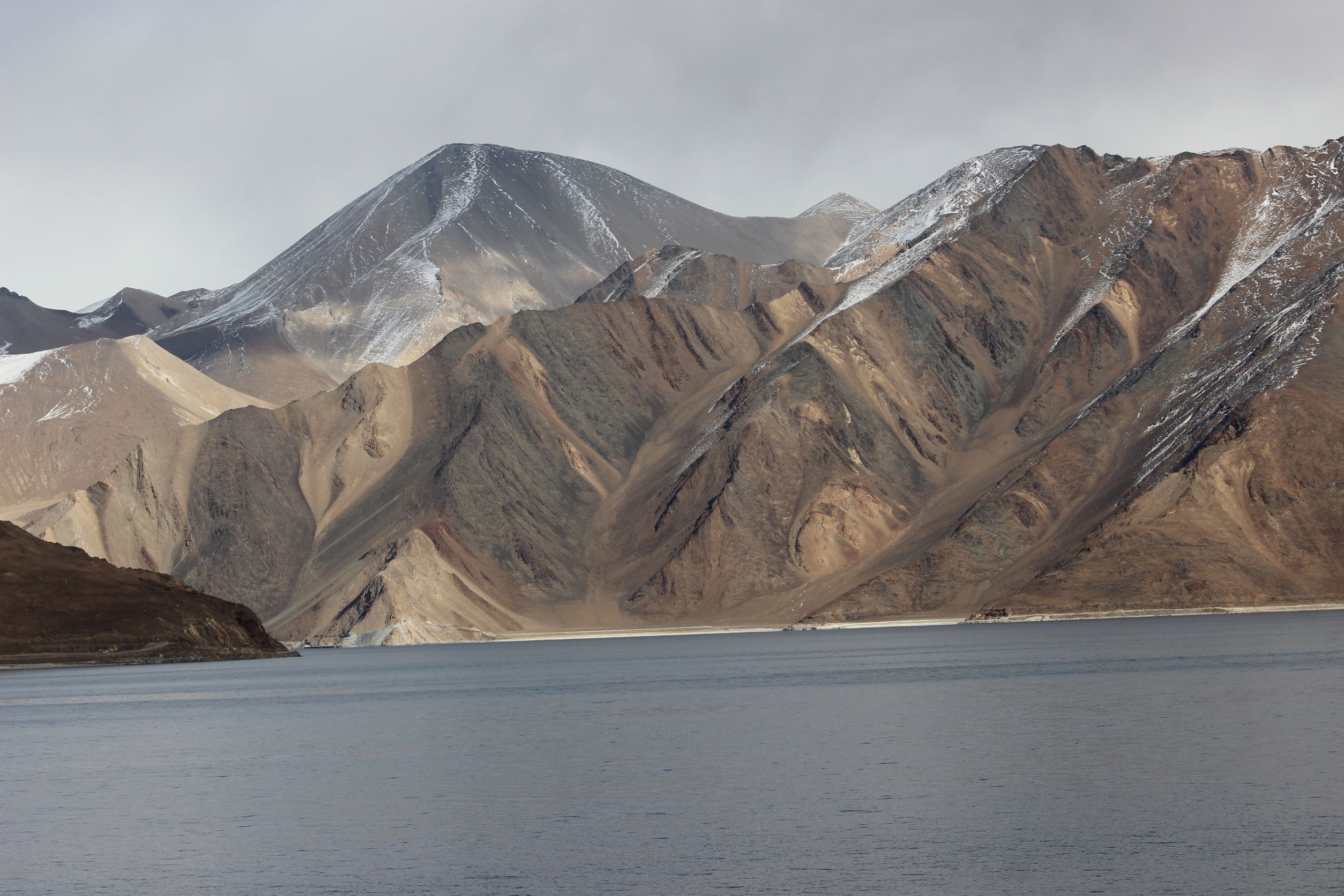
Pangong Tso, Ladakh

The lake at 14270 feet is 134 km long though only 1/3 is in Ladakh & the remaining is in Tibet. The lake has an endorheic basin, which means that it retains water and has no outflow. The lake completely freezes over in winters. Due to being endorheic, the water is salty and the Pangong is considered the world’s highest salt-water lake.


Pangong Tso with mountains on the eastern side

The photo does not justify the beauty of the place with the lake having multiple colours of blue, which is mesmerizing. One can just sit here and watch the lake changing colours – i.e. various shades of blue.
 

At the Pangong Tso, Ladakh

The hills, some bare and others snow clad add to the aura of the place. In summers, there is accommodation available here but after end-October most of them close it for winters though few eateries are still open in November.


Shades of Blue, Pangong Tso, Ladakh

You can reach Leh, capital of Ladakh by air or by road (long journey). From Leh you can book cabs/bikes. Travel in Ladakh is expensive because of long distances between destinations. Best time to visit Pangong Tso is summers but then be prepared to see lots of tourists trying to be ‘three idiots’. From Nubra to Pangong Tso the drive is about 270 kms and takes about seven hours. If one goes from Leh via the Chang La (at 17688 feet) then the distance is about 225 kms and take about five and a half hours.

Sunday, 26 September 2021

Places to Visit in Himachal: Serolsar Lake

I revisited the Banjar Valley & Seraj Valley in Himachal after a gap of thirteen years. This time I stayed at three different locations in the valley. 

Serolsar Lake, Seraj Valley, Himachal

The Banjar valley is more beautiful than the Kullu valley and less touristy as it is away from the main Delhi-Manali-Leh highway. While staying at Shoja I decided to go again on the trek to the Serolsar Lake. Since I had driven from Delhi by car (it would take anywhere between 15 to 17 hours from Delhi to Shoja as the road conditions from Mandi till Kullu tunnel are not good) so I went from Shoja to Jalori Pass by car.

The drive from Jalori Pass to Shoja

Jalori Pass is at a height of 10280 feet from Sea level on the Kullu-Shimla route. I encountered patches of snow on the road and sides even though it was end-March and early-April period.

The Jalori Pass-Serolsar Lake Trek path through forest

From Jalori Pass the trek starts to the Serolsar Lake (also known as Seruvalsar Lake). From Jalori Pass to Serolsar Lake the distance is around five km and I would rate the trek as ‘easy’. However, it is advisable to carry sufficient drinking water and eatables as once you leave Jalori Pass and almost upto the Serolsar Lake you won’t get any place to have water, tea or snacks (especially if it is not a tourist season). I did see some shacks on the way but they had not opened for the season yet. The trek is through forests and therefore the walk is pleasant. 

Tried bouldering on a rock face on way to Serolsar

There are at some places huge rock faces so I did try doing some bouldering. However, I would advise against it if you were not a rock-climber.

A pond near the Serolsar Lake

Very close to the lake, there is a pond that collects rain water from the catchment area – so do not get confused and assume that you have reached the lake. This pond does not have clear water and has some weeds.

A view of the Serolsar Lake

The moment you see some dhabas offering tea, snacks and food you would realise that you are about to reach the lake site. The lake is in a depression with hill surrounding it on all sides to form a bowl, which is perfect catchment area for rain and snow-melt water to accumulate.  

A 360 degree view of the Serolsar Lake area

The first view of the lake itself is beautiful with clear water and surrounding hills still having the winter snow.

At the Serolsar Lake 

Like most of the lakes in the Himalayas, the locals also consider the Serolsar Lake holy. Therefore, it is advisable not to enter the lake for bathing or to wash clothes etc. 

Serolsar Lake with Budhi Nagin temple in the background

There is also the Budhi Nagin temple close by. Before starting the return journey you can have hot (and tasty) meal of Rajma-Chawal or Kadhi-Chawal and tea etc at the few dhabas located nearby. One should keep at least half a day for this excursion if one really want to enjoy nature leisurely. 

Even in April there were patches of snow on the Jalori Pass- Serolsar Trek

If you are the more adventurous type then you can try to climb the hills on the way and do some snow walking as well. My advice to travellers – carry good trekking shoes, water, snacks and do not litter. In case you are not carrying water etc then these can be bought at the Jalori Pass as it has few shops and dhabas.

Monday, 22 September 2014

Siliserh Lake Palace – Does the Government Need to Run Hotels?

Just 15 km from Alwar is a beautiful man-made lake and adjoining the lake is the palace Siliserh Lake Palace. The palace has been taken over by the Rajasthan Tourism Development Corporation (RTDC) and converted into a hotel by the same name.

Siliserh Lake & Siliserh Lake Palace Hotel, Alwar, Rajasthan

There are no other hotels in and around Siliserh. Assuming that it is a palace that has been converted into a hotel (as is the trend in Rajasthan with so many other properties) I was quite excited when I had booked a room online. The online pictures seemed quite enticing.

The Silserh Palace- surrounded by dense vegetation on one side & lake on the other three sides

When I reached the place I was quite fascinated by the beauty of the place as the lake is surrounded by Aravalli hills – so I thought I had made the right decision. But my first shock was when the room I had booked (a non-AC as it was not summers) had the door almost falling. On top of that inside the room there were at least 15-20 lizards and lots of mosquitoes. When I protested about this they showed me some other rooms which were equally bad with paint chipping and the rooms in itself in a state of disrepair.

Beautiful view of the Silserh Lake from the hotel

Finally I asked for my room to be upgraded to an AC room for which I had to shell out extra money. After moving into the new room as I felt the room to be warm (due to permanently closed windows) I started the AC but within an hour the AC conked off and I had to spend a miserable night in that room. In the morning an electrician came and repaired the wires and assured me that now it will run properly. As the whole day I was out of the hotel I had no inkling of what was in store for me. The next night after starting the AC it kept tripping the whole night spoiling my whole night.

Silserh Lakae Palace Hotel in a state of disrepair

Also as this is a secluded place the hotel is the only place for meals and they do not give you too many options on the menu.

My question is why should a government be in the business of managing (mismanaging?) hotels? Why not ask a private player to run it instead who can market it properly as well as also do the maintenance of this heritage property in a better manner.

The traditional Rajasthani architecture being spoilt by a bad paint job

Also instead of just keeping a few boats and speed boats this place can really be developed into a hub of water sports activity.

Also read stories of places in and around Alwar –

Siliserh Lake near Alwar, Rajasthan
Cenotaph of Bakhtawar Singh of Alwar
Water Tank at City Palace, Alwar
Bala Quila – Alwar’s Way of How Not to Promote Tourism
Jaisamand Lake near Alwar, Rajasthan 

Sunday, 6 April 2014

Jaisamand Lake near Alwar, Rajasthan

The Jaisamand lake is an artificial lake near Alwar in Rajasthan that has been built to store water from the overflow of the Ruparel river and to use the water during the parched summer months.
Jaisamand Lake, Alwar

The lake is about six kms from Alwar on the way to Silserh lake and Sariska Tiger Reserve. There is a minor village road leading to this place. As I had driven from Delhi therefore connectivity was not an issue with me. I had stayed at the Silserh Lake Palace Hotel from which point the Jaisamand Lake is not very far. There is almost no traffic on this road either of the tourists or of the locals so if you want some solitude amidst beauty then this is the place for you. Do not expect any eatables etc to be available here. If you want to spend some time here then bring your own water and eatables.

View of the embankment from one of the Cenotaphs at Jaisamand Lake

What is interesting here is that instead of a drab embankment normally found on such lakes the Jaisamand lake embankment has beautiful chattris (cenotaph) made all along its 1.5 km stretch adding immense beauty to the place. The reflection of the chattris on the water is beautiful. The central cenotaph is the largest of them and much more work has been done on this compared to the other chattris.

The central cenotaph and other smaller ones in the background

Though at one time this lake was considered to be amongst the largest artificial lakes in Asia sadly now it is nowhere its original size as the water now is very less and most of the land has been taken over for cultivation. I saw locals using inflated tubes of truck tyres as dinghies in an innovative way and collecting fish and weeds and some water vegetables.

Jaisamand lake and the cenotaphs

Also read stories of places in and around Alwar –

Siliserh Lake near Alwar, Rajasthan
Cenotaph of Bakhtawar Singh of Alwar
Water Tank at City Palace, Alwar
Bala Quila – Alwar’s Way of How Not to Promote Tourism

Saturday, 28 December 2013

Siliserh Lake near Alwar, Rajasthan

I recently went and stayed at Silierh which is about 15 kms from Alwar city and about three and a half hours drive from Delhi. Also the Sariska Tiger Reserve is just 20 kms or so away from here.

Siliserh Lake viewed from the Siliserh Lake Palace


Silserh Lake and reservoir is a huge man-made lake made by the King Vinay Singh in 1845 to cater to the water needs of the Alwar town and the water channels are still intact from that duration. I am not sure though if the water is still supplied from this lake to Alwar or not.

Siliserh Lake with the Siliserh Lake Palace

I stayed at the Siliserh Lake Palace Hotel run by the RTDC which is the only accommodation available right next to the lake itself. I will specifically write about the Siliserh Lake Palace Hotel in a separate post though. The Lake is spread over ten square kms in area surrounded by the Aravalli hills on three sides.

Siliserh Lake surrounded by the Aravalli Hills

The advantage of staying at this site is that if you come otherwise during the day then sometimes there are many tourists but in the mornings and evenings you can have the place to yourself and enjoy the tranquility of the place is serene surroundings. The sunsets are not very spectacular as the sun sets behind the hills but the sunrise are definitely worth getting up early in the mornings.

The west side of the Siliserh Lake

The place also has the facility of boating which includes pedal boats, motor boats as well as speed boats but the prices for hiring these are steep as there is a monopoly here. The pedal boat can be hired for Rs 200 for half an hour whereas the motorboat costs Rs 600 and the speed boat can be taken for Rs 1000 for a 15 minute ride.

The east side of the Siliserh Lake

There is a great potential for the water sports to be developed here. The lake also generates revenue in the form of fishing rights that are auctioned every year and a local told me that this year the contract was for sold for 8 million rupees.

Siliserh Lake and the reflection of the hill as if it is a snake

Lot many local people do come here during the day and feed the fish. The feed is brought either with them or bought at the local tea shop. At the reservoir bund there are now too many monkeys and langurs and the government should take measures to shift them elsewhere.

Siliserh Lake - a boat and a crocodile in the foreground

I also saw couple of big crocodiles in the lake which made me think twice about the boating in the lake but still ended up boating nonetheless.

There is an entry fee to the hotel area for the tourist (not if you are staying at the hotel) which seemed silly to me as to why charge some money when no facility is being provided

Also read: Bala Quila – Alwar’s Way of How Not to Promote Tourism

Saturday, 13 July 2013

The Changing Moods of Hauz Khas Lake

I have been to Hauz Khas several years back. But during the recent visit as I had the camera with me I was able to click the lake in its various moods.

Hauz Khas Lake


Hauz means water tank (or a pond or lake) and Khas means special. So it is a special or royal tank meant for the rulers. Originally the tank was much larger than it is today and according to the rock plaque at the site the ruined pavilion or the Munda Gumbad on a mound in the north west corner of the tank was in the middle of the water. Originally called Hauz-e-Alai the tank was excavated under the orders of Alauddin Khalji (1296-1316 AD) for the use of the inhabitants of Siri. Siri was the second city of Delhi founded by Alauddin Khalji. Later on, however, the channels leading to the tank got silted and the tank dried up. Then in the mid-14th Century Feroz Shah restored the water supply to the tank and built a madrasa next to the tank.

Ducks & their Ducklings at Hauz Khas lake 

The water tank also is a host to several ducks and their ducklings. Though majority of the ducks are white there are some spot-billed ducks as well. The ducklings are yellow and they will shed their lovely colours with age.

Hauz Khas lake with the buildings in the background

When I was there I saw the lake change colours as per the mood of the sky. At the beginning the lake was looking a dark green due to the reflection of the trees that are in the middle of the lake as well as those that surround it.

Evening glow after rains on the Hauz Khas Lake

Then all of a sudden from a sunny day clouds emerged and it started drizzling and it became dark. After the rain there was a glowing red tinge in the sky and the mood of the lake changed accordingly.

Serene Hauz Khas lake at sunset

I had thought that since it has become so dark and then the evening tinge in the sky that the sun must have already set but as I was sitting on the fifth floor of a restaurant building I saw the sunset as the clouds vanished and the lake and its surroundings preparing for a night of rest. It was beautiful to watch the lake change its moods and colours in just a few hours so dramatically.

Sunday, 13 May 2012

Grouse Mountains, British Columbia, Canada


The beautiful Grouse Mountains is only a 15 minute drive from downtown Vancouver in the British Columbia, Canada.  


Frozen Lake on the Grouse Mountain


It must be among the few places in the world that one can reach from the sea level of Vancouver to above the forest line and among the snow capped Grouse Mountains to ski in a matter of minutes.

Frozen Lake in foreground with native painting on a wall


Be it day or night a winter playground can be found in the Grouse Mountains. In the winters Grouse Mountains is a popular tourist attraction as lot of locals come here to have a fun time not only during the day but also during the night. Of course lot many people miss the lake as it is slightly off route so I had plenty of time to myself here away from the crowd.


Black lizard on snow


I saw this black lizard making a slow but steady progress towards its destination and the contrast of colour was stark.

View from the Grouse Mountains

The best part is one can view from atop the Grouse mountains forested  green mountains in the foreground and the skyline of the Vancouver city (as is visible in the center foreground in the photo above), the Pacific Ocean with the barges and the distant snow clad mountains as a birds eye-view.

After a trek or ski if you are hungry then there are plenty of good options on the top like the Observatory for fine dining, the Altitudes Bistro for British Columbian cuisine from where I could see the Vancouver city as well as the Pacific Ocean 3700 feet below, Lupins Cafe for casual dining, Grouse Grind Coffee Bar, the Starbucks, among others.

The general admission ticket to reach the Grouse Mountains is $40 (Canadian Dollars) and this ticket is valid for the skyride, trails, skating pond etc.

Saturday, 10 March 2012

Tikkar Taal Lake

I am normally interested in going to smaller and off the usual tourist destinations. Therefore, this time I decided to visit the Morni Hills and its adjoining areas. Morni Hills is the only hill station of Haryana and is located in Panchkula district. Morni Hills is also the Tehsil headquarters. Tikkar Taal (Taal means lake) is about 45 kms from Panchkula and about 300 kms from Delhi and can be reached in five hours from Delhi.The road condition from Panchkula to Tikkar Taal is good.


Sunset at Tikkar Taal

In fact at Tikkar Taal there are two lakes - the bigger is known as Tikkar Taal and the smaller is called Chota Tikkar or the Sherla Taal.


The Twin Lakes: Bada Tikkar and Chota Tikkar

The water of the smaller lake is muddy. Both the lakes are surrounded by hills on all sides and therefore have a good natural catchment area for the collection of rain water.

Chota Tikkar

Closer to the smaller lake is located the Adventure Park maintained and run by the Haryana Tourism. It has taken the concept from outside but is not of the same standard. e.g. the Tree House is build on an artificial tree. But the only good thing it that the Tree House gave me a vantage position to see the smaller lake from above.

Tree House


One can visit the Adventure Park (entry ticket is Rs 50 per person) though I was not at all impressed by the same. It has ghost house, monkey maze, tree houses, swinging bridge (seems it is broken for quite some time with no one bothering to repair it). The Adventure Park that I visited in British Columbia, Canada for example was far more advanced and interesting.


Entrance to the Adventure Park


I was also able to see some water birds for the first time which I have not seen before.

Chota Tikkar from the tree house

The bigger lake has very clear water and it is mainly on this lake that boating, camping and other adventure activities are carried out. One can take a paddle boat for two persons for Rs 100 for 15 minutes.


Tikkar Taal

The Tikkar Taal is about 550 meters by 460 meters whereas the smaller one is about 365 meters (both ways). There is also a theory that both the lakes are interconnected by an underwater channel but I have my doubts on this theory as water of Tikkar Taal is clear whereas the water of Chota Tikkar is muddy.

Tikkar Taal from another angle

Haryana Tourism maintains a hotel at Tikkar Taal which has four AC rooms (Rs 1500) and two 16 bedded dormitories (Rs 200). The location could not be better as it is right on the lakeside.

Accommodation of Haryana Tourism

The place has limited eating options - either the Haryana Tourism maintained restaurant or the Happy Restaurant (closer to the Chota Tikkar)

On week days there are few persons who visit the place so one can have the place to oneself but I believe weekends could sometimes become maddening specifically if it is some holiday like Holi. Hordes of people, mainly the young crowd, come to the place from Chandigarh, Panchkula and Mohali. Mostly they stay there for less than an hour. More than the lake, it is probably the drive to it that they enjoy.

Best time to visit the Tikkar Taal area is October to March as the weather is pleasant. One can stay either the Haryana Tourism hotel or the smaller hotels. Smaller hotels do not have a online  booking system. Of course I was not able to book a room online even on the Haryana Tourism website. They seriously need to upgrade their website and match the ones maintained for example by the Himachal Tourism.