Showing posts with label India. Show all posts

Sunday, 1 January 2023

Places to visit in Ladakh - Pangong Tso


Pangong Tso, Ladakh

It is said that sometimes the journey is equally important, if not more, than the final destination. The same can be said for most of the journeys & destinations in Ladakh, an erstwhile province of Jammu & Kashmir and now a Union Territory. 


On way to Pangong Tso, Ladakh

My journey from Nubra region to Pangong Tso (or Pangong Lake), though long, was mesmerizing what with the clear green waters of the Shyok river and rivulets on the way as well as the moonscape mountains having different hues at every turn.


Shyok River, Ladakh
 

Changthangi, Ladakh

On the way I saw the Pashmina goats, also known as Changthangi (for the region they come from) grazing at high altitudes.


Yaks grazing, Ladakh

Then there were the Yaks feeling at home and grazing in the frozen pond and grass landscape. Yaks are at home in extremely low temperatures at these high altitudes. Yaks are sturdy beasts of the region providing not only milk and cheese but also as beasts of burden to the locals especially in winters when all motorised transport may cease in remote areas.


Pangong Tso, Ladakh

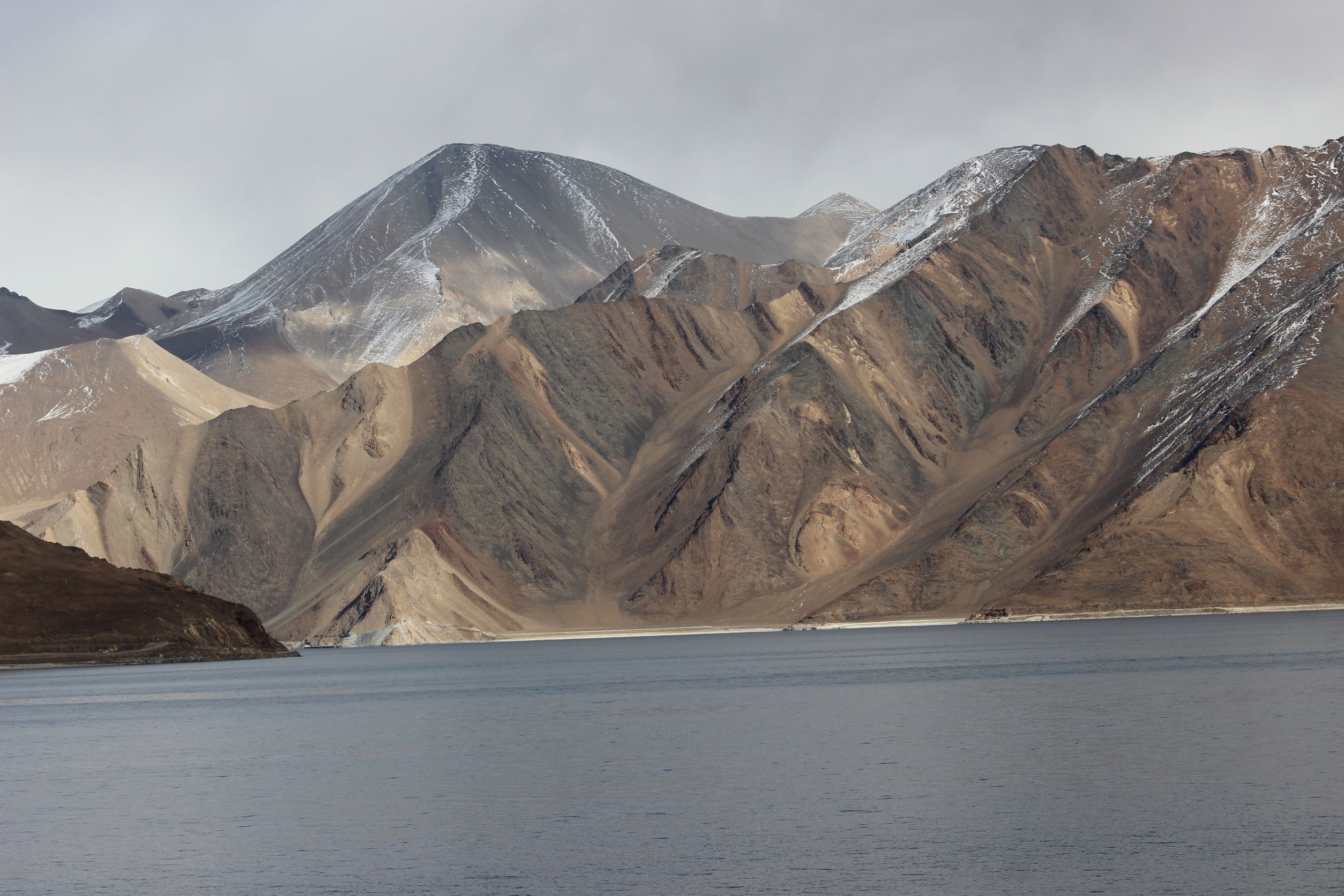
The lake at 14270 feet is 134 km long though only 1/3 is in Ladakh & the remaining is in Tibet. The lake has an endorheic basin, which means that it retains water and has no outflow. The lake completely freezes over in winters. Due to being endorheic, the water is salty and the Pangong is considered the world’s highest salt-water lake.


Pangong Tso with mountains on the eastern side

The photo does not justify the beauty of the place with the lake having multiple colours of blue, which is mesmerizing. One can just sit here and watch the lake changing colours – i.e. various shades of blue.
 

At the Pangong Tso, Ladakh

The hills, some bare and others snow clad add to the aura of the place. In summers, there is accommodation available here but after end-October most of them close it for winters though few eateries are still open in November.


Shades of Blue, Pangong Tso, Ladakh

You can reach Leh, capital of Ladakh by air or by road (long journey). From Leh you can book cabs/bikes. Travel in Ladakh is expensive because of long distances between destinations. Best time to visit Pangong Tso is summers but then be prepared to see lots of tourists trying to be ‘three idiots’. From Nubra to Pangong Tso the drive is about 270 kms and takes about seven hours. If one goes from Leh via the Chang La (at 17688 feet) then the distance is about 225 kms and take about five and a half hours.

Sunday, 21 May 2017

VFS Global -- a Kafkaesk nightmare

Passport to travel

I belong to the elite club of JNU professors. We think the world of ourselves. We are waiting for a revolution, just as the Jews wait for their Messiah. Once in a while we are forced to venture out of the self-sufficient campus established on the Aravalli hills. Why? Silly. To apply for visa of course. We often get invited by this and that Western university as guest and visiting scholars. I decided to go to the Gurgaon VFS, with my visa application thinking it will be less crowded. “Your appointment is at 9 am. Please come 15 minutes early.” said the online mail. I’ll be free by 9.30, I thought and innocently I planned the rest of my day. Here is where my nightmare with VFS office begins. Till 10 am there is no staff in this dystopia except the Safai Karamchari. Finally one young woman troops in, unapologetic. After going through my check-list, she asks me to wait for the Bio-metric staff. The wait is futile. After having wasted the whole day, I demand that I be transferred to VFS Delhi. An email is sent to Delhi VFS to get rid of me. This place is worse than a Government Office, I crib. It should first introduce biometrics for its own staff. My husband nudges me gently: “Keep quiet. They can spoil your application.” Delhi is Delhi, I tell him undeterred but a little anxious. Next day, the airport metro takes me to the gates of VFS Global. It was the first time I was travelling by airport metro and I was indeed impressed. Then start the problems. My water bottle and the humble biscuits I always carry in my bag are not allowed inside. Security is so tight that you can barely breathe. The gate-keeper would not let me in without an appointment letter. It takes me nearly an hour of argumentation, pleading and grovelling to get in. The words of the doorkeeper in Kafka’s famous parable Before the Law resound in my head: “I am powerful. And I am only the least of the doorkeepers. From hall to hall there is one doorkeeper after another, each more powerful than the last.” Why do I feel claustrophobic despite air-conditioning? Waiting for my turn, I soak in the surreal surroundings. It is a truly Kafkaesk world. Badly paid employees, all in early twenties, in ill-fitting, low-waist black trousers and velvet shirts, stuttering around like peacocks, enveloped in an aura of authority. Indians have a deep love for uniform. It starts with schools, the malls, the guards, the auto drivers and what not. Nowhere in the world does one see such an intense culture of uniform.

My turn comes fast. The young man at the counter has terrible nails. Must be a hard-core nail biter, I imagine. Well, with a job like this it is inevitable. Cash or card? Card. Access denied. Once, twice, thrice. You have only one card, he asks astonished. What about cash? No, then come again with a fresh appointment. How long will that take? I don’t know. My cup of sorrows is full. They cannot harass me in this manner, I am Prof in JNU my head screams. The echo replies back “darling, you are not at home.” You leave your den and the world pounces on you. All of a sudden the young man looks at his phone and says excitedly “twins”. The neighbour in the next booth congratulates him. Should he not be in the hospital, I ask myself. Probably no leave. He looks at me in the eye, smiles and directs me to an ATM where I could try my luck. Expecting absolutely nothing from machines, humans or the gods, I drag my tired feet to the ATM. Cash tumbles out! I dash back and the rest is history.

I am relieved to be back in the sanctuary called JNU. Recuperating from the ordeal, I try to find something positive in the experience. Maybe the Monaco biscuits will be eaten by some poor, hungry children. I wonder, how will the embassy treat my application? Am I really a Guest Scientist or an intruder? Also I cannot help wondering why we complain about Western arrogance when our own people are so mean to each other?  I sigh, I seek azadi from this absurd world.

Meanwhile I plan my revenge. You are reading it!

Note: This is a Guest Post.

Wednesday, 22 June 2016

Jaggo – a Punjabi wedding tradition


Punjab has several rituals cum celebrations that take place pre and post wedding. These may be shared functions or they take place either at the bride’s or the groom’s home.

The start of the Jaggo ceremony

Some of these functions are the Rokka, Mangni, Sagai, Chura etc. Although Delhi has a sizeable Punjabi and Sikh population I have never seen so far a Jaggo (literally translated as Stay Awake!) function in Delhi.

The start of the Jaggo procession from the bride's home

It seems it is more specific to Punjab, particularly in the interiors of Punjab. So when I was invited to a wedding in Hoshiarpur I decided that I must attend the Jaggo function which happens a day or two before the wedding.

The decorated pot is carried through the streets to the homes of relatives & friends

Jaggo is celebrated at the bride’s home at night. This is a ceremony in which there is lot of dancing and singing on boliyaan. It is mainly attended by close family and friends and is decidedly more women-centric.

The Jaggo moves from house to house

Two decorated gharas or copper pots with lamps filled with mustard oil are carried by the bride on her head accompanied by the beats of a dhol and a professional boli-singer. Bolis are to put it in simple words four line verses with references to various family members.

The bride along with friends in the Jaggo ceremony

The procession moves through the streets of the village/town singing folk songs and boliyaan in the darkness of the night. The maternal aunts take turns in carrying the pots on their heads. In fact the pots keeps getting transferred to various friends and relatives.There is also a decorated stick with bells on it to announce the arrival of Jaggo.


The Jaggo moves to another house 

They halt in front of a relative or friend’s house where the woman of the house pours some mustard oil at the threshold, as a form of welcome and then the women enter the veranda singing and dancing gidda. The punch line is: Jatta jag, vee jaggo aia. Sweets are distributed and then they move to the next house.

All smiles at the Jaggo

The bride, her sister, parents and other relatives enjoy the ceremony by vigorously participating in the fun and frolic. It is a kind of announcement of marriage for all in the village. Jaggo retains the charm of old Punjab, when Phulkaris and Baghs were embroidered by young girls as their daaj.

The aerial view of Jaggo at a house 

What is probably new is that once the round of the village/town street is over they assemble at one place where there is further fun, dancing to the DJ and of course drinks and food. After all how can a Punjabi evening be complete without fish pakoras and alcohol (at least for the men!).

A lady beating the winnower at the Jaggo

Also read:
No, It is not a painting
The Clock Tower of Hoshiarpur
Water Tank Themes in Punjab

Friday, 15 August 2014

Tourism in Thailand: Lessons for India

India is the world’s seventh largest country in geographical size and second largest in population but as far the tourist inflow is concerned India ranks almost nowhere compared to Thailand. Though Thailand is a small country, it ranks among the top ten in terms of international tourist arrivals as per the World Tourism Organization rankings. Bangkok, the capital of Thailand, is ranked the top destination city in the world for international tourist arrivals. So let me explore the reasons for this anomaly. This report is based mainly on my personal experience.

Safety:

Thailand is a safe travel destination

I could see that women feel safe travelling alone in Thailand. One can see girls out late at night in Bangkok as well as in other towns. This I consider as one of the top tourist attraction points as several single female tourists (as well as locals) could be seen moving around all over Thailand. On this aspect India rates poorly what with media full of rape and molestation stories across India. It is unimaginable for a single woman to be on the Delhi streets late at night (even day time is not considered very safe). Woman travelling in public transport often have to suffer groping hands.

Visa on Arrival:

Visa on Arrival at the Suvarnabhumi Airport, Bangkok

I believe that this is one great plus point for Thailand, whereas the same facility exists only for a handful of western countries in India. The Visa on Arrival process of Thailand is very smooth. All you need to do is fill a very small form with less than 10 entries. There are two lines - a normal one where you pay the fees of a thousand Baht (approx. Rs 2000) and an express line where the process is even faster (you pay a nominal 200 Baht extra). The visa is granted quickly. Compare this with India: even when the Indians arrive back to their home country the immigration officials look at all of them suspiciously, ask rude questions and are not even polite.

Infrastructure:

Thailand has excellent road network

I found that Thailand has excellent road network even 200 km away from its capital. And there are plenty of hotels of all categories. Now these two are the basic requirements to attract international tourist. On both counts, except for small pockets, India lags behind.

Affordability: 

The view from my room at the Amari Hua Hin

Thailand is a value for money kind of destination. First the visa fee is not very high, then hotels, restaurants etc are comparatively much cheaper compared to India (and the Europeans and Americans find it even cheaper with their stronger currency). The glitzy Bangkok is also considered a shopper’s paradise as all stuff, be it clothes or electronics or other items, is inexpensive. 

Beaches: 

Hua Hin Beach, Thailand

The beaches were very clean and the water not choppy. In India except some exclusive beaches, others are dirty with people staring at you if you are in beach wear. 

The smiles: Nowhere in Thailand did I encounter any rude behaviour or people trying to fleece me just because I am a tourist. Hawkers did not pester me to buy their product. Compared to this the moment a tourist lands at any Indian destination there are hordes of people who want to fleece you, stare at you, grope you.

The Street Food: In India the street food is normally not prepared very hygienically and offers few options. I was amazed to see the plethora of street food options in Thailand, hygienically prepared, consisting of all kinds of vegetarian, fruit as well as meat and sea products.

Cleanliness: 

The Pavilion at the Phraya Nakhon Cave 

All across Thailand I saw that the cities as well as the countryside are equally clean. Their national monuments and places of tourist attraction are well maintained and are not vandalized by miscreants scribbling on the walls. For example the trek I did in the Phraya Nakhon Cave in the Khao Sam Roi Yot National Park in Thailand had no waste thrown around on the trek and the Pavilion was also not spoilt. Compared to this I have seen innumerable vandalised Indian heritage sites like the Ranthambore Fort. When the tourists land in India they are greeted with garbage lying in the open (even in Delhi) with polythene bags lying and flying everywhere. Even the Indian Prime Minister extolled the Indians to make their cities clean in today’s maiden speech to the nation on the occasion of 68th Independence Day.

Driving etiquettes: In India it is a free for all on the roads and it is certainly not a pleasure to drive on the city roads. I was surprised that despite being an Asian nation the driving sense of Thai is European. Bangkok does have traffic jams during office hours but the drivers do not honk. At least I did not see any brawls on the road (unlike the daily road rage stories that we see and read in India).

Indian tourism authorities have a lot to learn from the Thailand experience.

Note: I was invited to visit Thailand by the Tourism Authority of Thailand and Thai Airways. I am thankful to them for their wonderful hospitality and the amazing experience that they provided.

Also read:
Phraya Nakhon Cave in the Khao Sam Roi Yot National Park in Thailand
Would you like to have a separate waiting room to yourself?