Showing posts with label Thailand. Show all posts

Thursday, 12 March 2015

A Sneak Peek in the House of a Traditional Thai Village

During my last visit to Thailand I got an opportunity to look at a traditional house, interact with its inhabitants and see the lifestyle in a Thai village about 50 km from the hustle and bustle of Bangkok.

Traditional Thai village kitchen tools


Thailand is still predominantly an agricultural economy though they are making great strides in the tourism sector. Thailand’s village economy is closely linked to three things – water, forest produce and coconuts. Rice farming and fishing are important activities in a village life.

Lots of windows for air & light


Most village houses are made of wood with one large living room. Only the more well off houses may have separate bedrooms for some of the family members. The houses are normally raised from the ground (could be on stilts as well) to avoid flooding in the house due to excessive rain. Below the raised house often they keep cattle and machinery. The house on the upper level is open on all sides or there are plenty of windows for light and air as in summers the temperatures can shoot up quite and bit and it can become muggy.

A Thai Village living room has plenty of photos of deities, King & Queen and their ancestors

All the photos depict the importance of Buddhism in the life of locals as they are deeply religious. In fact one section of the room is devoted to religious artefacts. One would also find that though the houses are made of wood but each village has a Wat (Buddhist temple) made of concrete which is mostly the grandest structure of the village. Also one often finds the photos of the King and Queen whom most Thais revere a lot. One will also find several photos of their ancestors and family members as well.

A room in a Thai village with a mat & mosquito net


And since there is so much water around the insects are bound to be there! That is why one sees mosquito nets inside the village houses.

Sugar being produced from coconut

I even saw in the house sugar being produced from coconut which was a novel experience for me! Thailand has plenty of waterways and are a means of transportation, irrigation and livelihood for lot many people. One would invariably find a house having some form of stream, pond or mini canal next to the house. Also along the canals one can see several floating markets where the shops come floating to you to sell their wares!

Beautiful Furniture

The furniture is made locally and consists of bamboo and other woods.
A Snake & a Dog

I also found that the house I visited had kept a few large snakes which seemed to be harmless. I am not sure whether they were raising them to be sold or for some other purpose.

Siesta Time?

And during summers what better way to take a siesta than laze on a bamboo made hammock!

Also read:
Tourism in Thailand: Lessons for India
Phra Nakhon Khiri Palace
Damnoen Saduak Floating Market in Thailand
Would you like to have a separate waiting room to yourself?
Phraya Nakhon Cave in the Khao Sam Roi Yot National Park in Thailand
The Royal Monastery of the Emerald Buddha, Bangkok
Skywatch Friday - View of A Halo from the Royal Palace, Bangkok
Wat Pho or the Temple of the Reclining Buddha in Bangkok, Thailand

Monday, 2 March 2015

Discover Thainess - The Charms of Thailand

The Discover Thainess 2015 was officially launched in India by the Minster of Tourism and Sports of Thailand Kobkarn Wattanavrangkul in Bombay (now officially called Mumbai) at the hotel Palladium on the 25th of February 2015.

TAT Director, Minister & the Counsel General of Thailand

The event was hosted by the Tourism Authority of Thailand, Mumbai Office and I was invited to attend the function and the press conference thereafter. The event started with an address by the minister. She was also happy to respond to the questions fielded by us.

With the Thailand Minister of Tourism & Sports Kobkarn Wattanavrangkul

Thailand is among the top 10 tourist destinations in the world and attracts as many as 25 million visitors annually and the tourists from India are the sixth largest group at almost a million tourists per year. But Thailand does not want to sit on its laurels and wants to increase this number dramatically. India can learn some important lessons from Thailand as it figures way below in tourists’ arrivals. 

The event was held at Hotel Palladium in Mumbai

The overall theme of this event was the floating market of Amphawa. Amphawa is the second most popular floating market after Damnoen Saduak. It is located about 50 km from Bangkok. Thailand has several places where the traditional floating markets have now become great tourist attractions. I have been to the Damnoen Saduak Floating Market already.

Thai Boat Girl at the Floating Market

We were also able to taste Thai snacks. At the entrance itself we were served unusual juices of Chrysanthemum, Longan and Roselle by a Ladyboy (transgender). I tasted these juices for the first time in my life and was pleasantly surprised to find that all of them tasted very nice.

Traditional Thai juices being served by a Ladyboy

And from the boats we were served several forms of sweets, non-vegetarian snacks and fruit salads.

Beautiful Fruit Art

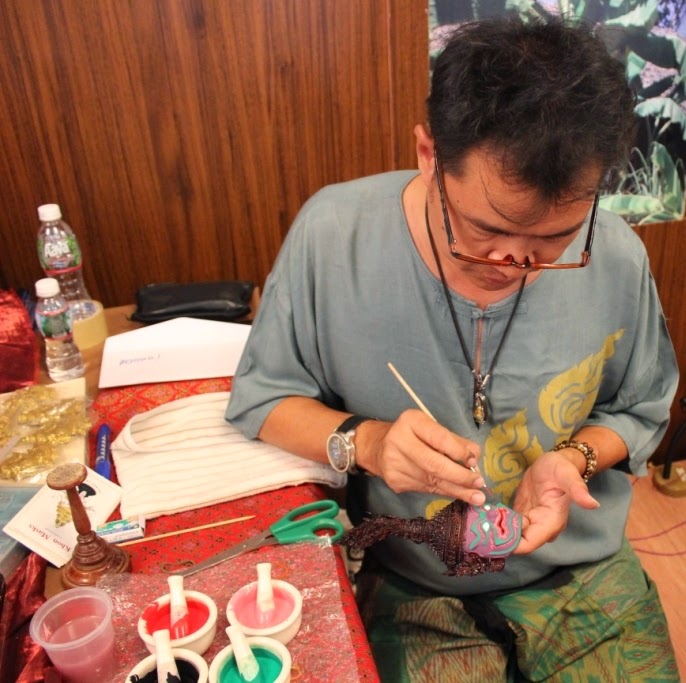
Along with the floating market on the sides were attractions like the fruit carving, mask painting, Thai massage etc. 

Mask Painting

Also we were entertained with various forms of Thai dances. 

Thai Dance

There was also a demonstration of Muay Thai, a form of combat sport, which is a popular Thai sport. Incidentally the Indian boxing legend Mary Kom has been made a Thai Ambassador for Muay Thai this year.

Muay Thai is a popular combat sport in Thailand

Also Read:
Damnoen Saduak Floating Market in Thailand
Tourism in Thailand: Lessons for India
Meeting the Legend - Mary Kom

Saturday, 8 November 2014

Loi Krathong Thai Festival in Delhi

Second year in succession I got the opportunity to attend the Loi Krathong Festival held in Delhi as I got an invite from the Tourism Authority of Thailand (TAT) to attend the festival this year as well. 

Traditional Thai Dance

This year it was held on the 6th of November as this festival is held on the full moon of the 12th Thai lunar calendar. Last year it was organised at the Dusit Devarana and this year it was held at the Radission Blu Plaza.

Cock-fight Dance

Loi means to float while Krathong means a lotus shaped container made from banana leaves (though being held in Delhi it was an improvised version made of thermocol and other artificial stuff). It is a festival to pay homage to the goddess of water.

Krathongs on display before they were floated

This festival of light of Thailand can be compared to the Indian festival of Diwali in some aspects as both are very important in their respective countries and both are festival of lights though the legend behind them may vary.

Another Thai dance

Of course Loi Krathong that is held in Thailand is of much grander version than the one held in India. The difference is like Diwali being celebrated in Delhi and Diwali being celebrated in Washington!

And yet another Thai dance

The festival started with several Thai dances and then followed by a dancing procession in which the ‘queen’ came on a palanquin carrying the Krathong.

The 'queen' on a palanquin with the Krathong 

 The first Krathong was floated by the Ambassador of Thailand in India and then we all floated Krathongs.

The Ambassador of Thailand in India with the Krathong

The whole atmosphere was Thai as this was followed by Thai food prepared by Thai chefs therefore it was authentic Thai food that was really good. The best was the Duck in Pineapple Sauce.

The floating Krathongs at the Radisson

Overall it was a great evening giving us a glimpse of Thai culture along with the Thai food in the amazingly good Thai hospitality.

Fruit art - Happy Loi Krathong

Also read: Loi Krathong Festival of Thailand held in Dusit Devarana

Monday, 20 October 2014

Wat Pho or the Temple of the Reclining Buddha in Bangkok, Thailand


The Reclining Buddha is a famous pattern across the world of the Buddha during his last days of illness before attaining Nirvana. He is seen resting on a cushion with the right hand supporting his head.

The entry gate to Wat Pho complex

The Wat Pho or the Temple of the Reclining Buddha (official name for me is an unpronounceable Wat Phra Chettuphon Wimon Mangkhlaram Ratchaworamahawihan) temple complex is next to the Temple of the Emerald Buddha in the Grand Palace complex in the capital city of Bangkok in Thailand. The entry ticket of 100 Baht gives you entry not only to the Reclining Buddha but to the whole Wat Pho complex along with a bottle of mineral water.

The Reclining Buddha


Though the Wat Pho complex has about a thousand statues of Buddha but this Reclining Buddha is the Thailand’s largest! The Buddha is 15 metere high and 43 metre long coated in gold.

The Reclining Buddha in Wat Pho

It is difficult to click the Buddha as it is housed in a building so a front shot or one in which the entire Buddha can be captured is difficult unlike the one in Burma which is in the open (and probably the world’s longest at 300 meters).

108 symbols of Buddha on the foot Reclining Buddha

The three metre high and 4.5 metre long foot is inlaid with mother of pearl 108 auspicious symbols of Buddha.

108 Bowls around the Reclining Buddha to drop coins


Likewise there are 108 bronze bowls indicating the 108 characters of Buddha in which the devotes drop coins to bring in good fortune. One can purchase a bowls of coins outside the complex to drop them in these bowls. Shoes are not allowed to be worn inside the complex but the interesting thing is that outside the complex you can take cloth bags in which you keep your shoes and carry them inside the temple (see the bags being carried by people in the above photo). This is the first time I saw this practice as in all other Buddhist and Hindu temples they would ask you to keep the shoes outside only.

The golden curls of the Buddha


The back side of the Buddha statue is also interesting where one can clearly see rectangular pillows on which Buddha’s curly haired head is resting.

But do not just walk out after seeing the Reclining Buddha as the other halls and monastery inside the Wat Pho complex is equally stunning. It also has the Thailand’s earliest Massage Schools

Also read:
Tourism in Thailand: Lessons for India
Phra Nakhon Khiri Palace
Damnoen Saduak Floating Market in Thailand
Would you like to have a separate waiting room to yourself?
Phraya Nakhon Cave in the Khao Sam Roi Yot National Park in Thailand
The Royal Monastery of the Emerald Buddha, Bangkok
Skywatch Friday - View of A Halo from the Royal Palace, Bangkok

Monday, 15 September 2014

The Royal Monastery of the Emerald Buddha, Bangkok

Inside the Royal Palace is the most venerated Buddhist site of Thailand - The Royal Monastery of the Emerald Buddha.
The Royal Monastery of the Emerald Buddha, Bangkok

The name itself is a misnomer as the Buddha is not made of emerald but of green jade. The locals call the monastery as Wat Phra Kaew. The story goes that when the Buddha statue was discovered in 1434 in a Stupa in Chiang Rai it was covered in a plaster. When part of the plaster peeled off the monk who saw the green stone underneath thought it was made of emerald and somehow the name of Emerald Buddha stuck. The origin of the statue is believed to be in India.

Pilgrims praying in front of the Royal Monastery, Bangkok 

In front as well as inside pilgrims light candle and joss sticks as well as place flowers and pray. What is interesting is that though it is a monastery no monks stay here and only on royal ceremonies the monks come from outside. This is so as the monastery also serves as a private praying place for the royal family.

Inside the monastery the walls are covered with murals depicting life of the Buddha. Outside walls of the monastery are covered all round with several statues in gold and the walls itself are gold plated.

Decorations on the outer walls of the Wat Phra Kaew Monastery

Despite the fact that the Emerald Buddha is located here since 1778 (for more than 200 years it was in Laos) the monastery looks like new and is well maintained. And despite the fact that there are always lots of tourists thronging the Royal Palace there is no disorder and the crowd management is very good.

The Emerald Buddha with gold costume

The Emerald Buddha sits on a golden throne and the costume of the Buddha is changed thrice a year as per the season by the King in a ceremony though I am told that now as the King is quite old this ceremony is performed by his son.

Photography inside the temple is not allowed. Also as is true for most temples in Thailand one needs to be properly attired. If you are not then you can buy or take on rent appropriate clothing near the entrance of the Royal Place. The entrance fee of 100 Baht is valid for the whole of the Royal Palace.

Also read:

Phraya Nakhon Cave in the Khao Sam Roi Yot National Park in Thailand

Would you like to have a separate waiting room to yourself?

Tourism in Thailand: Lessons for India

Damnoen Saduak Floating Market in Thailand

Phra Nakhon Khiri Palace

Skywatch Friday - View of A Halo from the Royal Palace, Bangkok

Friday, 12 September 2014

Skywatch Friday - View of A Halo from the Royal Palace, Bangkok

I had gone to see the Royal Palace and the Royal Monastery of the Emerald Buddha in Bangkok and while touring the place I incidentally looked up towards the sky and I saw this perfect round halo around the sun.
A Halo viewed from the Royal Palace, Bangkok

Not only was the halo there but it stayed for quite some time before it vanished. It is difficult to watch towards the blazing sun either with the naked eye or through your the viewfinder but I did manage to click few photos of the halo with the spires and dragons of the Royal palace as well as Royal Monastery.

Halo around the sun from the Royal Palace, Bangkok

A halo is caused by the rays of the Sun passing through the ice crystals in the clouds and is normally visible only at a particular angle. I have always associated the halo around the Sun or the Moon as precursor to bad weather.

The Royal Monastery in Bangkok and the halo in the sky
Maybe some day I would be able to post the pictures of a halo around the moon as well!

This post is part of Skywatch Friday.

Also read:

Phraya Nakhon Cave in the Khao Sam Roi Yot National Park in Thailand

Would you like to have a separate waiting room to yourself?

Tourism in Thailand: Lessons for India

Damnoen Saduak Floating Market in Thailand

Phra Nakhon Khiri Palace

Sunday, 31 August 2014

Phra Nakhon Khiri Palace

On my last day in Hua Hin we left early for Bangkok so that on the way we would be able to see the Phetchaburi's well-known landmark Phra Nakhon Khiri Palace. Phra Nakhon Khiri means celestial city on a hill. The locals though call it Khao Wang.


The tram car that takes you up to the Phra Nakhon Khiri Palace


Once we reached Phetchaburi we got down and took the tickets for the cable car to go up to the hill top where the palace is situated. The Palace is open from 9 AM to 4 PM and the ticket costs 200 Baht. It is a misnomer to call the ride up as a cable car ride as actually instead of a cable the car is on rail tracks and therefore calling it a tram would be more appropriate. One car can approximately carry 20 persons. Again like the experience I had in Damnoen Saduak I saw someone clicking our photographs but this time I knew what it is and gave a big smile to the photographer.

Beware of the monkeys

Even after getting down from the tram car one has to climb a steep step of stairs. Also one should be careful while walking as the place outside is full of monkeys.

A steep climb of stairs to the Phra Nakhon Khiri Palace

This was the first palace built on the mountain range by King Rama IV in 1859. The palace is surrounded by several temples or ‘Wat’ as is called in Thailand like the Wat Mahasamanaram, Wat Phra Kaew, Wat Phra That Chom Phet. The Palace itself is now a museum. Photography inside is not allowed.

Wat Phra Kaew or the Royal Temple

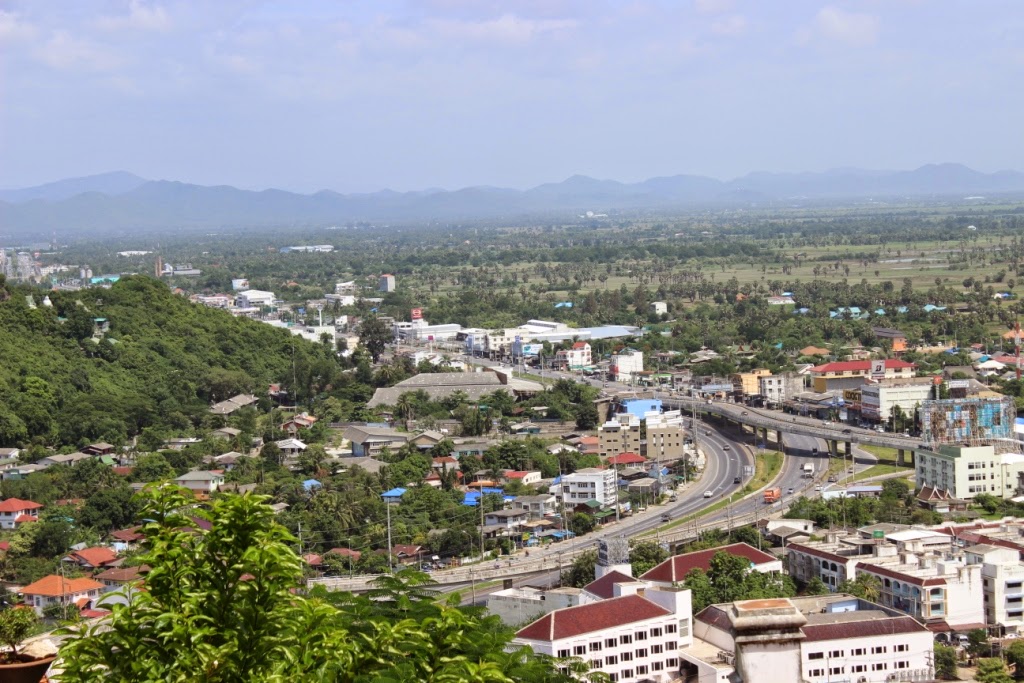
But the view from the Palace as well as from the various Wats is magnificent as it gives a bird’s eye view of the whole of Phetchburi town and the surrounding hills. The palace is located 92 metres above sea level on a hill top.

A Wat at the Phra Nakhon Khiri Palace

Do note the stair railing in the above picture of the Wat which has Buddhist significance. Ladies in shorts etc need to put on sarongs as the palace also has temples. This dress code is uniform across Thailand if one has to enter a temple as some of our companions learnt the hard way!

View of Phetchaburi from the Phra Nakhon Khiri Palace

The Palace itself has a European and Chinese architectural mix. It is mainly wooden with narrow staircases. It also probably had the first European style bath tubs in Thailand that were imported for the king.

Another view of Phetchaburi from the Phra Nakhon Khiri Palace

Phetchaburi is about 130 km from Bangkok and 70 km from Hua Hin. This trip was on invitation from the Tourism Authority of Thailand and Thai Air.

Also read:

Phraya Nakhon Cave in the Khao Sam Roi Yot National Park in Thailand

Would you like to have a separate waiting room to yourself?

Tourism in Thailand: Lessons for India

Damnoen Saduak Floating Market in Thailand

Sunday, 24 August 2014

Damnoen Saduak Floating Market in Thailand

While travelling from Bangkok to Hua Hin we detoured a bit to the Damnoen Saduak Floating Market in Thailand. It is about 100 km from Bangkok in the District Ratchaburi.

Long tail boats on the Damnoen Saduak Canal

We started early from Bangkok as our friendly guide Joey did tell us the market remains open only in the morning. We got off the bus at a point where we got into long tailed motor boats which took us along the Damnoen Saduak canal (same name as the market) with views of the local villages, upraised boats (when not being used) and houses on stilts and even a giant statue of Buddha.

A statue of Buddha along the Damnoen Saduak waterway

The motor boat ride lasted for about 15-20 minutes. One should be careful not to stick any of their body parts outside the boat as at turns the boat almost touches the cemented sides and one good get hurt if not careful.

Villages enroute to the floating market in Ratchburi District

The canal serves both the purpose of providing transportation to the locals as well as irrigation water to the farmers. At the market the canal is packed with colourful wooden boats selling mainly fruits, vegetables, hats etc to the people on the land. Of course there was some buying and selling from boat to boat (mainly to the tourists). Some parts of the market are relatively quiet but the main area is very loud as one would expect of an Asian market!

A boat carrying fruits at the Damnoen Saduak flating market

I have seen floating market in India as well on the Dal Lake in Srinagar in the state of Jammu & Kashmir. But the one I saw in Damnoen Saduak was more colourful and boisterous.

Coconut pancakes being made & sold on the boat in the floating market

The Damnoen Saduak Floating Market is considered to be the original floating market catering to the locals though there are now other floating markets that have come up. Now some of these floating markets are mainly catering to the tourists.

The quieter side of the Damnoen Saduak Flaring Market 

Surprising thing was that several of the merchandise was being sold by boat-ladies in their colourful attire and the big hats. The fixed market on the land selling wares were actually expensive compared to Bangkok though I am told one can negotiate the prices upto 40% or so though I still did not buy anything from this place.

Damnoen Saduak Floating Market in Thailand

Another unique thing here is that when you are getting into the boat someone takes your picture (I did not even realise it at that time) and when you finish the market tour at one of the shops they are selling souvenir plates with your photo on it and you are completely taken by surprise as to how did this happen. The price of this souvenir varies from 200 to 400 Baht.

Damnoen Saduak Floating Market in Thailand

Note: This trip was on invitation from the Tourism Authority of Thailand and Thai Air. I am thankful to them for their wonderful hospitality and the amazing experience that they provided.

Also read:
Phraya Nakhon Cave in the Khao Sam Roi Yot National Park in Thailand

Would you like to have a separate waiting room to yourself?

Tourism in Thailand: Lessons for India