Friday, 11 March 2016

Kila Raipur Rural Olympics – the unusual sporting events

In the earlier post I wrote about the sporting events at Kila Raipur Rural Olympics.
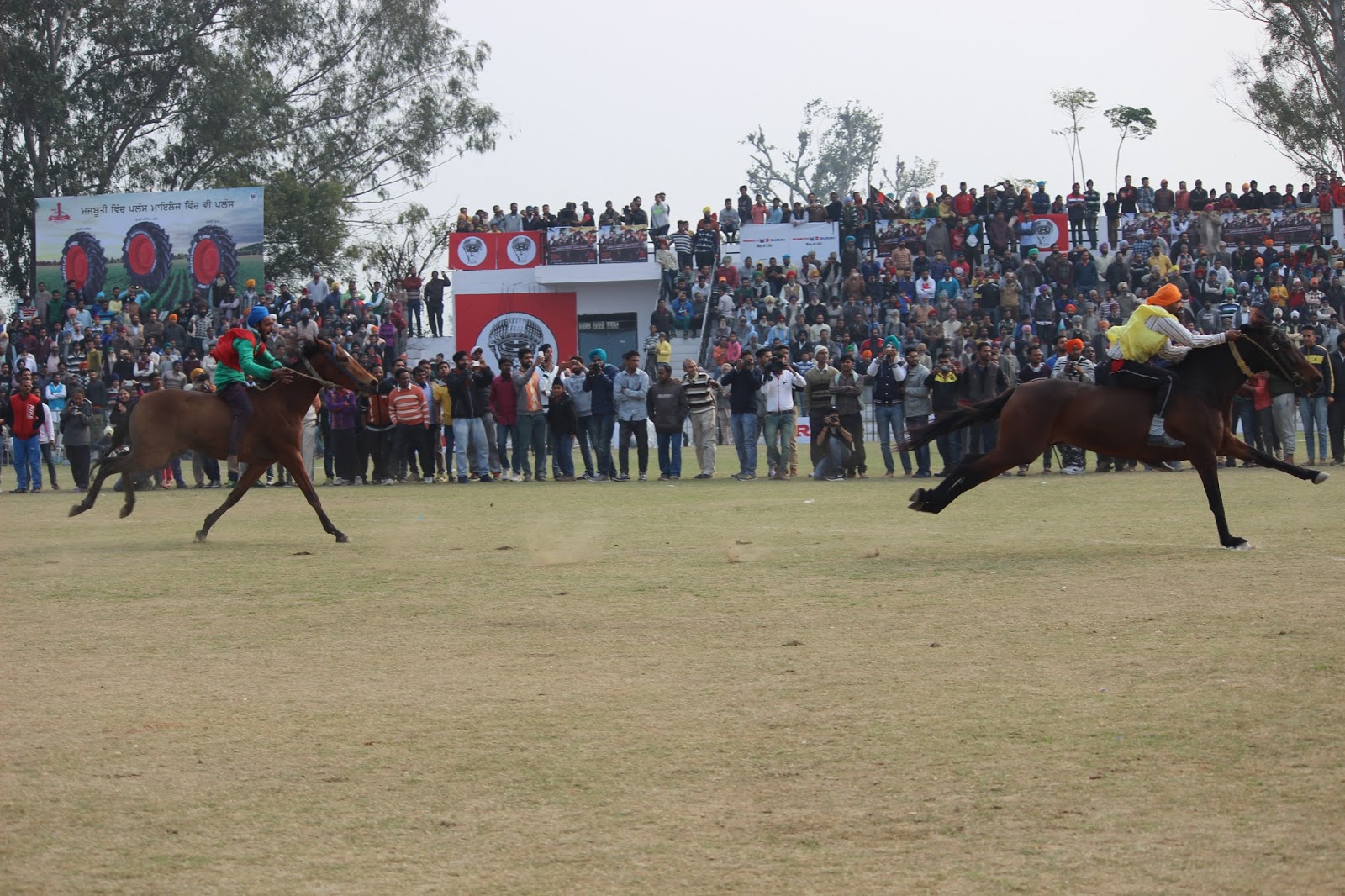
Kila Raipur Rural Olympics - Horse racing

Other unusual sports event I saw was the tractor race. After all in the Punjab rural area how can you have any event, sporting or otherwise, without a tractor!

Kila Raipur Rural Olympics - Tractor race

Then there was a tractor tyre race. Some of you may have done a cycle tyre race in your childhood but imagine doing it with the huge tractor tyres!

Kila Raipur Rural Olympics - Horse Cart Race

Another one was the horse cart race. Also there was a horse race as well. But all these were more in the form of sprints at the stadium itself. I think to make it more interesting the cart and the horse races could be made long distance races.

Kila Raipur Rural Olympics - Nihang rides two horses

Then I saw a Nihang who rode (standing with each foot on a horse) on two horses and galloped at a great speed. What has been popular here at the Kila Raipur Rural Olympics events over the years has been the race of the bulls but I believe due to the intervention of an NGO and on the orders of the court this sporting event was not allowed to be held this year. There was a huge protest against this on the last day of the event when I saw several hundred people march with the bulls and raised slogans against the NGO and the court order. By that logic all races involving any animals (and not only bulls) should be banned whereas horse race and horse cart races were held. Do only bulls qualify for the animal rights protection and not any other animal?

Kila Raipur Rural Olympics - Muscle power

There was a competition between two teams on unloading and reloading a tractor trolley full of sacks weighing a quintal each in the fastest time. And how could the competitions be complete without the Tug-of-War. The funny part of one of these was that the rope itself broke in two and both the sides’ participants fell on the ground.

Kila Raipur Rural Olympics - Tug-of-war

Other unusual sporting events that I saw were guys pulling a bike, car etc by their teeth.

Kila Raipur Rural Olympics - Man lifts a sack by his teeth

Another one lifted a bag full of vegetable by his teeth. Then there was a guy who stopped two bikes to move in opposing directions by the bicep muscle power. 

Kila Raipur Rural Olympics - Muscle power

There was a man in a sitting position on whom a six quintal load was put.

Kila Raipur Rural Olympics - 6 quintals on the man

There was a show of stunts on the Royal Enfield’s by several men and one woman.

Kila Raipur Rural Olympics - Bike stunts

The games meant competition but also fun and frolic and the stadium was full and surprisingly there were lot of female spectators as well. 

Kila Raipur Rural Olympics - Women spectators

I saw only one race which was for the girls else all others were for the men. But then I attended the event only on the last day. Maybe some events for the females happened on the earlier two days. 

I would attend the full event next year!

Also read: Kila Raipur Rural Olympics

Friday, 19 February 2016

Kila Raipur Rural Olympics

You may have watched or participated in various sports events be it at the School, State, regional, National or International level in the recognised and popular sports.

Kila Raipur Sports Festival 2016

But have you have watched sports with a local rural flavour to it. Yes I recently happened to attend one sports festival at Grewal Stadium at Kila Raipur which over the years has now become very popular and has been termed as the Rural Olympics. Kila Raipur is a small village about 20 km from Ludhiana. The Sports Festival is held every year as a four day event.

The 800 meter race for women at Kila Raipur Rural Olympics

Some of the sports events are the same as the ones popular elsewhere like to 100 to 800 meter races etc. A keenly participated event was the 100 meter track race for the persons above the age of 70!


The 70+ race was a keenly contested & watched event at Kila Raipur

I could not believe when I saw these 70+ years young sprint with so much zeal and stamina. It does remind one of Fauza Singh who even at 104 years still participates in marathons.

The cycle race at the Kila Raipur Rural Olympics

There was a cycling race also though not in a velodrome but on the athletic tracks itself.

This man got the loudest cheers from the crowd

Though most had racing cycles and proper athletic gear and dress the loudest cheer was for the local guy who had the ordinary cycle (which used to be a norm for commuting in India for School kids and still does for lot many workers) and normal day wear clothes. Infact several people announced cash rewards for this person!


The tricycle race at Kila Raipur Sports Festival

Then there were also tricycle races for the physically handicapped.

Kabaddi rural style at the Kila Raipur Rural Olympics

Another event which is also an international sport originating from India is Kabaddi. But the Kabaddi that you observe in the events and the Kabaddi played at Kila Raipur varied a lot. First of all the size of the Kabaddi ground was huge (at least half the size of a football field in a circle). Watch this video for the game and the size of the field.

A short video of rural Kabaddi at Kila Raipur Rural Olympics

Secondly, there are four players to a team but once a player touches the player of the opposing side then it remains a fight between only two contestants as a one to one duel and not a fight of four against one. And all the players were bare-chested and one could see the ripping muscles at work!

I would be writing another post on the unusual sporting events at the Rural Olympics of Kila Raipur.

Sunday, 10 January 2016

Sanghol Archaeological Museum – a gem among museums

Normally one would associate museums with capitals or big cities. But the Sanghol Archaeological Museum is different in the sense that it is located at the site where the Harappan, Buddhist and Kushan period artefacts have been unearthed. 

Sanghol Archaeological Museum Building 

Located in Ucha Pind Sanghol the place has been inhabited from Late Harappan to Medieval to the current days. In fact during Kushan period of 1st to 3rd century AD this place was an important town and was on a trade route. The museums displays antiquities, sculptures, coins, household materials found in the excavation here.

Buddha Statue outside the Sanghol Museum

Two Buddhist Stupa sites here revealed the largest collection of sculptures belonging to the Mathura School of Art found outside Mathura. And these sandstone sculptures on pillars, railings, coping stones and crossbars are the pride of the museum. There were 118 pillars that were unearthed from the Sanghol site and about 60 of them are displayed in the museum and I must say they are in excellent condition.

Salabhanjikas on the railing pillars at the Sanghol Museum

There is a section on Salabhanjika which is an art motif of the Kushan period. It means the lady breaking the branches of the Sal tree.

Pillars depcting Gandharva and Salbhanjikas

There is a section of pillars where women are drinking wine. It tells us about the culture during that period when women use to openly partake liquor whereas in today’s world (Indian) it is considered as a bad habit even among men!

A woman dancing and balancing a pot on her elbow

There is a Toilette section where the pillars depict different aspects of beautiful young maiden’s toilet in a number of railing pillars – be it looking at themselves in the mirror or making braids of their long hair or a woman squeezing out water from her hair after bath. It goes on to prove that taking care of their beauty is an old art among women!

A Mother playing with her child

The round shape museum has only two floors. The first floor has seals and Late Harapppan pottery belonging to 2000 BC to 1200 BC, stone and terracotta objects as well as jewellery unearthed from the place.

A Jataka tale motif

There is a nominal entry fee of Rs 10 for adults and Rs 4 for children below 12 years of age and the Museum remain open on all days except Mondays from 10 to 4. Photography inside the museum is not allowed. If one wants then a special permission and payment of Rs 1100 have to be made at their office in Chandigarh. One can reach Sanghol from both Chandigarh (40 Km) and Ludhiana (55 Km) as it is located on the Chandigarh-Ludhiana highway. 

It is a must-visit museum for those who are interested in art and history and on top of that a history that dates back to Harappan civilization!

Also read: 
Buddhist Vestiges of Sanghol, Punjab
Punjabi Folk Music

Thursday, 31 December 2015

Punjabi Folk Music

First of all let me wish all the readers of my blog a happy, successful and peaceful 2016.

I was recently visiting a site of Buddhist Stupa remains which are 2100 years old and where at the same site carved statues and pillars and coins of Kushan period of 1 to 3 CE have been recovered. The site also revealed several artefacts of the Late Harappan period.

But today's' post is not about the site but the person I met there and who rendered Punjabi Folk music in his rustic voice.

Teja Singh on Tumba at Sanghol

Teja Singh, an employee of ASI is also a prolific Punjabi Folk singer. Here he sings in the majestic setting of Buddhist and Harappan ancient site of Sanghol in Punjab, India. The musical instrument that he is playing is called Tumba or Tumbi.

Teja Singh on Tumba

He is singing the folk song on the Punjabi legend Puran Bhagat.

Also read:
Buddhist Vestiges of Sanghol, Punjab

Friday, 18 December 2015

Buddhist Vestiges of Sanghol, Punjab

One would not associate Buddhism with Punjab in the current era. But you would be surprised (at least I was) that Buddhism was thriving in Punjab 2100 years ago.

Buddhist Stupa site at Sanghol, Punjab

This is corroborated by the fact that recently (in comparative terms) Stupa and monasteries were unearthed in Sanghol on the Chandigarh-Ludhiana highway. (Stupa contains relics of a Buddhist teacher.) Sanghol is also called Ucha Pind (high village) as it is situated on a mound. Seven sites in the village were excavated by the Archaeological Survey of India (ASI) from1968 to 1990. Two of these are significantly important which I visited and are called SGL5 and SGL11.

View from the entrance of SGL5 Buddhist Stupa site at Sanghol

The larger site contains the bigger Stupa having three concentric circles with spoke-like radial walls raised on a square platform. It has a diameter of 16 meters on a 17 meter square platform.

Concentric circles placed on a square platform, Sanghol Buddhist Stupa site

The smaller site also has a Stupa but much smaller in size. Both the sites also have Vihara (residences for the monks). What has been excavated is only the base which was mainly below the ground as the super structure was completely destroyed (by man or nature over time). Maybe the ASI should reconstruct at one of the sites to give a feel of the place as it was at that time.

The smaller Stupa at SGL11 Buddhist Stupa site, Sanghol

A rich treasure of 69 pillars and 35 cross bars have been unearthed from Sanghol containing figures of Yakshis and Salabhanjikas (art motifs of the Kushan period). Also found on the site were seals and pottery of the Late Harappan period. These are no longer on the site and have been placed in the Archaeological Museum at Sanghol. As both the sites are out in the open a security fencing around both the places have been put up to prevent encroachment.

The squarish ones were the living quarters of the monks, Buddhist Stupa site SGL11, Sanghol

Teja Singh, an employee of the ASI was kind enough to show me the first site and explain about the place. Not only that - he has a hidden talent of Punjabi folk music – and he enthralled me with the rendition of few folk songs with the accompaniment of Tumba.

Teja Singh with his Tumba
The Tourism Department of Punjab should give more publicity to such a great heritage site.

Friday, 30 October 2015

Foot-tapping Fusion Drums Music from Ghana, Africa

I recently had the opportunity to attend the Indo Africa Cultural Confluence which has coincided with the Indo-African Summit currently being held in Delhi. 

Fusion Drums music performance from Ghana

The event was organised by the Delhi International Arts Festival at Nehru Park in Delhi. There were performances of whirling dervish of Egypt, dance & music of Ethiopia & fusion drums of Ghana. Besides this the Indian band Delhi Inde Project also known as Dilli Wala Band also rendered some rock Sufi music.

The drum performances by the Ghana team was superb. Listen and see the small video of their performance here-

A short video of Fusion Drums music from Ghana

More such performances should be held so that we can listen and see the music and culture of the world.

Also read:
Sufiana Music by Bandanawazi Qawwals
European Day of Languages - Enthralling Performance
Wise Guys and the Maharaj Trio for the Butterflies

Tuesday, 27 October 2015

Places to visit in Mumbai: Elephanta Caves - a World Heritage Site

Elephanta Caves, located on the Elephanta Island can be reached by a ferry from the Gateway of India, Bombay. It is a UNESCO World Heritage Site. 

Trimurti, Elephanta Caves

Distance from Bombay: 10 km
Duration of Ferry: one hour, first ferry at 9 a.m.
Price: Rs 160 to-and-fro (as of October 2015)
Monday closed
Ticket: Rs 10 for the village and Rs 10 for the caves. Foreigners have to pay Rs 250.

Elephanta hills and the Arabian Sea

Then there is a toy train for a km or less and then a steep ascent of about 120 steps. October is not the best month for this excursion. You need stamina and lots of water intake. Those with knee problems should stay away. There are lots of shops selling all kinds of stuff but the most sought ones are food stalls selling raw mangoes, starfruit (amrack) and lemon water. Many of them are run by women.

The entrance to the Elephanta cave 1

These rock-cut temple caves dated between 5 and 7 Century CE comprise of five Hindu caves dedicated to Lord Shiva and two Buddhist caves at a distance of about 2 km. 

Grand pillars at Elephanta cave 1

The latter are closed to public and amongst the five Hindu caves only the first cave is worth the trouble. The other caves are almost empty except for the presence of a shivling. In that sense there is a slight sense of disappointment. 

Gangadhara Shiva & Parvati

However Cave 1 is a magnificent structure. It is a grand cave with huge pillars and huge sculptures, many of them fragments. The fragments speak for the glorious art in ancient India. Most of the panels depict Lord Shiva and Parvati. Then there is a huge Trimurti (first photo in this post) sculpture depicting the three faces of Shiva: the creator, the preserver and the destroyer. It is said that the Portuguese colonisers destroyed many of these grand narratives, including the elephant structure that gave the island its name.

Shiva as Yogisvara

Visitors who came 10-15 years ago say the caves were dirty and stinking. The last time I visited the caves was in 1985 of which I have only some hazy memories. But now that they are managed by Archaeological Survey of India (ASI), they are clean and there are guards to prevent vandalising. There are toilet facilities. Monkeys are however a nuisance.

Also read:
Karla Buddhist Caves near Pune
Places to visit in Mumbai: The Haji Ali Dargah