Showing posts with label Museum. Show all posts

Sunday, 10 January 2016

Sanghol Archaeological Museum – a gem among museums

Normally one would associate museums with capitals or big cities. But the Sanghol Archaeological Museum is different in the sense that it is located at the site where the Harappan, Buddhist and Kushan period artefacts have been unearthed. 

Sanghol Archaeological Museum Building 

Located in Ucha Pind Sanghol the place has been inhabited from Late Harappan to Medieval to the current days. In fact during Kushan period of 1st to 3rd century AD this place was an important town and was on a trade route. The museums displays antiquities, sculptures, coins, household materials found in the excavation here.

Buddha Statue outside the Sanghol Museum

Two Buddhist Stupa sites here revealed the largest collection of sculptures belonging to the Mathura School of Art found outside Mathura. And these sandstone sculptures on pillars, railings, coping stones and crossbars are the pride of the museum. There were 118 pillars that were unearthed from the Sanghol site and about 60 of them are displayed in the museum and I must say they are in excellent condition.

Salabhanjikas on the railing pillars at the Sanghol Museum

There is a section on Salabhanjika which is an art motif of the Kushan period. It means the lady breaking the branches of the Sal tree.

Pillars depcting Gandharva and Salbhanjikas

There is a section of pillars where women are drinking wine. It tells us about the culture during that period when women use to openly partake liquor whereas in today’s world (Indian) it is considered as a bad habit even among men!

A woman dancing and balancing a pot on her elbow

There is a Toilette section where the pillars depict different aspects of beautiful young maiden’s toilet in a number of railing pillars – be it looking at themselves in the mirror or making braids of their long hair or a woman squeezing out water from her hair after bath. It goes on to prove that taking care of their beauty is an old art among women!

A Mother playing with her child

The round shape museum has only two floors. The first floor has seals and Late Harapppan pottery belonging to 2000 BC to 1200 BC, stone and terracotta objects as well as jewellery unearthed from the place.

A Jataka tale motif

There is a nominal entry fee of Rs 10 for adults and Rs 4 for children below 12 years of age and the Museum remain open on all days except Mondays from 10 to 4. Photography inside the museum is not allowed. If one wants then a special permission and payment of Rs 1100 have to be made at their office in Chandigarh. One can reach Sanghol from both Chandigarh (40 Km) and Ludhiana (55 Km) as it is located on the Chandigarh-Ludhiana highway. 

It is a must-visit museum for those who are interested in art and history and on top of that a history that dates back to Harappan civilization!

Also read: 
Buddhist Vestiges of Sanghol, Punjab
Punjabi Folk Music

Sunday, 19 July 2015

Places to visit in Delhi: Mirza Ghalib ki Haveli

I have been to the Chandni Chowk area in Old Delhi a few times over the years but this is the first opportunity I had to visit Mirza Ghalib ki Haveli in Ballimaran. Unfortunately very few Delhites are aware of Ghalib ki Haveli. Or they don’t care. The indifference to the cultural past is amazing. 

The arched entrance to Mirza Ghalib's Haveli

Mirza Ghalib is arguably the best known poet in Urdu and Persian that Delhi (and arguably again India) has produced. I was part of a photo-walk in the lanes of Chandni Chowk. Mirza Ghalib lived in this Haveli (though Haveli normally is supposed to be a grand structure this place is not big). Before Delhi government took over, the house was in poor condition and it was actually being used as a coal dump. 

The bust of Mirza Ghalib along with his poems

Now the place has been finally converted into a museum. The locals in Ballimaran are proud of their heritage. Ask anyone there the way to ‘Ghalib ki Haveli’ and their eyes light up in pride. “Ghalib Mia ko hamara aadab kahie ga!” (please greet Ghalib on our behalf) said a shopkeeper to us in chaste Urdu when we asked for directions.

The roof is not part of the original Haveli

The museum displays some of the poet’s handwritten poems, portraits and also a bust of Mirza Ghalib. He stayed in the Haveli from 1860 till his death in 1869. The Haveli has been aesthetically renovated even if it is surrounded by commercial enterprises on all sides. Old tiles are clearly visible. It is not the complete haveli but only a part of it. One must remember that India is not Europe. It does not have a tradition of converting houses of great poets and writers into museums. We spend a lot of tax-payers money and precious space in the capital of India on building and maintaining ugly samadhis (memorial) of politicians. This structure is an exception to the rule and we should be grateful that it exists at all. The house has undeniably the aura of the medieval period. You get goose pimples standing in the Haveli where the great poet of the melancholy once walked. 

The walls are adorned with Ghalib's writings & in one room it seems like he is writing his poems

Several of his poems have been further immortalised by the Bollywood as film songs. Couple of his poems that I remember are-
Hazaroon Khawhishen aisi ki har khawhish pe dum nikle
Bahut nikley mere armaan, lekin phir bhi kam nikle...

And another one-
Yeh na thi hamaari kismet ke wisaale yaar hota
Agar aur jeete rahte yahin intezaar hota...


With the portrait of Ghalib

How to reach: Mirza Ghalib ki Haveli is open on all days except Mondays and public holidays from 11 AM to 6 PM and the entry is free. Located in Gali Kasim Jaan in the Ballimaran area of Old Delhi one can reach it by alighting at the Chandni Chowk Metro Station and either walk (10-15 minutes) or take a rickshaw. Taking the metro is advisable at it frees you from the hassle of parking in this congested area but if you do want to go by car then park it near the Red Fort and then take a rickshaw from there.

Also read:
Places to Visit in Delhi: Humayun Tomb
Places to visit in Delhi: The Isa Khan’s Garden Tomb
Places to visit in Delhi: Ugrasen ki Baoli
The Changing Moods of Hauz Khas Lake

Thursday, 27 February 2014

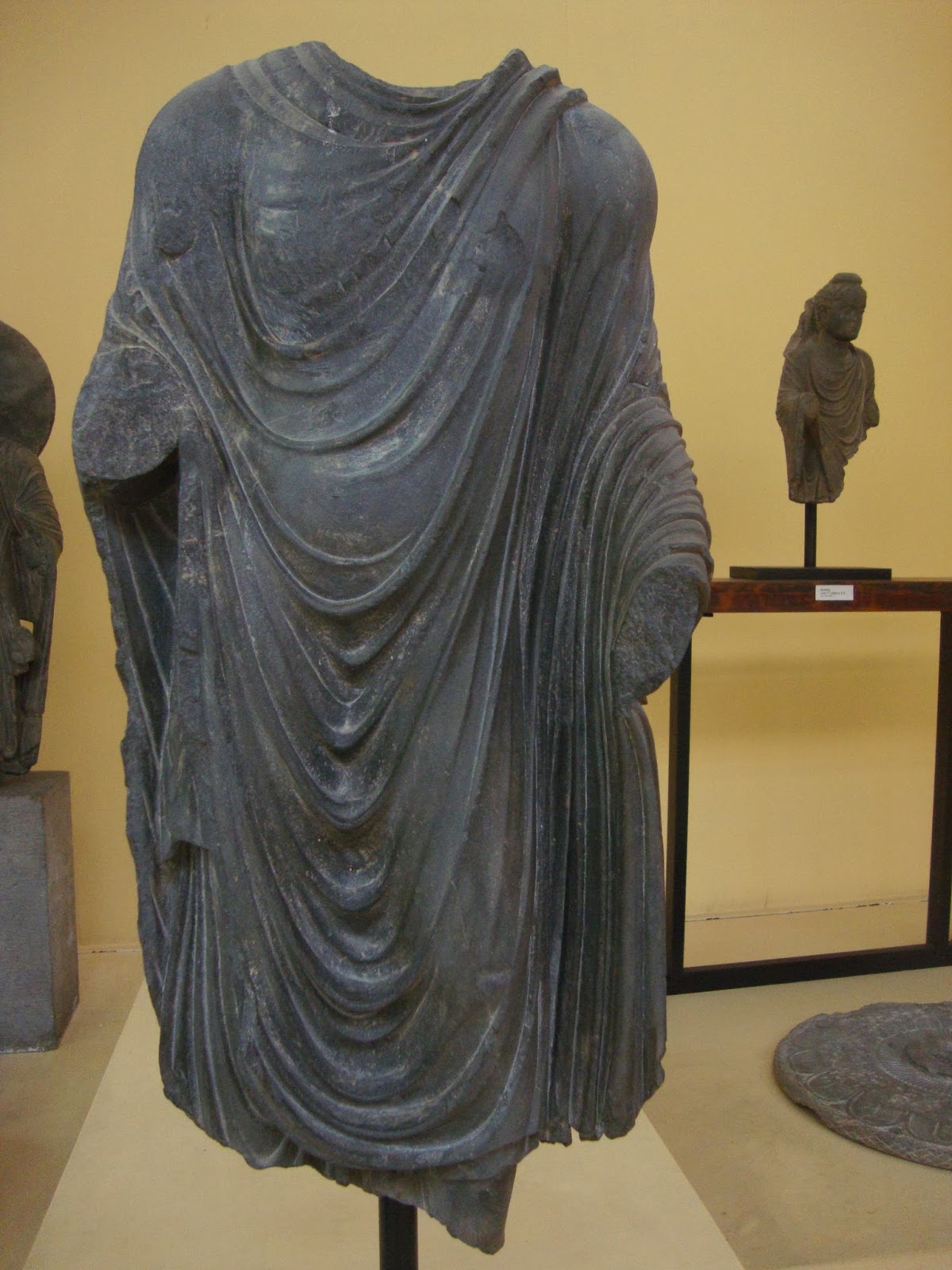
The Gandhara Art in Chandigarh

Have you ever heard people talking about anything else about Chandigarh besides the Rock Garden, Sukhna Lake and Rose Garden?

Buddha, 2 C AD

Well, you will be surprised that Chandigarh can boast of a museum that contains Gandhara Art sculptures. Somehow this fact is never advertised in all the publicity materials. Chandigarh was lucky to have these as originally all these were located at the Central Museum in Lahore but due to partition of India even the artifact of this museum were divided and India got some of the the Gandhara sculptures along with the miniature paintings. The building of Government Museum and Art Gallery of Chandigarh has been designed by Le Corbusier (yes the very same person who designed Chandigarh). The same campus also host two other museums- The Chandigarh Architecture Museum and the Natural History Museum.

Bodhisattva, 2 C AD

The Gandhara Art is a mix of Greco-Buddhist art and the origin of this is that when Alexander died his generals setup several kingdoms and around 1 AD several foreigners who came to Gandhara region (from Kabul to Rawalpindi) converted to Buddhism and therefore the art that developed is a mix of Greco-Roman and Indian art. Another interesting thing is that the first statue of Buddha was made only after a lapse of 500 years or so after his death and therefore no one knew how he looked and all statues are imaginations. Infact the early Buddha statues showed him with the mustaches which disappeared in the later ones.

Padmavati, the Jain Goddess, 12 C AD

Several statues (not Gandhara) have been placed artistically outside the building itself increasing the ambiance of the place.

Chandigarh is also known for being the only planned city with wide roads and no congestion on the streets.

So next time when you are heading to Chandigarh do check out this place.

Saturday, 12 January 2013

Sambhar Salt

The Sambhar Lake is the largest inland salt lake and produces nearly nine percent of India's total salt. Salt here is produced by the evaporation process of brine.

I had stayed in the Circuit House of the Sambhar Salts Ltd. (SSL) which is a joint venture of the Hindustan Salts Ltd. and the State Government of Rajasthan.

Salt Museum 

Just in front of the Circuit House is an ancient structure which is the Salt Museum. The building though stays closed and one can only observe the model of the Salt Lake and the salt works which is out in the open.

View of the dawn

You get a wonderful view of the dawn from the Circuit House with the Salt Museum building providing an excellent outline against the backdrop of the golden dawn.

Snowfall in Rajasthan?

If you look at the photo above it gives the impression of snow lying on the earth (that also in Rajasthan?). This is salt that gives the impression of snow.

Salt Fields

Around the huge lake one can see the color of the earth in stretches is white indicating salt content.

Salt Evaporation Pond

The lake is divided into two main parts by five km long dam. Once the salt water reaches certain concentration it is released and stored on evaporation ponds and salt pans. Some ponds have red color of water due to the presence of algae.

Salt Pans

Once the water dries the layers of salt is scrapped and collected as mounds of salt. From here it is again manually collected and put in the rail wagons. The Salt Works area is crisscrossed by railway network  - a narrow gauge - which was built by the Britishers in the 19th century to carry the salt to other destinations.

Salt Train

The rail wagons that you see in the photo above are made of wood not only because they are old wagons but they also serve another purpose i.e. since it is salt that they carry if they are made of iron they will rust away very quickly! Though the chassis is of course made of metal.

Salt being collected

I asked the workers how much they are paid for the work and I was astonished to find that they get paid a miserly Rs 300 for filling one wagon which after a whole days work one family (they operate in this manner here) is barely able to fill. One wagon can take upto six metric tons of salt.

Salt Hill

Salt around the lake gives employment of lot many persons. It is stored in huge mounds before it is sent to the factories for further processing.

As stated in my earlier post on Sambhar Lake the area is a key wintering site for several migratory birds like flamingos and waterfowls, among others, and is a designated Ramsar site.

The tourism infrastructure though is severely lacking in this area but I was pleased to read a Times of India (TOI) report that the Hindustan Salts Ltd. and the India Tourism Development Corporation (ITDC) have signed an MOU to create tourism infrastructure in the Sambhar area.

Also read Sambhar Lake if you are in interested in bird watching.