Friday, 30 October 2015

Foot-tapping Fusion Drums Music from Ghana, Africa

I recently had the opportunity to attend the Indo Africa Cultural Confluence which has coincided with the Indo-African Summit currently being held in Delhi. 

Fusion Drums music performance from Ghana

The event was organised by the Delhi International Arts Festival at Nehru Park in Delhi. There were performances of whirling dervish of Egypt, dance & music of Ethiopia & fusion drums of Ghana. Besides this the Indian band Delhi Inde Project also known as Dilli Wala Band also rendered some rock Sufi music.

The drum performances by the Ghana team was superb. Listen and see the small video of their performance here-

A short video of Fusion Drums music from Ghana

More such performances should be held so that we can listen and see the music and culture of the world.

Also read:
Sufiana Music by Bandanawazi Qawwals
European Day of Languages - Enthralling Performance
Wise Guys and the Maharaj Trio for the Butterflies

Tuesday, 27 October 2015

Places to visit in Mumbai: Elephanta Caves - a World Heritage Site

Elephanta Caves, located on the Elephanta Island can be reached by a ferry from the Gateway of India, Bombay. It is a UNESCO World Heritage Site. 

Trimurti, Elephanta Caves

Distance from Bombay: 10 km
Duration of Ferry: one hour, first ferry at 9 a.m.
Price: Rs 160 to-and-fro (as of October 2015)
Monday closed
Ticket: Rs 10 for the village and Rs 10 for the caves. Foreigners have to pay Rs 250.

Elephanta hills and the Arabian Sea

Then there is a toy train for a km or less and then a steep ascent of about 120 steps. October is not the best month for this excursion. You need stamina and lots of water intake. Those with knee problems should stay away. There are lots of shops selling all kinds of stuff but the most sought ones are food stalls selling raw mangoes, starfruit (amrack) and lemon water. Many of them are run by women.

The entrance to the Elephanta cave 1

These rock-cut temple caves dated between 5 and 7 Century CE comprise of five Hindu caves dedicated to Lord Shiva and two Buddhist caves at a distance of about 2 km. 

Grand pillars at Elephanta cave 1

The latter are closed to public and amongst the five Hindu caves only the first cave is worth the trouble. The other caves are almost empty except for the presence of a shivling. In that sense there is a slight sense of disappointment. 

Gangadhara Shiva & Parvati

However Cave 1 is a magnificent structure. It is a grand cave with huge pillars and huge sculptures, many of them fragments. The fragments speak for the glorious art in ancient India. Most of the panels depict Lord Shiva and Parvati. Then there is a huge Trimurti (first photo in this post) sculpture depicting the three faces of Shiva: the creator, the preserver and the destroyer. It is said that the Portuguese colonisers destroyed many of these grand narratives, including the elephant structure that gave the island its name.

Shiva as Yogisvara

Visitors who came 10-15 years ago say the caves were dirty and stinking. The last time I visited the caves was in 1985 of which I have only some hazy memories. But now that they are managed by Archaeological Survey of India (ASI), they are clean and there are guards to prevent vandalising. There are toilet facilities. Monkeys are however a nuisance.

Also read:
Karla Buddhist Caves near Pune
Places to visit in Mumbai: The Haji Ali Dargah

Friday, 23 October 2015

Sufiana Music by Bandanawazi Qawwals

I spent an enjoyable evening listening to the Qawalis & Sufiana Music by Bandanawazi Qawwals from Hyderabad. The event was organised at the Epicentre in Gurgaon as part of the Delhi International Arts Festival 2015.

The Bandanawazi Qawwals rendering Sufi music

One of the living descendants of this famous band of people is Ateeq Hussein Khan Bandanawazi. Born in 1980 in Hyderabad to a family of classical Sufiana qawwals, he belongs to the Rampur Sahaswan Gharana of musicians. Besides learning Qawwali from his father Ustad Iqbal Hussein Khan Bandanawazi from a very early age, he also picked up various forms of classical music like Dhrupad, Khayal, Thumri, Dadra, Tarana and Bhajan.

The evening started with the soulful song Kahe ko Byahi Bidesh – by Amit Khusrau – the best known Sufi poet that Delhi has produced. He lived from 1253 to 1325 CE and was the best known disciple of Hazrat Nizamuddin Auliya of Delhi. Indians may have heard this song umpteen times as it is played at almost all weddings at the time of departure of the bride from her parents house.

They mesmerised the audience with the rendition of Chaap Tilak Sab Cheeni – again by Amir Khusrau

This was followed by Bhar Do Jholi Meri –popularised more recently by the film Bajrangi Bhijaan. Do hear the clipping given below.

Bhar Do Jholi Meri sung by Bandanawazi Qawwals

Last, but not the least, was the ever popular song Dumdum Mast Kalandar. I have heard Runa Laila, Abida Parveen, Nusrat Fateh Ali Khan, Sabri Brothers and others rendition of this song earlier.

Dumdum Mast Kalandar sung by Bandanawazi Qawwals

The evening was supposed to have commenced with of Qawalis & Sufiana Music by Ayaz Nizami Qawwals from Pakistan. But because of the recent happenings in Bombay & Delhi we were deprived of listening to them. At least the Bandanawazi Qawwals did not disappoint! They got a standing ovation by an appreciative audience. The auditorium was full on Dussehra/Durga Puja holiday.

Also read:
Sufi Music by Sabri Brothers
Sufi Dervish Dance

Monday, 28 September 2015

European Day of Languages - Enthralling Performance

I got an invitation to attend the European Day of Languages (EDL) held on 26 September 2015 at the Cyber Hub, Gurgaon. 

Karim Ellaboudi, Matteo Fabroni, Vasundhra, Marcello Allulli & Saurabh Suman at EDL

Initially when I went there I was a bit disappointed as the programme was not well organised and the information on the schedule of events was sketchy. But as the programme progressed we were enthralled by performers from various countries and organisations. The programme was the courtesy of the European Union.

First performance was a Tango performed by the two performers (as they say it takes two to Tango) from the Instituto Cervantes which was very sensual. After their performance they did an impromptu dance lesson for the audience and several couples joined on the stage. Here is a small video of the Tango-

It takes two to Tango

This was followed by a brilliant Opera performance by the Neemrana Music Foundation. All the three girls were superb in their performance. I was surprised that such talent exist in India in the field of Opera singing. Here I am presenting a small video of the one of the performers.

Opera by the Neemrana Music Foundation

There was also Latin music where one of the instruments was Mexican but looked like the long horn like Tibetan instrument. It also sounded like that.

Latin Music at the European Day of Languages

The best performance of the day was the performance by Vasundhra Vidalur. First she sang couple of songs accompanied by Karim Ellaboudi on Piano. Later she was also joined by Marcello Allulli on Saxophone, Matteo Fraboni on drums and Bass by Saurabh Suman. She has an amazing voice and I wonder how come I have not heard her before. Her Jazz and Blues are really enthralling. It is a pity that as the programme was not publicised well and as her performance was at the end several people had left before her performance started. Watch a small video of their performance-

Vasundhra and group performing at the EDL

There should be more such programmes so that we can listen to the languages and see dance and culture of countries across the world.

Also read:
Sufi Music by Sabri Brothers
Wise Guys and the Maharaj Trio for the Butterflies
Sufi Dervish Dance

Saturday, 19 September 2015

My Stay at Palladium Hotel, Mumbai

During a recent trip to Mumbai (Bombay) I stayed at the Palladium Hotel.

The grand lobby of the Palladium Hotel Mumbai

My flight from Delhi was in the morning and I reached the Chattrapati Shivaji Airport around 1130. As the trip was arranged by the Tourism Authority of Thailand I was picked up by them and brought to the Palladium in Lower Parel. The journey took more than an hour as this was a peak traffic time and we were traversing some of the busiest routes of the city. 

Modern-art: lobby of the Palladium Mumbai

The first surprise I got there was that the reception lobby was not on the ground but on the 9th floor. After doing the check-in which was a done by the courteous staff I was given the room key-card which also is used to operate the lifts and one can go only to the lobby, ground floor and to your own floor with the key card. Now majority of the new hotels across the world are using this security feature in the hotels. A slight annoying feature was that one has to change the lift at the ninth floor if your room is above that. As the first event for which I had gone was about to start (in the hotel itself on the 8th floor which is used for conventions) I quickly took a shower as there was no time for a bath despite the very inviting bathtub! 

My room at Palladium Hotel, Mumbai

It was only after the event got over that I was able to observe the amenities in the room. I had a huge double bed with button controlled curtains, ample supply of coffee, tea and water, bowl of fruits and a mini bar stocked with chocolates and drinks etc. 

View at dusk of Worli, Haji Ali, Arabian Sea from rooftop bar of Palladium Hotel

But the best was the views I got from the room as well as when I went to their rooftop bar Asilo. In one sweep you can see all the high rises of Worli, the Mahalaxmi Race course, the Haji Ali Dargah and the Arabian Sea itself!

View of Bombay at night from the Palladium Hotel

What I was really impressed with was their spread of breakfast especially the English breakfast and the black coffee. They also had a spread of Indian breakfast including a whole section of South-Indian section.

Note: From 1st September 2015 the hotel has been renamed as The St. Regis Mumbai.

Also Read:
Places to visit in Mumbai: The Haji Ali Dargah

Saturday, 12 September 2015

Poster-Art and Political Activism in JNU, Delhi

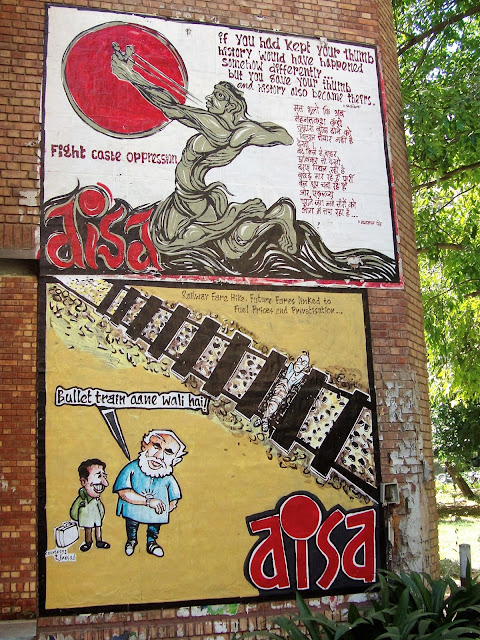
Posters in JNU

Artistic, eye-catching and thought-provoking political posters are an intrinsic part of the culture of Jawaharlal Nehru University. Whether it is Marxism or Gandhiism, Women’s Rights or Dalit Rights, Imperialism or Casteism, the student community in JNU has always been politically active and views are expressed through huge, colourful posters with interesting slogans. “Study and Struggle” is one of the oldest slogans that still reverberates through the hostels, schools and streets of JNU. It epitomises the spirit of studies that are not divorced from society and its problems. The posters make you think, they create awareness and above all, they reflect an intellectual spirit, which should be the aim of any university.

Picasso in JNU!

For obvious reasons, there have been a lot of posters lately on women’s emancipation. Here is one such poster, pasted on the wall of School of Arts and Aesthetics which draws on the famous painting by Pablo Picasso Le Bordel d’ Avignon (The Brothel of Avignon, 1907). It depicts five nude prostitutes in a group, looking not defeated but confrontational, as if they were ready to take on the society. Picasso’s painting caused a scandal in turn-of-the-century Europe and he had to hide it in his studio for more than a decade. The painting is, as I see it, a metaphor for women with courage. JNU has healthy gender relations compared to rest of India. Girl students can roam around in the campus late at night. This is unthinkable in any other university of India.

Anti-establishment posters in JNU

This poster caricatures State sponsored censorship in Indian Cinema. On the left, the poster lampoons the statement of the Chief of the ICHR in praise of the Caste System in India.

Che in JNU!

Che Guevara, the face of Cuban Revolution, now appropriated by T-Shirt grafittis because of his handsome looks, is a favourite with some left-leaning political parties in JNU.

Poster-art at JNU

The poster above criticizes Caste System with the mythical story of the low-caste Eklavya, who gave his thumb to the high caste Guru in the epic Mahabharat. The poster below it makes fun of the contemporary Central Government in India.

I was not politically aligned to any party in JNU during my student days but the posters always ignited a thought process.

Also read:
Travelling through Alma Mater, JNU

Tuesday, 8 September 2015

Patalpuri Gurudwara in Kiratpur Sahib, Punjab


Built on the banks of Sutlej river and the foothills of Shivalik range is the beautiful and historic Gurudwara of Patalpuri in Kiratpur Sahib, a small religious town in the Ropar (or Roopnagar) district of Punjab.

Patalpuri Gurudwara, Kiratpur

Kiratpur was established by the 6th Sikh Guru Hargobind Singh. Another famous Gurudwara nearby is Anandpur Sahib or Keshgarh Sahib, 10 km away (considered as the second most important place for the Sikhs as it is the birthplace of the Khalsa).

The Darbar Sahib at Patalpuri Gurudwara, Kiratpur

The significance of Kiratpur’s Patalpuri Gurudwara lies in the fact that Sikhs come here to immerse the ashes of their loved ones and it is not uncommon for the Sikhs living abroad also to come here to immerse the ashes. Two of the Sikh Gurus – Guru Hargobind and Guru Har Rai have been cremated here.

The Sarovar at the Patalpuri Gurudwara, Kiratpur

The Gurudwara, like most Gurudwaras, is made of white marble and shimmers in the sun. Next to the Darbar Hall there is a Langar Hall. There is a sarovar, a big sacred water pond where the pilgrims can take a holy dip.

Sutlej waters at Patalpuri Gurudwara

The water from the Sutlej main river flows next to the Gurdwara by means of a canal and the water is clean. There is also a footbridge made for persons to go across.

The footbridge over the Sutlej

One problem that people face is that they have to climb 15-20 steps which is problematic for the old and the handicapped. The management should make a ramp.
 
Another view of the Patalpuri Gurudwara

There are no flights to Kiratpur. Nearest point is Chandigarh from where it is about 90 km and one can take either a Punjab Roadways bus or hire a cab. From Delhi it takes about seven hours by car to cover the distance of about 300 km.

As kiratpur is near the foothills of the Himalayas, it can also be made a base for further explorations into the mountains to places like Palampur, Dharamshal, Mandi, Manali and further.

Also Read:
The Unique Gurudwara at Sussaan
Keshgarh Sahib
Virasat-E-Khalsa