Saturday, 12 September 2015

Poster-Art and Political Activism in JNU, Delhi

Posters in JNU

Artistic, eye-catching and thought-provoking political posters are an intrinsic part of the culture of Jawaharlal Nehru University. Whether it is Marxism or Gandhiism, Women’s Rights or Dalit Rights, Imperialism or Casteism, the student community in JNU has always been politically active and views are expressed through huge, colourful posters with interesting slogans. “Study and Struggle” is one of the oldest slogans that still reverberates through the hostels, schools and streets of JNU. It epitomises the spirit of studies that are not divorced from society and its problems. The posters make you think, they create awareness and above all, they reflect an intellectual spirit, which should be the aim of any university.

Picasso in JNU!

For obvious reasons, there have been a lot of posters lately on women’s emancipation. Here is one such poster, pasted on the wall of School of Arts and Aesthetics which draws on the famous painting by Pablo Picasso Le Bordel d’ Avignon (The Brothel of Avignon, 1907). It depicts five nude prostitutes in a group, looking not defeated but confrontational, as if they were ready to take on the society. Picasso’s painting caused a scandal in turn-of-the-century Europe and he had to hide it in his studio for more than a decade. The painting is, as I see it, a metaphor for women with courage. JNU has healthy gender relations compared to rest of India. Girl students can roam around in the campus late at night. This is unthinkable in any other university of India.

Anti-establishment posters in JNU

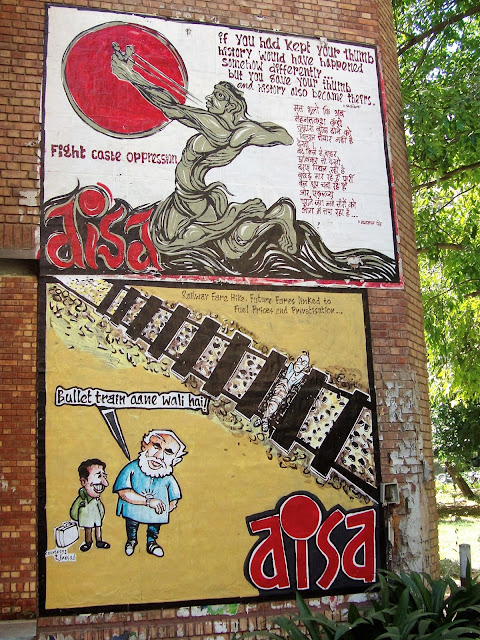
This poster caricatures State sponsored censorship in Indian Cinema. On the left, the poster lampoons the statement of the Chief of the ICHR in praise of the Caste System in India.

Che in JNU!

Che Guevara, the face of Cuban Revolution, now appropriated by T-Shirt grafittis because of his handsome looks, is a favourite with some left-leaning political parties in JNU.
Poster-art at JNU

The poster above criticizes Caste System with the mythical story of the low-caste Eklavya, who gave his thumb to the high caste Guru in the epic Mahabharat. The poster below it makes fun of the contemporary Central Government in India.

I was not politically aligned to any party in JNU during my student days but the posters always ignited a thought process.

Also read:
Travelling through Alma Mater, JNU

Tuesday, 8 September 2015

Patalpuri Gurudwara in Kiratpur Sahib, Punjab


Built on the banks of Sutlej river and the foothills of Shivalik range is the beautiful and historic Gurudwara of Patalpuri in Kiratpur Sahib, a small religious town in the Ropar (or Roopnagar) district of Punjab.

Patalpuri Gurudwara, Kiratpur

Kiratpur was established by the 6th Sikh Guru Hargobind Singh. Another famous Gurudwara nearby is Anandpur Sahib or Keshgarh Sahib, 10 km away (considered as the second most important place for the Sikhs as it is the birthplace of the Khalsa).

The Darbar Sahib at Patalpuri Gurudwara, Kiratpur

The significance of Kiratpur’s Patalpuri Gurudwara lies in the fact that Sikhs come here to immerse the ashes of their loved ones and it is not uncommon for the Sikhs living abroad also to come here to immerse the ashes. Two of the Sikh Gurus – Guru Hargobind and Guru Har Rai have been cremated here.

The Sarovar at the Patalpuri Gurudwara, Kiratpur

The Gurudwara, like most Gurudwaras, is made of white marble and shimmers in the sun. Next to the Darbar Hall there is a Langar Hall. There is a sarovar, a big sacred water pond where the pilgrims can take a holy dip.

Sutlej waters at Patalpuri Gurudwara

The water from the Sutlej main river flows next to the Gurdwara by means of a canal and the water is clean. There is also a footbridge made for persons to go across.

The footbridge over the Sutlej

One problem that people face is that they have to climb 15-20 steps which is problematic for the old and the handicapped. The management should make a ramp.
 
Another view of the Patalpuri Gurudwara

There are no flights to Kiratpur. Nearest point is Chandigarh from where it is about 90 km and one can take either a Punjab Roadways bus or hire a cab. From Delhi it takes about seven hours by car to cover the distance of about 300 km.

As kiratpur is near the foothills of the Himalayas, it can also be made a base for further explorations into the mountains to places like Palampur, Dharamshal, Mandi, Manali and further.

Also Read:
The Unique Gurudwara at Sussaan
Keshgarh Sahib
Virasat-E-Khalsa

Thursday, 3 September 2015

Travelling through Alma Mater, JNU


After several years I got a chance to visit, rather revisit JNU, my alma mater. It is hard for an outsider to think of JNU, a 1000 acre campus, as part of the congested capital city. There are plenty of open spaces, even wild, practically untouched spaces.

The various JNU school buildings in the foreground with Vasant Kunj in the background

The Aravali hill on which JNU is located, is lush green, especially in monsoons. Despite many new university buildings coming up in the past few years, the forest-like impression persists and there is still a lot of undergrowth.

The JNU Library

The green cover and the buildings are integrated together in such a way that they blend into each other.

Purvanchal & Mahanadi hostels in the foreground with Qutub Minar in the background

The aerial shots from the top floor (10th floor) of the university central library show a dense green cover. The Mehrauli area in general and Qutub Minar in particular is clearly visible.

Qutub Minar & Alai Minar seen from JNU

The Alai Minar, the unfinished Qutub Minar like structure which Alauddin Khilji planned to build two times higher than Qutub Minar is also visible.

Adham Khan's tomb in Mehrauli seen from JNU

The Adham Khan’s tomb in the Mehrauli area is also clearly visible from the JNU.

NII, Munirka in the foreground and Lotus Temple in the background as seen from JNU

On a clear day, one can even see the Lotus Temple and Nehru Place which are several km away. If you observe the photo carefully you can see the lotus temple in the far centre. Only when I saw the photo at leisure on the laptop, I realised that the photo captures the temple.

The new manicured look of JNU campus

Fortunately, the nature is allowed to be, although there seem to be attempts here-and-there to give it a manicured lawn look with potted plants and hedges that, in my view, looks out of place with the overall grandeur of undergrowth and huge trees.

The campus is ideal for walking, jogging and cycling. JNU is a paradise for bird-watchers. Peacocks are common. Some JNU residents swear that they have seen owls and snakes. Wolfs and Nilgais (Asian Antelope or Blue Bull) are not exactly uncommon. Caves exploration and rock-climbing is another activity which I indulged in during my student days here.

Parthsarthi Rocks, JNU

And how can I complete this post without mentioning Parthasarathi Rocks (named after the first VC of JNU). It is the highest natural vantage point in JNU and functions as an open auditorium and venue for various late-night parties. One can sit and view the beautiful sunsets from here.

Friday, 28 August 2015

Delicious Food at Ali’s Restaurant in Dehradun

As I wrote in an earlier post on Dehradun, I had some spare time before I catch a train back to Delhi. On Gandhi Road near the Jama Masjid area I noticed several restaurants serving non-vegetarian food. It was still early for dinner, so I marked one of them – Ali’s.

Ali's Non-Vegetarian Restaurant on Gandhi Road, Dehradun

Later on I returned to Ali’s Restaurant. The decor of the place was nice and the place looked hygienic. I did wonder though why there were hardly any families around and it seemed mainly a male bastion. But then I saw some families emerge from the inside. Then I realised that this restaurant, like so many others in smaller towns in India, has a separate seating arrangement for families.

Mutton Seekh Kababs, Rumali Roti & Onion Rings at Ali's

Initially I ordered mutton Seekh Kabab with Rumali Roti. These were accompanied with onion rings and green chutney. I must say that they were one of the best kababs I have eaten in a long time. They were soft and kind of melted in the mouth. Also one must try their Mutton Nihari. The prices of the dishes are reasonable. In fact compared to the prices in the NCR and Delhi they are definitely on the lower side yet superior in quality (as well as quantity!).

The owner at Ali's Restaurant in Dehradun 

I was told that this restaurant is running since 1955. I also observed that they were serving kheer (an Indian sweet dish made of milk, rice and sugar) and I asked the owner that why no sweet dish has been mentioned in the menu. He told me that they have recently introduced this and are yet to come out with a menu. He invited me to try the kheer.

Delicious Kheer at Ali's Restaurant in Dehradun

And how could I refuse as there is always some scope for a dessert! The kheer (chilled) sprinkled with lots of dry fruits was delicious and amongst the best kheers that I have eaten anywhere.

Do check out the place the next time you are in Dehradun.

Also Read:
Skywatch Friday- A short visit to Dehradun

Monday, 24 August 2015

The ASUS #ZenFestival 2015

Recently Asus organised Zen Festival at the Jawaharlal Nehru Stadium in Delhi. I thought it would be a small gathering of media and bloggers but when I reached there I found that more than two thousand persons have been invited for the Indian launch of six of their products!

VJ Cyrus Sahukar at the ZenFestival

The ZenFestival was anchored by the famous VJ Cyrus Sahukar who entertained the audience by his witty comments.

Brilliant performance by flying drummers at the ZenFestival

The programme started with a dazzling performance by flying drummers who were supported by two acrobatic dancers on the stage. In fact the performance was highlight of the event and it was superb.

ASUS Chairman Jonney Shih

ASUS Chairman Jonney Shih announced latest additions to ZenFone & ZenPad families. He announced not one but India launch of six of their new products ZenFone 2 Deluxe, ZenFone Selfie, ZenFone 2 Laser, ZenPad 7.0 and ZenPad 8.0, and worldwide launch of ZenFone Max

Sonakshi Sinha launching Zenfone Selfie

Zenfone Selfie was launched by the famous Bollywood actress Sonakshi Sinha. The photographers from the media went crazy and almost stampeded the stage in order to get the perfect click. The organisers should keep marshals to keep such behaviour in check. The Zenfone Selfie would become the choice of millions of selfie clickers as it has 13 MP camera in the front as well as back!

Zenny the mascot of Zenfone

Zenny the mascot of Asus Zenfone was also there to entertain the audience.

The programme concluded with a late lunch which I decided to skip as it was too crowded.

Note: I was invited to the ZenFestival 2015 by the organisers.

Friday, 21 August 2015

Skywatch Friday- A short visit to Dehradun

I recently went on a very short trip to Dehradun. Dehradun is the capital of the state of Uttrakhand. I took a Shatabdi train which takes about six hours to cover a distance of about 317 kms in about six hours. I reached Dehradun at about One in the afternoon and did the work that I had gone there for which finished in the evening and my train back was still a few hours away. I had booked my return journey by Mussoorie Express which takes about double the time compared to the Shatabdi but then you can sleep for the night and reach Delhi in the morning. So I decided to walk in the city to while away the time.

The iconic Ghantaghar or clock tower of Dehradun

I headed towards Ghantaghar (clock tower) which is an iconic structure of Dehradun made during British days. In fact one can see lot of the clock towers in several towns across India. They are normally in the centre of a town.

Paltan Bazaar, Dehradun

Next to the Ghantaghar is the Paltan Bazaar. On any given day it is very crowded and though the whole market is a pedestrian zone still walking in the market gives you a feeling of going to a crowded fair! While going towards this place on the Gandhi Road I observed several restaurants specifically serving non-vegetarian food near the mosque area. It was still some time for dinner time so I did mark one of them – Ali’s - to return later to try out the food there. But that I would write in a separate post.

Sunset in Dehradun

While walking around dusk time the sky and the clouds turned fabulous.

Every cloud has a silver lining - Dehradun

The sky gave a red tinge and as the phrase goes – every cloud has a silver lining – I did get to see the clouds with silver lining! 

Dehradun Railway Station

The Dehradun Railway Station building also is quite old (opened in 1899) and in front of it I could see several Ambassador cars which have almost disappeared from the metros but still ply in smaller towns. 

This post is part of Skywatch Friday.

Tuesday, 18 August 2015

Karla Buddhist Caves near Pune


Karla Caves are situated about 60 km from the city of Pune. Taxi can be arranged from Pune for the to-and-fro trip. The last leg of the site involves some walking, so be prepared.


Karla rock-cut Buddhist caves

The first impression of the hillock with the caves is grand. These caves, cut out of sheer rock, are historically dated between 2 BCE and 5 CE. They remind the visitors of the grandeur and grace of Buddhist India. During the Maurya rule in India, Buddhism was the State religion.

The Chaitygruha or prayer hall with stone Stupa

The main cave is a Buddhist prayer hall (chaitya in Sanskrit) - Chaitygruha dated to 1 BCE. It is a huge cave carved within a hill. The roof of the cave is made of wood and even after 2000 years it is in excellent condition.

Sculptures on pillars


The pillars in the prayer hall have sculptured torsos of men and women, paying obeisance to Lord Buddha. There is a stone stupa in the cave. Stupas are Buddhist structures of worship, moulds basically, simple yet elegant.

The Ashoka Pillar at the entrance of the Karla Caves

There is an Asoka pillar at the entrance with 4 lions on the top. Today it is the National Emblem of India. Unfortunately the entry to the cave has been encroached upon by a kitschy modern Hindu temple which came up much later in history. Not many know that thousands of Buddhist sites, monasteries, libraries and even Nalanda University that flourished under Emperor Asoka (3 century BCE) were burned down by Brahmins in the struggle for supremacy. Buddhism was wiped out from India, reduced to remote mountain areas like Ladakh, Lahaul-Spiti and Tibet and in South to Sri Lanka. You can read more about it in B.R. Ambedkar’s essay Triumph of Brahmanism.


The wall of sculptures

In one of the caves there is a huge reclining Buddha but because of the fragile structure, it is not open to public. There are many small caves, Viharas or dormitories where monks used to rest and meditate. The caves are cool, even in high summer. There are also huge sculptures of elephants.

Buddhist sculptures at Karla

The sculptures of men and women are beautiful, a reminder of the glorious temple art in Ancient India.

Temple art at Karla

Many of the sculptures are fragments but these fragments are in a way complete in themselves. Rest is for the imagination.

The view of the area from the Karla caves

It is a puzzle why Karla caves have not got the attention they deserve.

Also read:
Wat Pho or the Temple of the Reclining Buddha in Bangkok, Thailand
The Royal Monastery of the Emerald Buddha, Bangkok
The Gandhara Art in Chandigarh
Jangchub Rabtenling Monastery, Himachal
Bon Monastery in Himachal
Rewalsar- An Important Buddhist Centre