Showing posts with label Salt Lake. Show all posts

Sunday, 1 January 2023

Places to visit in Ladakh - Pangong Tso


Pangong Tso, Ladakh

It is said that sometimes the journey is equally important, if not more, than the final destination. The same can be said for most of the journeys & destinations in Ladakh, an erstwhile province of Jammu & Kashmir and now a Union Territory. 


On way to Pangong Tso, Ladakh

My journey from Nubra region to Pangong Tso (or Pangong Lake), though long, was mesmerizing what with the clear green waters of the Shyok river and rivulets on the way as well as the moonscape mountains having different hues at every turn.


Shyok River, Ladakh
 

Changthangi, Ladakh

On the way I saw the Pashmina goats, also known as Changthangi (for the region they come from) grazing at high altitudes.


Yaks grazing, Ladakh

Then there were the Yaks feeling at home and grazing in the frozen pond and grass landscape. Yaks are at home in extremely low temperatures at these high altitudes. Yaks are sturdy beasts of the region providing not only milk and cheese but also as beasts of burden to the locals especially in winters when all motorised transport may cease in remote areas.


Pangong Tso, Ladakh

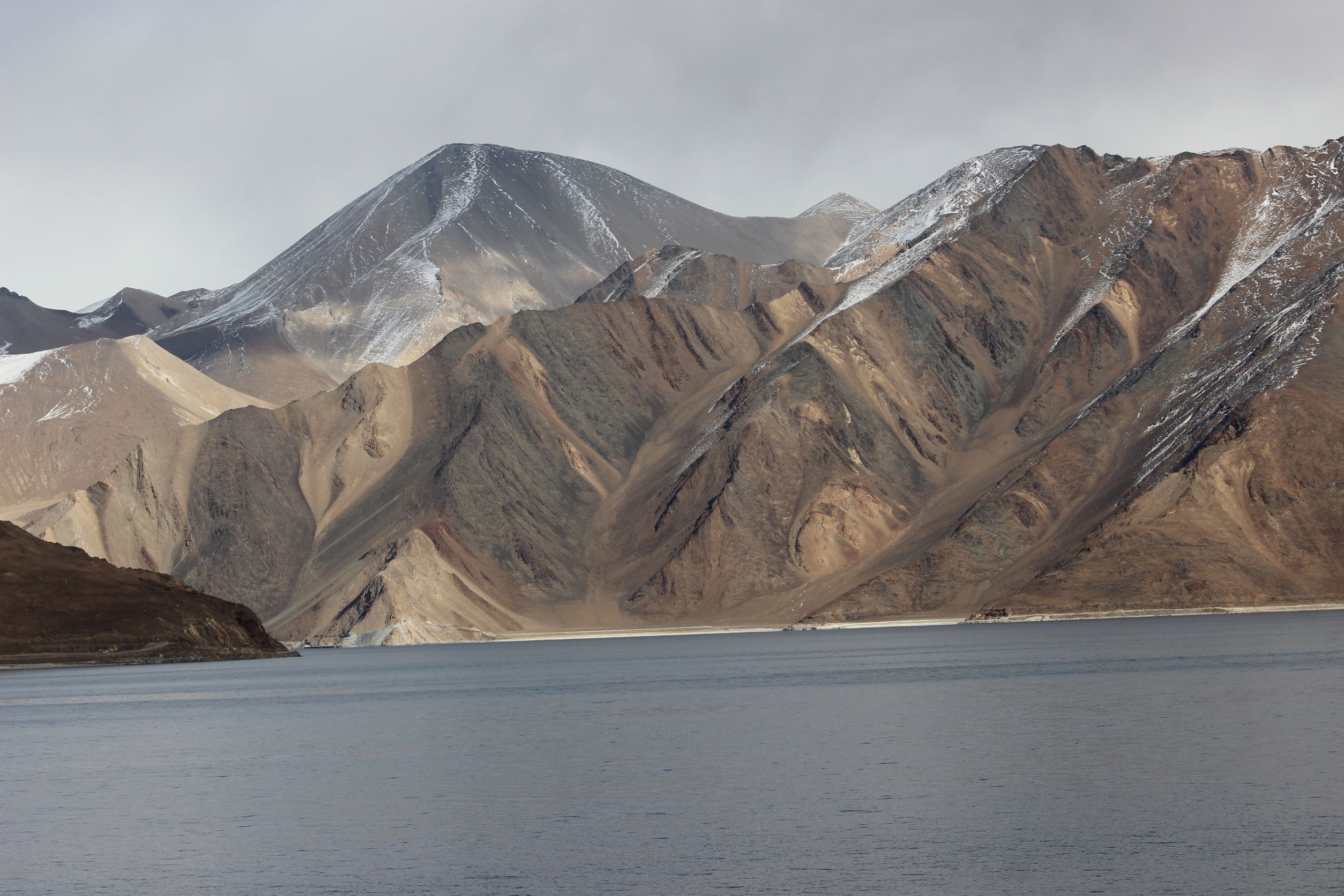
The lake at 14270 feet is 134 km long though only 1/3 is in Ladakh & the remaining is in Tibet. The lake has an endorheic basin, which means that it retains water and has no outflow. The lake completely freezes over in winters. Due to being endorheic, the water is salty and the Pangong is considered the world’s highest salt-water lake.


Pangong Tso with mountains on the eastern side

The photo does not justify the beauty of the place with the lake having multiple colours of blue, which is mesmerizing. One can just sit here and watch the lake changing colours – i.e. various shades of blue.
 

At the Pangong Tso, Ladakh

The hills, some bare and others snow clad add to the aura of the place. In summers, there is accommodation available here but after end-October most of them close it for winters though few eateries are still open in November.


Shades of Blue, Pangong Tso, Ladakh

You can reach Leh, capital of Ladakh by air or by road (long journey). From Leh you can book cabs/bikes. Travel in Ladakh is expensive because of long distances between destinations. Best time to visit Pangong Tso is summers but then be prepared to see lots of tourists trying to be ‘three idiots’. From Nubra to Pangong Tso the drive is about 270 kms and takes about seven hours. If one goes from Leh via the Chang La (at 17688 feet) then the distance is about 225 kms and take about five and a half hours.

Saturday, 12 January 2013

Sambhar Salt

The Sambhar Lake is the largest inland salt lake and produces nearly nine percent of India's total salt. Salt here is produced by the evaporation process of brine.

I had stayed in the Circuit House of the Sambhar Salts Ltd. (SSL) which is a joint venture of the Hindustan Salts Ltd. and the State Government of Rajasthan.

Salt Museum 

Just in front of the Circuit House is an ancient structure which is the Salt Museum. The building though stays closed and one can only observe the model of the Salt Lake and the salt works which is out in the open.

View of the dawn

You get a wonderful view of the dawn from the Circuit House with the Salt Museum building providing an excellent outline against the backdrop of the golden dawn.

Snowfall in Rajasthan?

If you look at the photo above it gives the impression of snow lying on the earth (that also in Rajasthan?). This is salt that gives the impression of snow.

Salt Fields

Around the huge lake one can see the color of the earth in stretches is white indicating salt content.

Salt Evaporation Pond

The lake is divided into two main parts by five km long dam. Once the salt water reaches certain concentration it is released and stored on evaporation ponds and salt pans. Some ponds have red color of water due to the presence of algae.

Salt Pans

Once the water dries the layers of salt is scrapped and collected as mounds of salt. From here it is again manually collected and put in the rail wagons. The Salt Works area is crisscrossed by railway network  - a narrow gauge - which was built by the Britishers in the 19th century to carry the salt to other destinations.

Salt Train

The rail wagons that you see in the photo above are made of wood not only because they are old wagons but they also serve another purpose i.e. since it is salt that they carry if they are made of iron they will rust away very quickly! Though the chassis is of course made of metal.

Salt being collected

I asked the workers how much they are paid for the work and I was astonished to find that they get paid a miserly Rs 300 for filling one wagon which after a whole days work one family (they operate in this manner here) is barely able to fill. One wagon can take upto six metric tons of salt.

Salt Hill

Salt around the lake gives employment of lot many persons. It is stored in huge mounds before it is sent to the factories for further processing.

As stated in my earlier post on Sambhar Lake the area is a key wintering site for several migratory birds like flamingos and waterfowls, among others, and is a designated Ramsar site.

The tourism infrastructure though is severely lacking in this area but I was pleased to read a Times of India (TOI) report that the Hindustan Salts Ltd. and the India Tourism Development Corporation (ITDC) have signed an MOU to create tourism infrastructure in the Sambhar area.

Also read Sambhar Lake if you are in interested in bird watching.

Wednesday, 2 January 2013

Sambhar Lake

Sambhar Lake is located in the Jaipur and Nagaur districts of the state of Rajasthan and is the largest inland salt lake of India. It spreads over approximately 230 square kms with a circumference of nearly 100 kms. It is also a designated Ramsar Site i.e.it is a wetland area of international importance especially as a waterfowl habitat.

It is due to this reason that I decided to go in winters as this area is a heaven for migratory birds from northern Asia when they come here in huge numbers from October to March each year.

Waterfowls

Sambhar town is located about 100 kms from Jaipur. It took me nearly eight hours to reach (including breaks) due to the fact that Delhi- Jaipur National Highways nowadays in a complete mess due to the six laning project.

Nilgai

I stayed in the Sambhar Salt Works Circuit House which gives a wide angle view of the whole area as it is located at a height. But I would write about the Circuit House in another post.

Peacocks

The best time to see the birds and other wild life activity is the morning period as they are more active at this time therefore I ventured out before the dawn the next day.

A huge Banyan tree

Besides the migratory birds I was also able to see lots of pheasants, peafowls and peahens as well as several Nilgais. Nilgai is the biggest antelope that can be found on the Indian sub continent.

Nilgai giving a pose

The waterfowls and various kind of migratory ducks were in abundant numbers. The area is dotted with water bodies and some bodies have abundance of one variety whereas the other water bodies were home to other varieties.

Waterfowls

Besides the waterfowls I was able to spot a few Indian Pond Herons as well.

A nesting Pond Heron 


Picture perfect


A paradise for birdwatchers

The area is also host to vast number of flamingos but they will not come near the human habitations and prefer the bigger water bodies which are surrounded by marsh land. Due to this one cannot go too near to view them properly. One can only make out flocks of them but cannot see them clearly with naked eyes so it is advisable to carry powerful binoculars and telephoto lenses.

Dried up part of the lake

I took my car on the dried part of the lake as far as possible before the marsh prevented me to go further. In the photo above the car can be seen on the lake bed with the Sakhambari temple and the cenotaph on the hill in the background.

Marsh land in front and the lake shimmering in the background 

To move around it is essential that you have a vehicle as the area is vast as for example the distance from the town to the Sakhambari temple is about 22 kms. Also one should avoid cars like Honda City which has very low clearance from the ground. As I knew that I can expect rough roads in the interiors of Rajasthan therefore I took the Swift for the journey.

Shakambari Temple at Sambhar

The Sakhambari temple does not receive many visitors on a normal day. It seems that only during the fair large number of people come and visit. I was the only visitor, for example, on the day I reached there. Like so many other temples in India, the vicinity has not been kept clean as one can see polythene packs lying around the temple area as well as in the small temple baoli (water reservoir).

Sakhambari Cenotaph

The cenotaph on the hill above the Sakhambari temple is an excellent spot to view the area far and wide. The trees in the photo below look like patches of grass as the photo was taken from above.

View from the cenotaph of the Sakhambari temple

Rajasthan Tourism has unfortunately not developed this area nor are they advertising about it though it is definitely a paradise for the ornithologists.