Showing posts with label Flamingos. Show all posts

Sunday, 26 May 2019

Bharatpur National Park - a Birders Delight

A Snake Bird in flight at Bharatpur National Park

Barely 185 km away from Gurgaon, a four-hour drive can take you to the birders paradise of Bharatpur Bird Sanctuary, also known as Keoladeo Ghana National Park.

Flamingos & Ducks at the Keoladeo Bird Sanctuary

The best time to visit the Park is in winters when the place is swarming with migratory birds from as far away as Siberia and even Africa! 

A Deer & an Egret at the Bharatpur National Park

There are plenty of stay options at Bharatpur including the hotel inside the park as well as several hotels and guest houses at a walkable distance from the Park. 

A huge Sparrow Hawk at the Bharatpur National Park

Owls at the Bharatpur National Park

Best time of the day for bird watching is early in the morning as the birds are more active then. The entrance fee is Rs 50 per person. 

All the way from Africa - Egyptian Vulture at the Bharatpur National Park

Once you reach near the entrance of the Park you will notice that there are lots of cycle-rickshaws. It is a huge Park of 29 sq km. So it is advisable to take some form of transport. 

Darter & Cormorants at the Bharatpur National Park 

Mother comes to feed its Kids at the Bharatpur National Park 

Avoid taking a rickshaw from outside. Rather take one from inside the Park as the rikshawalas inside also serve as guides (they have done the guiding course and are experienced and competent). 

Flock of Birds being watched by Cormorants at the Bharatpur National Park

In 2018 the Cycle cum guide rent was Rs 150 for an hour. They also have binoculars for which you pay extra but it is definitely useful as the birds like to keep their distance from the tourists. 

A Glossy Ibis watching another bird at the Bharatpur National Park 

Several of these guides are Sikhs (as was mine) who were given land near Bharatpur when they migrated from West Punjab (now Pakistan) in 1947 at the time of partition. 

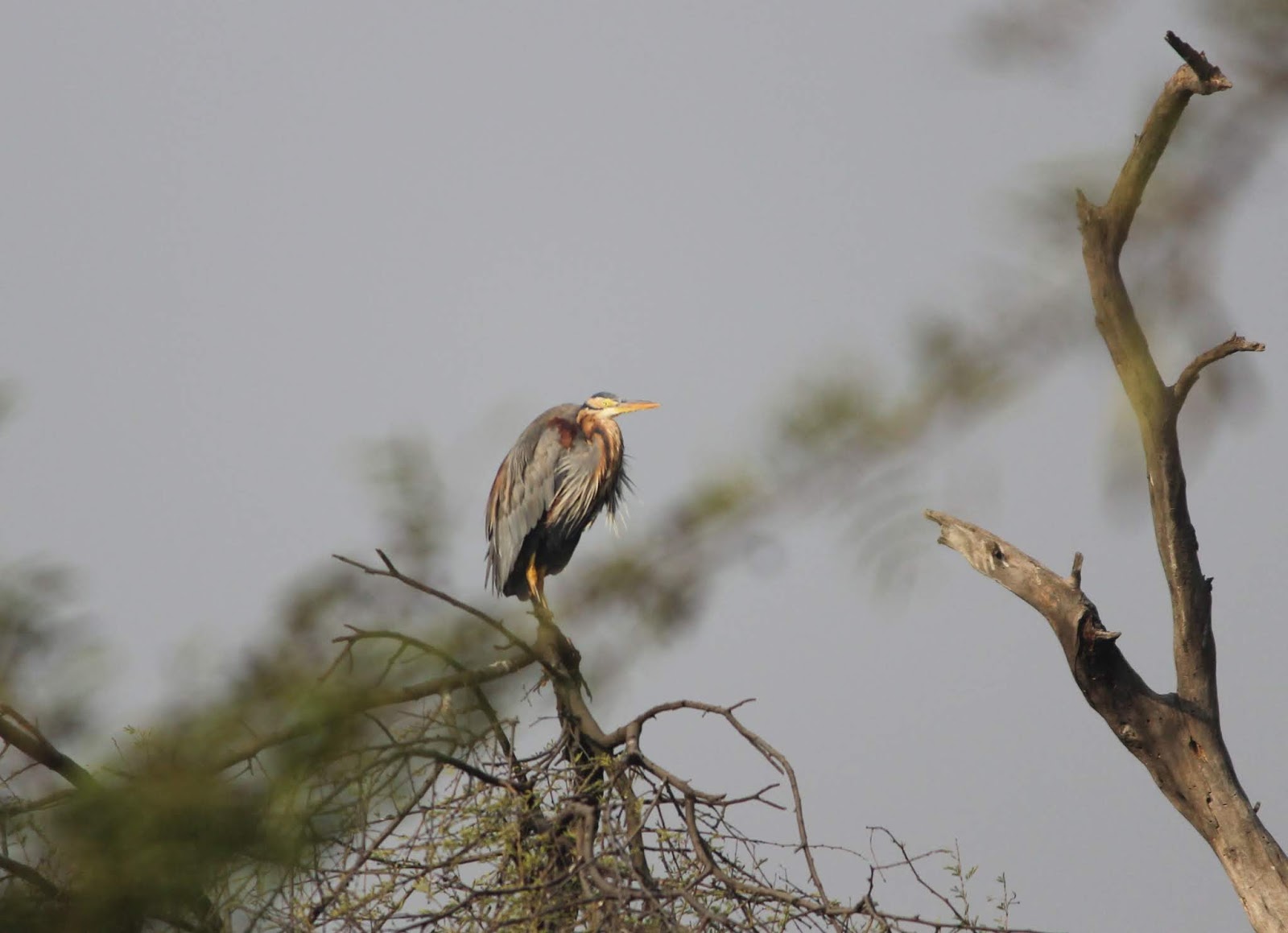
A Purple Pond Heron at the Bharatpur National Park

One can also hire cycles inside the Park but as my partner could not cycle, I therefore took the rickshaw for 5 hours. After that I let the rickshaw go and explored further on foot going on trails not visited by too many people. For bigger groups there are options of battery operated golf-carts and horse drawn carts as well. 

Glossy Ibis at the Bharatpur National Park

The rickshaw pullers cum guides know the routine, the nests and the favourite spots of birds and they can also identify them for you. Our guide knew exactly the nests of owlets, eagles and kites, snakes taking siesta in the sun etc. They also tell you anecdotes, so it is worth the money. 

An eagle about to attack its prey at the Bharatpur National Park

It is advisable not to hurry. See the birds and the wildlife at leisure. 

Kingfisher at the Bharatpur National Park

However, keep in mind that if you are going to spend a long part of the day inside the Park then do carry sufficient water bottles and eatables (please do not litter) as inside the Park the two canteens serve miserable snacks. 

Bharatpur National Park has a huge colony of Storks

Storks displaying themselves at the Bharatpur National Park

Let's take 'Stork" of the Situation

I sat for half an hour at one place and was rewarded by this - absolutely still like a statue -  Pond Heron catching a fish. It was a delight to watch. 

Nice catch - A Pond Heron with its prize - Bharatpur National Park

A Pelican at the Bharatpur National Park

Besides the birds that I could identify like the Egyptian Vulture, Green Himalayan Pigeon or the Ghuggi (in Punjabi), Common Babbler, Dove, Sparrow Hawk, Goose, Oriental Magpie Robin, Pelican, Herons, Cormorants, big colonies of Storks, various types of Kingfishers and wildlife like the Deer, Wild cows (there were some domestic ones also roaming around. Villagers get rid of unproductive cows by dumping them in the Sanctuary over the boundary walls), Wild Boar, Snakes etc. There were several others, which were a delight to watch.

Ajgar Snake sunning itself at the Bharatpur National Park

This UNESCO World Heritage Site incidentally was earlier was a royal Duck game reserve where the local royalty use to come and shoot the ducks as a game.

Perched high on a tree at the Bharatpur National Park

Purple Swamp-hens at the Bharatpur National Park 

Do remember to have good walking shoes, water bottle, snacks, good binoculars (if not then good zoom camera) so as to enjoy your birding experience!

Also Read:

Sunday, 27 January 2013

Guda Bishnoi

Recently I was in Jodhpur on a vacation. Though I knew that around Jodhpur one can see lots of deer and other wildlife I was surprised to see also several water bodies where the migratory birds come in winters from as far as Siberia.

Flamingos

We used the google maps to search for water bodies and saw that a place called Guda Bishnoi has some water bodies. So we headed out to the place.

A flock resting after a long flight

Guda Bishnoi is about 25 kms from Jodhpur and once we crossed the village we saw two lakes visible from the road but since we were carrying the GPS enabled mobile we were also able to detect water bodies which otherwise we would have missed completely. And what a feast these water bodies were to our eyes!

Indian Pond Heron

The second lake (an artificial one in which during summers water is pumped so that the local wildlife as well as cattle of the nearby villages have water to drink) was full of Flamingos, Siberian Cranes - called Khurja in the local language- waterfowls etc. I was also able to spot a solitary Indian Pond Heron and few Shell Ducks as well.

Shell Ducks

The best season to visit Guda Bishnoi is the winter season from October to March as lots of migratory birds from colder climes come to this area.

Indian Gazelle

Around the lake there were several Chinkara or the Indian Gazelle and some of them were in quite a playful mood locking horns and having a mock fight as well!

Chinkaras locking horns

And of course I saw several blackbucks. The area has lots of them as the Bishnoi community protects them with gusto. One may remember a case where one of the Bollywood actors  - Salman Khan - killed blackbucks and was arrested due to pressure from the community.


Blackbucks


A male blackbuck is brown-black with and white underbelly with twisted long horns whereas the female blackbucks are fawn coloured and do not have horns. One of the blackbucks crossed in front of my car just five feet away!


A male & Female Blackbuck


The Bishnoi's also protect Khejri tree (also known as 'Janti' in Hindi) as they worship it and therefore help in preserving the ecosystem of this semi-arid land.


Black Winged Stilt

Though there were several other varieties of birds, I could recognize only a few of them like the Black Winged Stilt in the above photo.

Birds in flight

The third water body which was actually hidden from view and also had lots of weeds in the water was a perfect watering hole for several birds for nesting. A brief glance and you will notice nothing, but wait a few moments and you will see a bird take flight like this Siberian Crane in the photo below.

Siberian Crane

In the fourth water body, I also saw, besides several waterfowls this one huge Purple Pond Heron. It seems that these birds do not stay in flocks like others.

Purple Pond Heron

Overall it was a fantastic tour and in some ways better than my visit to Sambhar Lake as here in Guda Bishnoi I could see the birds and animals from a really close distance. Certainly a very good place for bird watchers. Binoculars are a big help.

Wednesday, 2 January 2013

Sambhar Lake

Sambhar Lake is located in the Jaipur and Nagaur districts of the state of Rajasthan and is the largest inland salt lake of India. It spreads over approximately 230 square kms with a circumference of nearly 100 kms. It is also a designated Ramsar Site i.e.it is a wetland area of international importance especially as a waterfowl habitat.

It is due to this reason that I decided to go in winters as this area is a heaven for migratory birds from northern Asia when they come here in huge numbers from October to March each year.

Waterfowls

Sambhar town is located about 100 kms from Jaipur. It took me nearly eight hours to reach (including breaks) due to the fact that Delhi- Jaipur National Highways nowadays in a complete mess due to the six laning project.

Nilgai

I stayed in the Sambhar Salt Works Circuit House which gives a wide angle view of the whole area as it is located at a height. But I would write about the Circuit House in another post.

Peacocks

The best time to see the birds and other wild life activity is the morning period as they are more active at this time therefore I ventured out before the dawn the next day.

A huge Banyan tree

Besides the migratory birds I was also able to see lots of pheasants, peafowls and peahens as well as several Nilgais. Nilgai is the biggest antelope that can be found on the Indian sub continent.

Nilgai giving a pose

The waterfowls and various kind of migratory ducks were in abundant numbers. The area is dotted with water bodies and some bodies have abundance of one variety whereas the other water bodies were home to other varieties.

Waterfowls

Besides the waterfowls I was able to spot a few Indian Pond Herons as well.

A nesting Pond Heron 


Picture perfect


A paradise for birdwatchers

The area is also host to vast number of flamingos but they will not come near the human habitations and prefer the bigger water bodies which are surrounded by marsh land. Due to this one cannot go too near to view them properly. One can only make out flocks of them but cannot see them clearly with naked eyes so it is advisable to carry powerful binoculars and telephoto lenses.

Dried up part of the lake

I took my car on the dried part of the lake as far as possible before the marsh prevented me to go further. In the photo above the car can be seen on the lake bed with the Sakhambari temple and the cenotaph on the hill in the background.

Marsh land in front and the lake shimmering in the background 

To move around it is essential that you have a vehicle as the area is vast as for example the distance from the town to the Sakhambari temple is about 22 kms. Also one should avoid cars like Honda City which has very low clearance from the ground. As I knew that I can expect rough roads in the interiors of Rajasthan therefore I took the Swift for the journey.

Shakambari Temple at Sambhar

The Sakhambari temple does not receive many visitors on a normal day. It seems that only during the fair large number of people come and visit. I was the only visitor, for example, on the day I reached there. Like so many other temples in India, the vicinity has not been kept clean as one can see polythene packs lying around the temple area as well as in the small temple baoli (water reservoir).

Sakhambari Cenotaph

The cenotaph on the hill above the Sakhambari temple is an excellent spot to view the area far and wide. The trees in the photo below look like patches of grass as the photo was taken from above.

View from the cenotaph of the Sakhambari temple

Rajasthan Tourism has unfortunately not developed this area nor are they advertising about it though it is definitely a paradise for the ornithologists.