Saturday, 14 May 2016

When I flew Like a Bird

Paragliding - a lifetime experience at Bir-Billing, Himachal. PC: Akanksha Dureja 

On the recent trip to Palampur in Kangra, Himachal I was very keen to do paragliding. So the moment I reached Himachal Heritage Village in Palampur where I was staying for couple of days I immediately headed to Bir-Billing. By the time I reached Bir it was already lunch time and on inquiry I was told that the weather conditions are not right for flying. For paragliding the wind speed, direction, thermals which provide uplift to a parachute and cloud cover do play a crucial role. In fact some of the fellow bloggers who had reached Palampur the day earlier were able to do paragliding in the morning but later on the conditions deteriorated. Listening to their accounts I was all the more interested to do it as well. I was disappointed but not defeated.

My team unloading the parachutes from the Jeep at Billing

Next day when we inquired about the weather conditions we were told that it is perfect to fly. So we headed to Bir. At Bir we shifted to a Jeep of the Paragliding agency to go up to Billing which is the takeoff point for the paragliding.

The takeoff point at Billing is among the best in the world

From Bir it is 14 kms of narrow, steep road along the flowering rhododendrons all the way up to 8000 feet (2400 meters). Billing is an excellent takeoff site.

A small video of takeoff at Billing

When it was my time to get ready I wore the seat harness and locked the karabiners. Being a mountaineer I am familiar with this equipment. Next the parachute was spread out fully at the back and the strings were checked that they were not entangled. Then I and my pilot fastened to each other. Once done we ran a very short distance together and were airborne in only 5-6 running steps. In this sense the Billing takeoff site is among the best in the world. The thermals lifted us immediately several hundred feet above the takeoff site. I was also filming the whole ride using the GoPro camera with selfie stick as well as using my own camera as and when possible.

I got amazing bird's eye-view of the valley below from my parachute

You get the adrenaline rush in the beginning and it is definitely an experience of a lifetime. Within seconds you can sit down in your bucket seat harness and soak in the scenery containing the mighty snow capped Dhauladhars, terraced farms, monasteries and villages 4500 feet below you. In fact taking advantage of thermals an experienced pilot can go up several times higher and higher instead of descending.

Another view of Bir and surrounding area from my paraglide ride

Now I realise what the bird’s eye view is and what fun they have up in the air!

Steppped fields as I approach the landing site at Bir

It was smooth ride that day as the wind conditions were very favourable. But when the pilot asked me whether I would like to get some ‘real experience’ of turbulent conditions and some wild swings I said why not. Then the pilot made the parachute swing like a pendulum and it did become a bit scary but I enjoyed that experience as well. We were up in the air for about 35 minutes and now it was time to land. 

Watch my short video as I land at Bir

I straightened my legs and had a super smooth landing. (I did notice one landing which was kind of a thumping abrupt landing). Again Bir as a landing site is very good as there is no obstruction nearby.

I approach the landing site at Bir. PC:Akanksha Dureja

And finally I land at Bir. PC:Akanksha Dureja

After the exhilarating experience I reached the software shop where they downloaded the GoPro video and gave it to me on a CD. Then I headed back to the Himachal Heritage Village after this once in a lifetime experience.

Also read:
In the Lap of Nature – Himachal Heritage Village Palampur

Saturday, 30 April 2016

In the Lap of Nature – Himachal Heritage Village Palampur

Some days back the Travel Correspondents and Bloggers Group invited me to visit the Palampur area of Himachal so I accepted the invite immediately. It is another thing that due to office work I was unsure of going till the evening of the previous day.

Himachal Heritage Village with Dhauladhar Mountains in the background

I am currently located in Sanghol and from here it was showing 250 kms journey. I decided to go by my own car and left at five in the morning and landed in Palampur at 10. The place, Thala Kandi, where I was to stay was five kms from the town up the valley near Neugal Khad (rivulet). When I reached the Himachal Heritage Village I was amazed to see almost the whole of Himachal, architecture wise, located at one place with the Dhauladhar Mountains providing a beautiful backdrop. As of now there are five buildings and all of them have different architecture representing different regions/villages/towns of Himachal. Four of these are residential buildings for the guests. Una, Kangra, Barot and Khaniara style houses represent these areas while the dining area and office building is made in the Kinnaur style.

The bedroom at the Una House, Himachal Heritage Village

On the first day I stayed in the Una style house which is made completely of sun dried mud bricks and no cement has been used in its construction. The windows are beautifully carved and painted and the roof is made of bamboo whereas the floor is made of mud. Though the basic structure is made of mud but all modern amenities have been provided inside including glass enclosed shower area etc.

The chullah at Una house, also observe the old style switchboards

The first floor where I stayed also had a traditional chullah (earthen fireplace for cooking) for ambiance. The room made of traditional material was cosy and warm and I could sleep in only one blanket comfortably. The management has taken extra pains to ensure that the look of the building reminds one of the old days for example they had to secure the old style switchboards which are no longer used from Old Delhi.

Bonfire at Himachal Heritage Village

In the evening we all sat together with the bonfire giving us warmth and the stars for company as we watched the moon rise above the hills. One can sit for hours in such a beautiful setting!

The dining hall is built in Kinnauri style

After spending a wonderful evening under the stars we all went in the dining hall which has been made as per the architecture of the kinnaur region.

Traditional Kangra food being eaten in Himachli style 

The dinner was a local Himchali affair served on the floor in Pattal (plate made of leaves) and to be eaten with hands. The food was fantastic and truly prepared in the Hiamchali style. I especially liked their Khatta Maas. I am told that they serve the Himachali food at least once to all the guests.
HImachal Heritage Village, Palampur

The next day I had the full attention of the person behind the concept Mr Hem Dogra who narrated to me how they have brought the water from 500 meters away to form a pond as well as creating a waterfall. The project started in 2011 and took four years of painstaking work and skilled labour to make the houses in real traditional style. Nowadays most people even in the hills make concrete cement houses and it is difficult to find skilled labour to make such houses now.

Khaniara style house at the Himachal Heritage Village

The second day I shifted to the Khaniara house so that I can experience it as well. Unlike the Una style this is made completely of stone found in Khaniara near Dharamshala (and that is why the name).

My bedroom in the Khaniara house

Again like the Una house no cement has been used in this house as well. The floor however is made of wooden planks. The bathroom in Khaniara house is luxurious with even a cascading waterfall inside!

The bathroom in the Khaniara house

There are plenty of options to spend your time here. One can go on short or long hikes. There is a naturally formed serene pool, a short walk from this place, which gives the impression of a huge tub in the lap of nature. Palampur and its surrounding area is known for its tea gardens, temples, monasteries and paragliding. But about these things I will write in separate posts.

I had a wonderful, though short, stay at the Himachal Heritage Village. I would like to go and stay there for a longer period.

Also read:
McLeodganj, Dharamshala, Himachal
Why I love to go to McLeodganj
Skywatch Friday - Sunset at McLeodganj, Himachal
Places to visit in McLeodganj: Bhagsunag Waterfall
Places to visit in McLeodganj: The Church of St John-in-the-Wilderness

Friday, 11 March 2016

Kila Raipur Rural Olympics – the unusual sporting events

In the earlier post I wrote about the sporting events at Kila Raipur Rural Olympics.

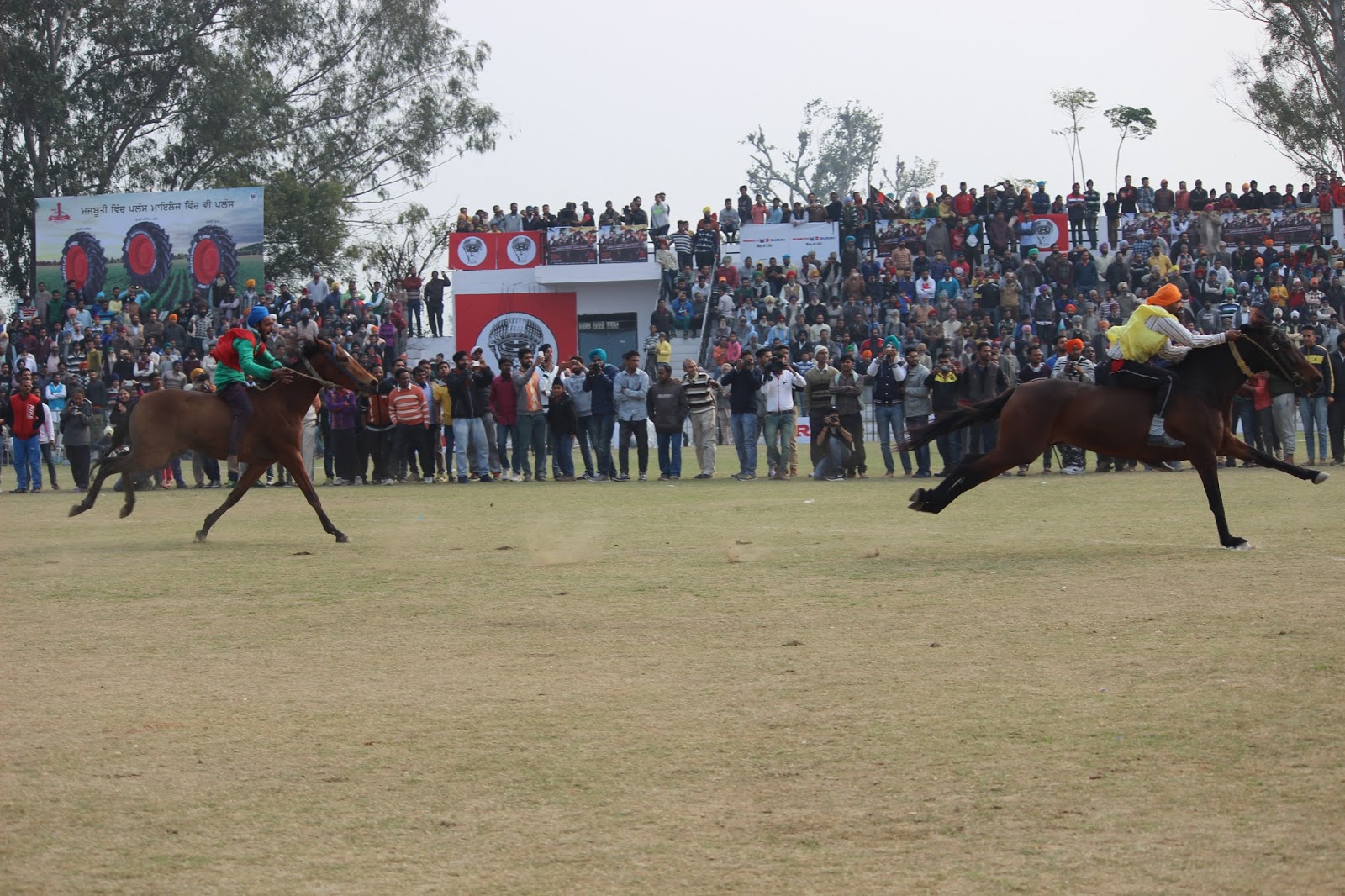
Kila Raipur Rural Olympics - Horse racing

Other unusual sports event I saw was the tractor race. After all in the Punjab rural area how can you have any event, sporting or otherwise, without a tractor!

Kila Raipur Rural Olympics - Tractor race

Then there was a tractor tyre race. Some of you may have done a cycle tyre race in your childhood but imagine doing it with the huge tractor tyres!

Kila Raipur Rural Olympics - Horse Cart Race

Another one was the horse cart race. Also there was a horse race as well. But all these were more in the form of sprints at the stadium itself. I think to make it more interesting the cart and the horse races could be made long distance races.

Kila Raipur Rural Olympics - Nihang rides two horses

Then I saw a Nihang who rode (standing with each foot on a horse) on two horses and galloped at a great speed. What has been popular here at the Kila Raipur Rural Olympics events over the years has been the race of the bulls but I believe due to the intervention of an NGO and on the orders of the court this sporting event was not allowed to be held this year. There was a huge protest against this on the last day of the event when I saw several hundred people march with the bulls and raised slogans against the NGO and the court order. By that logic all races involving any animals (and not only bulls) should be banned whereas horse race and horse cart races were held. Do only bulls qualify for the animal rights protection and not any other animal?

Kila Raipur Rural Olympics - Muscle power

There was a competition between two teams on unloading and reloading a tractor trolley full of sacks weighing a quintal each in the fastest time. And how could the competitions be complete without the Tug-of-War. The funny part of one of these was that the rope itself broke in two and both the sides’ participants fell on the ground.

Kila Raipur Rural Olympics - Tug-of-war

Other unusual sporting events that I saw were guys pulling a bike, car etc by their teeth.

Kila Raipur Rural Olympics - Man lifts a sack by his teeth

Another one lifted a bag full of vegetable by his teeth. Then there was a guy who stopped two bikes to move in opposing directions by the bicep muscle power. 

Kila Raipur Rural Olympics - Muscle power

There was a man in a sitting position on whom a six quintal load was put.

Kila Raipur Rural Olympics - 6 quintals on the man

There was a show of stunts on the Royal Enfield’s by several men and one woman.

Kila Raipur Rural Olympics - Bike stunts

The games meant competition but also fun and frolic and the stadium was full and surprisingly there were lot of female spectators as well. 

Kila Raipur Rural Olympics - Women spectators

I saw only one race which was for the girls else all others were for the men. But then I attended the event only on the last day. Maybe some events for the females happened on the earlier two days. 

I would attend the full event next year!

Also read: Kila Raipur Rural Olympics

Friday, 19 February 2016

Kila Raipur Rural Olympics

You may have watched or participated in various sports events be it at the School, State, regional, National or International level in the recognised and popular sports.

Kila Raipur Sports Festival 2016

But have you have watched sports with a local rural flavour to it. Yes I recently happened to attend one sports festival at Grewal Stadium at Kila Raipur which over the years has now become very popular and has been termed as the Rural Olympics. Kila Raipur is a small village about 20 km from Ludhiana. The Sports Festival is held every year as a four day event.

The 800 meter race for women at Kila Raipur Rural Olympics

Some of the sports events are the same as the ones popular elsewhere like to 100 to 800 meter races etc. A keenly participated event was the 100 meter track race for the persons above the age of 70!


The 70+ race was a keenly contested & watched event at Kila Raipur

I could not believe when I saw these 70+ years young sprint with so much zeal and stamina. It does remind one of Fauza Singh who even at 104 years still participates in marathons.

The cycle race at the Kila Raipur Rural Olympics

There was a cycling race also though not in a velodrome but on the athletic tracks itself.

This man got the loudest cheers from the crowd

Though most had racing cycles and proper athletic gear and dress the loudest cheer was for the local guy who had the ordinary cycle (which used to be a norm for commuting in India for School kids and still does for lot many workers) and normal day wear clothes. Infact several people announced cash rewards for this person!


The tricycle race at Kila Raipur Sports Festival

Then there were also tricycle races for the physically handicapped.

Kabaddi rural style at the Kila Raipur Rural Olympics

Another event which is also an international sport originating from India is Kabaddi. But the Kabaddi that you observe in the events and the Kabaddi played at Kila Raipur varied a lot. First of all the size of the Kabaddi ground was huge (at least half the size of a football field in a circle). Watch this video for the game and the size of the field.

A short video of rural Kabaddi at Kila Raipur Rural Olympics

Secondly, there are four players to a team but once a player touches the player of the opposing side then it remains a fight between only two contestants as a one to one duel and not a fight of four against one. And all the players were bare-chested and one could see the ripping muscles at work!

I would be writing another post on the unusual sporting events at the Rural Olympics of Kila Raipur.

Sunday, 10 January 2016

Sanghol Archaeological Museum – a gem among museums

Normally one would associate museums with capitals or big cities. But the Sanghol Archaeological Museum is different in the sense that it is located at the site where the Harappan, Buddhist and Kushan period artefacts have been unearthed. 

Sanghol Archaeological Museum Building 

Located in Ucha Pind Sanghol the place has been inhabited from Late Harappan to Medieval to the current days. In fact during Kushan period of 1st to 3rd century AD this place was an important town and was on a trade route. The museums displays antiquities, sculptures, coins, household materials found in the excavation here.

Buddha Statue outside the Sanghol Museum

Two Buddhist Stupa sites here revealed the largest collection of sculptures belonging to the Mathura School of Art found outside Mathura. And these sandstone sculptures on pillars, railings, coping stones and crossbars are the pride of the museum. There were 118 pillars that were unearthed from the Sanghol site and about 60 of them are displayed in the museum and I must say they are in excellent condition.

Salabhanjikas on the railing pillars at the Sanghol Museum

There is a section on Salabhanjika which is an art motif of the Kushan period. It means the lady breaking the branches of the Sal tree.

Pillars depcting Gandharva and Salbhanjikas

There is a section of pillars where women are drinking wine. It tells us about the culture during that period when women use to openly partake liquor whereas in today’s world (Indian) it is considered as a bad habit even among men!

A woman dancing and balancing a pot on her elbow

There is a Toilette section where the pillars depict different aspects of beautiful young maiden’s toilet in a number of railing pillars – be it looking at themselves in the mirror or making braids of their long hair or a woman squeezing out water from her hair after bath. It goes on to prove that taking care of their beauty is an old art among women!

A Mother playing with her child

The round shape museum has only two floors. The first floor has seals and Late Harapppan pottery belonging to 2000 BC to 1200 BC, stone and terracotta objects as well as jewellery unearthed from the place.

A Jataka tale motif

There is a nominal entry fee of Rs 10 for adults and Rs 4 for children below 12 years of age and the Museum remain open on all days except Mondays from 10 to 4. Photography inside the museum is not allowed. If one wants then a special permission and payment of Rs 1100 have to be made at their office in Chandigarh. One can reach Sanghol from both Chandigarh (40 Km) and Ludhiana (55 Km) as it is located on the Chandigarh-Ludhiana highway. 

It is a must-visit museum for those who are interested in art and history and on top of that a history that dates back to Harappan civilization!

Also read: 
Buddhist Vestiges of Sanghol, Punjab
Punjabi Folk Music

Thursday, 31 December 2015

Punjabi Folk Music

First of all let me wish all the readers of my blog a happy, successful and peaceful 2016.

I was recently visiting a site of Buddhist Stupa remains which are 2100 years old and where at the same site carved statues and pillars and coins of Kushan period of 1 to 3 CE have been recovered. The site also revealed several artefacts of the Late Harappan period.

But today's' post is not about the site but the person I met there and who rendered Punjabi Folk music in his rustic voice.

Teja Singh on Tumba at Sanghol

Teja Singh, an employee of ASI is also a prolific Punjabi Folk singer. Here he sings in the majestic setting of Buddhist and Harappan ancient site of Sanghol in Punjab, India. The musical instrument that he is playing is called Tumba or Tumbi.

Teja Singh on Tumba

He is singing the folk song on the Punjabi legend Puran Bhagat.

Also read:
Buddhist Vestiges of Sanghol, Punjab

Friday, 18 December 2015

Buddhist Vestiges of Sanghol, Punjab

One would not associate Buddhism with Punjab in the current era. But you would be surprised (at least I was) that Buddhism was thriving in Punjab 2100 years ago.

Buddhist Stupa site at Sanghol, Punjab

This is corroborated by the fact that recently (in comparative terms) Stupa and monasteries were unearthed in Sanghol on the Chandigarh-Ludhiana highway. (Stupa contains relics of a Buddhist teacher.) Sanghol is also called Ucha Pind (high village) as it is situated on a mound. Seven sites in the village were excavated by the Archaeological Survey of India (ASI) from1968 to 1990. Two of these are significantly important which I visited and are called SGL5 and SGL11.

View from the entrance of SGL5 Buddhist Stupa site at Sanghol

The larger site contains the bigger Stupa having three concentric circles with spoke-like radial walls raised on a square platform. It has a diameter of 16 meters on a 17 meter square platform.

Concentric circles placed on a square platform, Sanghol Buddhist Stupa site

The smaller site also has a Stupa but much smaller in size. Both the sites also have Vihara (residences for the monks). What has been excavated is only the base which was mainly below the ground as the super structure was completely destroyed (by man or nature over time). Maybe the ASI should reconstruct at one of the sites to give a feel of the place as it was at that time.

The smaller Stupa at SGL11 Buddhist Stupa site, Sanghol

A rich treasure of 69 pillars and 35 cross bars have been unearthed from Sanghol containing figures of Yakshis and Salabhanjikas (art motifs of the Kushan period). Also found on the site were seals and pottery of the Late Harappan period. These are no longer on the site and have been placed in the Archaeological Museum at Sanghol. As both the sites are out in the open a security fencing around both the places have been put up to prevent encroachment.

The squarish ones were the living quarters of the monks, Buddhist Stupa site SGL11, Sanghol

Teja Singh, an employee of the ASI was kind enough to show me the first site and explain about the place. Not only that - he has a hidden talent of Punjabi folk music – and he enthralled me with the rendition of few folk songs with the accompaniment of Tumba.

Teja Singh with his Tumba
The Tourism Department of Punjab should give more publicity to such a great heritage site.